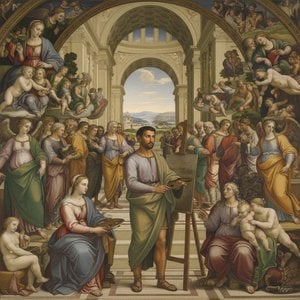
The Transfiguration (detail) : A Symphony of Light and Faith
Raphael’s “The Transfiguration,” completed between 1517 and 1520, stands as an unparalleled achievement of High Renaissance art—a testament to the artist's mastery of form and color, and a profound meditation on divine majesty. Currently housed in the Pinacoteca Vaticana, this monumental fresco continues to captivate viewers centuries later with its breathtaking beauty and layered symbolism.
Introduction to Raphael : The Trinity of Renaissance Brilliance
Born March 28 or April 6, 1483, in Urbino, Italy, Raffaello Sanzio Da Urbino—commonly known as Raphael—was a cornerstone figure amongst the triumvirate of artistic geniuses that defined the High Renaissance alongside Leonardo da Vinci and Michelangelo. His distinctive style characterized by serene grace, meticulous detail, and harmonious composition cemented his place among history’s most revered painters.
The Painting : A Masterpiece of Composition and Technique
Executed on panel in oil paint, “The Transfiguration” exemplifies Raphael's exceptional skill in capturing human grandeur while maintaining an unwavering clarity of form. The fresco depicts Jesus ascending into heaven accompanied by Saint Peter, Saint John the Evangelist, and Moses—a scene drawn directly from Matthew 17:1-8. Raphael skillfully employs pyramidal composition to create a sense of stability and balance, guiding the viewer’s eye upwards towards the radiant glory of God.
- Color Palette : Raphael utilizes a luminous palette dominated by golds, blues, and reds—colors traditionally associated with divinity and spiritual illumination.
- Brushwork : Delicate brushstrokes contribute to the painting's ethereal quality, capturing subtle nuances of light and shadow that imbue the figures with palpable realism.
- Perspective : Raphael’s masterful use of linear perspective enhances the illusionistic depth of the scene, transporting viewers into the otherworldly realm of Mount Tabor.
Significance of The Transfiguration : Neoplatonic Ideals Embodied
"The Transfiguration" transcends mere depiction; it embodies Neoplatonic ideals—a belief that God permeates all creation and seeks to unite humanity with divine perfection. The painting’s serene atmosphere reflects the contemplative spirit of Renaissance humanism, inviting contemplation on themes of faith, transcendence, and spiritual transformation.
Throughout the 16th century, “The Transfiguration” was regarded as the pinnacle of artistic achievement—the world's most renowned oil painting. Its visual splendor captivated audiences and inspired artists for generations to come. For a deeper understanding of this iconic artwork, explore Wikipedia.
Sources : Artistic Inspiration and Historical Context
Discover exquisite handmade oil paintings reproductions of “The Transfiguration” on WahooArt.com and elevate your interior décor with a timeless masterpiece.
Questions et réponses
Quelle technique et quel style caractérisent «La Transfiguration ( détail)» de Raphaël ?
Dans « La Transfiguration ( détail) », la technique du Acrylique sur toile rencontre le mouvement High Renaissance.
Quelle technique a été utilisée pour «La Transfiguration ( détail)» de Raphaël ?
Raphaël a utilisé la technique du Acrylique sur toile pour "La Transfiguration ( détail)". Cette technique définit la nature matérielle de l'œuvre originale.
L'œuvre « La Transfiguration ( détail) » est-elle plutôt claire ou plutôt sombre dans l'ensemble ?
Les valeurs enregistrées pour «La Transfiguration ( détail)» de Raphaël sont : une luminosité de éclatant, une luminance de Équilibre lumineux.



 Aperçu en situation
 Passer au format impression
 Partager
 Partager
 Détails
 Guide imprimable

 Télécharger
 Articles similaires
 Radiographie
 Voir le diaporama
 Statistiques

 Afficher la suite






































 L'option verre n'est disponible que pour les dimensions inférieures à 110 cm.