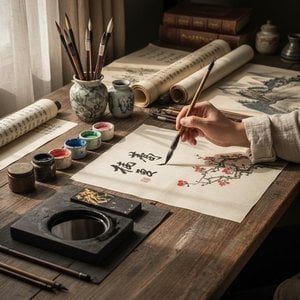
The Legacy of Ink: The Life and Art of Nakabayashi Chikkei
In the quiet, contemplative atmosphere of late Edo-period Japan, a profound artistic dialogue was unfolding between the ancient traditions of China and the burgeoning sensibilities of the Japanese literati. At the heart of this movement stood Nakabayashi Chikkei, an artist whose brushstrokes served as a vital bridge between eras. Born in Nagoya in 1801, Chikkei entered a world where art was not merely a display of technical skill, but a pursuit of intellectual depth and poetic resonance. As the son of the renowned nanga master Nakabayashi Chikutō, Chikkei’s very existence was steeped in the refined aesthetics of the literati tradition, a lineage that would profoundly shape his creative soul.
Chikkei’s early years were defined by a rigorous and meticulous training process. Following the established customs of nanga education, he spent much of his youth engaged in the disciplined practice of copying the works of masters. This was far more than simple imitation; it was a spiritual absorption of the rhythmic complexities and tonal subtleties found in Chinese landscape painting. Through this method, he internalized the essence of the Yuan Dynasty masters, particularly the minimalist elegance and evocative use of space characteristic of artists like Wu Zhen and Ni Zan. This foundation allowed him to develop a nuanced understanding of ink techniques that would later define his mature style.
A Synthesis of Styles and Naturalism
While Chikkei remained deeply rooted in the nanga tradition, his artistic journey was marked by an extraordinary breadth of exploration. He did not confine himself to a single school; instead, he sought to expand the boundaries of his visual language by studying diverse Japanese traditions. His curiosity led him to engage with the Maruyama Shijo and Yamato-e schools, as well as the Nanbin style. This eclectic education infused his work with a unique sense of realism, particularly in his ability to render the delicate textures of nature.
This stylistic synthesis is perhaps most evident when observing his treatment of flora and fauna. While many of his contemporaries focused solely on the abstract spiritualism of landscapes, Chikkei demonstrated a remarkable capacity for shinkeizu—naturalistic views. In his floral compositions, one can witness a breathtaking attention to detail, where the soft petals of roses or the intricate feathers of a sparrow are rendered with a freshness that feels almost tactile. He possessed the rare ability to balance the rugged, strangely-shaped rocks typical of the Chinese bunjinga style with a delicate, lifelike precision that suggested a deep, personal connection to the physical world.
Historical Significance and Artistic Spirit
As the Edo period transitioned into an era of increasing social change and Western influence, Chikkei’s work remained a steadfast testament to the enduring power of the ink wash tradition. His landscapes, often featuring serene mountains and cascading waterfalls, captured a sense of timelessness that transcended the political shifts of his age. He was not merely a painter of scenery, but a poet of the landscape, using subtle tonal gradations to create atmospheres that felt both physically present and spiritually distant.
The historical significance of Nakabayashi Chikkei lies in his role as a custodian of the nanga spirit during a period of profound transformation. Through his mastery of ink and color, he ensured that the intellectual and philosophical underpinnings of the literati movement continued to flourish. His legacy is found in the balance he achieved between the scholarly weight of Chinese tradition and the observant, naturalistic beauty of Japanese art, leaving behind a body of work that continues to resonate with those seeking harmony within the natural world.



 Aperçu en situation
 Passer au format impression
 Partager
 Partager
 Détails
 Guide imprimable

 Télécharger
 Articles similaires
 Radiographie
 Voir le diaporama
 Statistiques


 Afficher la suite






































 L'option verre n'est disponible que pour les dimensions inférieures à 110 cm.