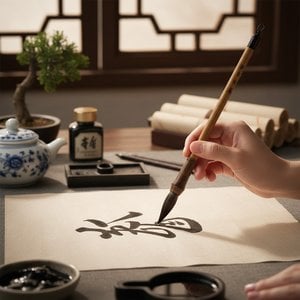
Su Renshan : Un pionnier de l'innovation sous la dynastie Qing
Su Renshan (1814 – 1850 ?), figure enveloppée d'un mystère intrigant, s'impose comme l'un des artistes les plus non conventionnels et captivants de la dynastie Qing en Chine. Malgré une existence tragiquement brève, il a laissé une empreinte indélébile sur le paysage artistique, continuant de fasciner savants et collectionneurs par son style distinctif — une rupture audacieuse avec les conventions établies qui n'en demeurait pas moins profondément ancrée dans la tradition chinoise. Né à Shunde, dans la province du Guangdong, le parcours artistique de Su Renshan s'est déployé durant une période de transformations culturelles majeures, faisant de lui un visionnaire dont l'œuvre défie toute catégorisation simple.- Jeunesse et influences : Peu de choses sont connues avec certitude sur les années de formation de Su Renshan. Cependant, des témoignages suggèrent qu'il fut instruit dans l'art de la calligraphie et de la peinture, absorbant les traditions du Shanshui (paysage montagneux) — un mouvement privilégiant la spontanéité et la capture de l'essence de la nature — sous l'influence particulière de Wanganyi et Yunqi. Ces maîtres prônaient une technique de pinceau plus libre, privilégiant l'expression émotionnelle au détriment d'un réalisme méticuleux.
- Un style singulier : La marque de fabrique de Su Renshan résidait dans son approche révolutionnaire de la peinture. Contrairement à nombre de ses contemporains qui adhéraient rigoureusement aux normes stylistiques, il embrassa des couleurs vibrantes — un choix audacieux au regard de l'esthétique monochrome prédominante — et employa des compositions dynamiques transmettant un sentiment palpable de mouvement et d'énergie. Sa perspective était tout aussi innovante, intégrant souvent des points de vue inhabituels qui défiaient les représentations conventionnelles des terrains montagneux.
Œuvres notables et accomplissements artistiques
La production artistique de Su Renshan se composait principalement de peintures à l'encre de Chine et de calligraphie, reflétant sa compréhension profonde de la culture et de la philosophie chinoises. Parmi ses pièces les plus célèbres figure le « Record of the Iron Ox », un superbe rouleau calligraphique exécuté en écriture cursive — un style reconnu pour son rythme fluide et son caractère expressif — qui capture l'esprit des paysages montagneux de la province du Guizhou. L'exécution méticuleuse de la main gauche souligne le dévouement de l'artiste à la maîtrise technique, tout en transmettant une sensation d'immédiateté et d'émotion. Par ailleurs, le « Tigre », issu de son album « Landscapes and More », illustre la maîtrise magistrale de Su Renshan dans le travail du pinceau et les dégradés tonaux — l'essence même de l'art Shanshui — démontrant sa capacité à distiller des informations visuelles complexes en une imagerie évocatrice. Enfin, « Travellers in the Mountains », une peinture de paysage monochrome et sereine, témoigne de la sensibilité de Su Renshan à capturer la beauté sublime de la nature et sa résonance spirituelle.- Héritage et importance : Malgré sa disparition prématurée à l'âge de trente-six ans, l'influence de Su Renshin s'est étendue bien au-delà de sa vie. Son style pionnier a servi de catalyseur à l'expérimentation artistique durant la dynastie Qing, inspirant les générations suivantes d'artistes à repousser les limites et à explorer de nouvelles possibilités expressives. Aujourd'hui, les œuvres de Su Renshan sont vénérées comme des chefs-d'œuvre de l'art chinois, témoignages de son engagement indéfectible envers l'innovation et de son lien profond avec le patrimoine culturel de la Chine.
Pour aller plus loin
Pour une compréhension plus approfondie de la vision artistique de Su Renshan et de son impact durable, nous vous encourageons à visiter le profil de l'artiste Su Renshan. Vous pouvez également explorer sa célèbre œuvre « Record of the Iron Ox » ici et admirer le « Tigre » de son album Landscapes and More via ce lien.Questions et réponses
Où et en quelle année Su Renshan est-il né ?
Su Renshan est né à Shunde en 1814.
Où peut-on retrouver les œuvres de Su Renshan classées par sujet ?
La page Atlas thématique répertorie les œuvres de Su Renshan par sujet.
À quelle période historique Su Renshan a-t-il exercé ?
Su Renshan a œuvré durant la période XIXe siècle. Cette période situe l'activité de l'artiste dans l'histoire.