The Poetics of Presence: A Meditation on Lee Ufan’s From Line
In the quiet intersection where Eastern philosophy meets Western minimalism, Lee Ufan’s From Line emerges as a profound meditation on existence and the passage of time. As a central figure of the Mono-ha movement, Lee does not merely paint; he orchestrates a delicate dialogue between the void and the mark. This particular work serves as a breathtaking example of his ability to transform a canvas into a living, breathing landscape of thought. The composition, characterized by its rhythmic verticality, invites the viewer into a space where the distinction between the painted stroke and the surrounding emptiness begins to dissolve, creating an atmosphere of deep contemplation.
The visual journey of From Line is one of mesmerizing movement. At first glance, the eye is drawn to the series of vertical lines that traverse the canvas, creating a sense of depth and dimension that defies the two-dimensional surface. These strokes, reminiscent of traditional Eastern brushwork, possess a weight and texture that suggest the relentless flow of a waterfall or the steady descent of rain through a misty forest. A subtle horizontal line cuts through the center, acting as a horizon of sorts, providing a structural anchor that balances the kinetic energy of the vertical elements. This careful arrangement creates a profound sense of harmony, where every interval and every void plays a vital role in the overall equilibrium of the piece.
Mastery of Materiality and Technique
Technically, the work is a masterclass in controlled spontaneity. Lee Ufan utilizes the relationship between color and space to evoke raw emotion, employing a palette that—while appearing simple—carries immense psychological weight. The interplay of light and shadow within the strokes suggests a physical presence, as if the paint itself is an organic material emerging from the canvas. In some iterations of this series, Lee has even paired Japanese powdered mineral pigments with Western canvas, dipping his brush in cobalt-blue paint and pulling it across the support in one continuous, decisive motion. This method ensures that each trace captures a moment of pure, unrepeatable action, making the painting a record of its own creation.
For the discerning collector or interior designer, this piece offers more than just aesthetic beauty; it provides a focal point of serenity. The way the lines move from fullness to near-invisibility allows the artwork to breathe within a room, interacting with the surrounding architecture and light. It is a work that demands a slow gaze, rewarding those who approach it with patience.
A Bridge Between Worlds
To understand From Line, one must look toward the artist's profound intellectual journey. Born in 1936, Lee’s early life was steeped in the disciplined rhythms of a traditional Confucian household, where calligraphy and inkbrush painting served as his first languages. His later immersion in Western phenomenology—engaging with thinkers like Heidegger and Merleau-Ponty—allowed him to bridge the gap between being and nothingness. This synthesis is palpable in the artwork; it is a piece that exists in the tension between the physical mark of the brush and the infinite potential of the empty space.
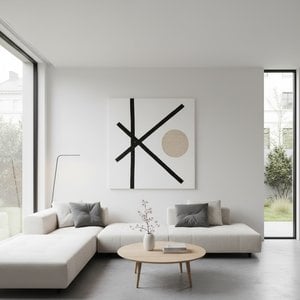
Owning a high-quality reproduction of such a masterpiece allows one to bring this sense of philosophical depth into a modern living space. Whether placed in a minimalist gallery-style lounge or a quiet study, From Line acts as an anchor of calm, reminding the viewer of the beauty found in simplicity and the profound resonance of a single, well-placed stroke.
Questions et réponses
À quelle étape de la carrière de Lee Ufan « De la ligne » appartient-elle ?
«De la ligne» appartient à la période Période de maturité de la carrière de Lee Ufan. Cette classification relie l'œuvre à l'évolution de l'artiste.
Quelle nuance dominante traverse «De la ligne» de Lee Ufan ?
La teinte dominante de «De la ligne» de Lee Ufan est Gamme de couleurs du vert au violet. Cette teinte constitue la tonalité de fond de la palette.
Quelle est la technique et les dimensions de l'original de «De la ligne» de Lee Ufan ?
«De la ligne» a été réalisé en Peinture et mesure 227 x 181 cm dans sa forme originale.



 Aperçu en situation
 Acheter la peinture faite à la main
 Partager
 Partager
 Détails
 Guide imprimable

 Télécharger
 Articles similaires
 Radiographie
 Voir le diaporama
 Statistiques


 Afficher la suite






































 L'option verre n'est disponible que pour les dimensions inférieures à 110 cm.