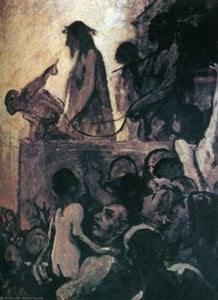
Une Vie Dédiée à l'Art et à l'Activité
Honoré-Victorin Daumier, un graveur, caricaturiste, peintre et sculpteur français, a laissé une marque indélébile sur la scène artistique du XIXe siècle. Né à Marseille le 26 février 1808 et décédé à Paris le 10 février 1879, sa vie fut un témoignage de son dévouement inébranlable à capturer l'essence de la société française.
Jeunesse et Influences
La jeunesse de Daumier a été marquée par les aspirations poétiques de son père, ce qui conduisit la famille à déménager à Paris en 1814. Cette exposition à la scène artistique vibrante de la ville a influencé sa propension vers l'art. Il commença son apprentissage sous Alexandre Lenoir puis entra à l’Académie Suisse.
Carrière Artistique
La carrière prolifique de Daumier s'étend sur plusieurs médiums, notamment la lithographie, la peinture et la sculpture. Son travail précoce se caractérisait par des contributions anonymes à des éditeurs, imitant le style de Charlet et affichant un enthousiasme fervent pour la légende napoléonienne. Après la révolution de 1830, l'art de Daumier est devenu plus ouvertement politique.
- Le Charivari, un journal humoristique lancé par Charles Philipon, a fourni une plateforme pour le travail satirique de Daumier, ciblant la bourgeoisie et l’incompétence du gouvernement.
- Ses caricatures de figures politiques et ses satires sur le comportement de la société lui ont valu à la fois les éloges et la controverse, y compris un emprisonnement de six mois en 1832.
Œuvres Notables et Héritage
- Rue Transnonain, 15 avril 1834 : Une lithographie poignante dépeignant le massacre dans la rue Transnonain, faisant partie des émeutes du 15 avril 1834 à Paris.
- Les Gens de Justice : Une satire acerbe sur la profession juridique, mettant en valeur la maîtrise de Daumier de la caricature.
L'impact de Daumier sur l'histoire de l'art L’engagement indéfectible de Daumier à capturer la vérité de la société française a influencé des générations d'artistes. Son travail peut être trouvé dans divers musées et collections, y compris ceux présentés sur WahooArt, qui offre un aperçu complet de sa production artistique.
- Explorez les lithographies et peintures de Daumier sur WahooArt.
- Découvrez davantage sur les mouvements artistiques français, y compris le réalisme, sur Wikipédia.
Conclusion
La vie de Daumier fut un témoignage de son dévouement inébranlable à capturer l'essence de la société française. À travers son art, il continue d’inspirer et de provoquer, offrant une fenêtre unique sur la France du XIXe siècle.
- Le Musée d'Orsay à Paris présente certaines des sculptures en argile non cuite restaurées de Daumier.
- En savoir plus sur la vie et l'œuvre de Daumier sur WahooArt.



 Commander la reproduction peinte à la main
 Envoyer
 Partager
 Détails de l'œuvre

 Télécharger
 Articles similaires
 Diaporama
 Statistiques


 Lire la suite






































 L'option verre n'est disponible que pour les dimensions inférieures à 110 cm.