Impressions giclées ou sur toile de qualité musée, avec une production rapide et des finitions au choix. ( Commander la reproduction peinte à la main Passer au format numérique)
Choisissez parmi nos formats prédéfinis qui respectent les proportions originales de l’œuvre.

Saisissez la largeur et la hauteur souhaitées pour qu'elles s'adaptent à votre cadre ou à votre mur. Une impression peut être recadrée, mais jamais agrandie au-delà de l'image originale ; ainsi, un format de forme différente entraînera la perte d'une partie de l'image. Nous vous envoyons une maquette numérique pour approbation avant toute impression. L'image présentée sur cette page ne montre pas le recadrage réel — seule la maquette le permet.
Livraison dans le monde entier () en 2 semaines au lieu des 4/5 semaines habituelles. (8 novembre)
Ratapoil
Format de la reproduction
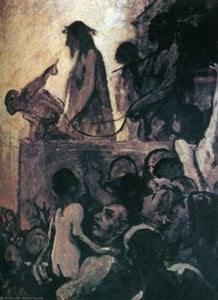
The photograph captures a pivotal moment – a frozen dance of energy and emotion rendered in the enduring medium of bronze. This exquisite reproduction offers an intimate encounter with "Ratapoil," a sculpture by the visionary artist Honoré Daumier, born in Marseille in 1808 and tragically lost in 1879. More than just a depiction of a figure, it’s a window into the social anxieties and artistic fervor that defined mid-19th century France, a period meticulously documented through Daumier's keen eye for detail and his unflinching portrayal of human experience.
Honoré Daumier was a revolutionary figure in the world of art, challenging conventional notions of beauty and truth. His work wasn't confined to idealized forms; instead, he sought to capture the raw essence of everyday life, often focusing on the marginalized and oppressed. “Ratapoil,” as evidenced by its connection to Daumier’s painting of the same name, embodies this commitment. The sculpture depicts a woman in a dynamic pose, likely engaged in dance or performance – an act that speaks volumes about freedom, expression, and perhaps even defiance within the constraints of societal expectations. Daumier's training under Alexandre Lenoir instilled in him a deep understanding of classical techniques, particularly the dramatic use of light and shadow—a hallmark of Rubens’ work—which he masterfully employs here to heighten the emotional impact of the piece.
The outstretched arms and flowing drapery of “Ratapoil” are not merely decorative elements; they are imbued with symbolic meaning. They suggest a yearning for freedom, an embrace of movement, or perhaps even a theatrical performance—a deliberate act of self-expression in a world often governed by rigid rules. The sculpture’s stark white background further amplifies these emotions, creating a powerful contrast that draws the viewer's eye directly to the figure's dynamic pose and expressive gestures. The work resonates with a timeless quality, evoking both classical beauty and Daumier’s characteristic realism – a potent combination that continues to captivate audiences today.
« Ratapoil » se définit par une palette Neutrals dominée par le White (#f0f2f1).
Les couleurs de « Ratapoil » présentent une luminance Luminous.
L'œuvre originale «Ratapoil» de Honoré Daumier est une Bronze mesurant 1 x 19 cm. La technique et les dimensions correspondent à l'œuvre originale.


1808 - 1879 , France

Découvrez l'élégance intemporelle des sculptures en bronze. De la maîtrise de la fonderie d'art aux chefs-d'œuvre de Rodin, WahooArt vous guide pour sublimer vos intérieurs de prestige avec des pièces d'exception et un savoir-faire d'excellence.

Maîtrisez l'art du bronze et de la cire perdue avec notre guide d'expert. Découvrez les secrets des maîtres dès maintenant.

Maîtrisez l'art du bronze, de la cire perdue à la patine. Découvrez les secrets des grands maîtres et investissez avec expertise.
 Envoyer
 Partager
 Détails de l'œuvre
 Guide
Guide

 Télécharger l'image
 Articles similaires
 Diaporama
 Questions et réponses
 Statistiques


 Lire la suite






































 L'option verre n'est disponible que pour les dimensions inférieures à 110 cm.