x
Aperçu en situationAperçu en situation Visualiser en RAVisualiser en RA Commander la reproduction peinte à la main Commander la reproduction peinte à la mainAcheter l'image haute résolution Acheter l'image haute résolution EnvoyerEnvoyer
Détails de l'œuvreDétails de l'œuvre Ajouter aux favoris Ajouter aux favoris TéléchargerTélécharger Articles similairesArticles similaires RadiographieRadiographie DiaporamaDiaporama

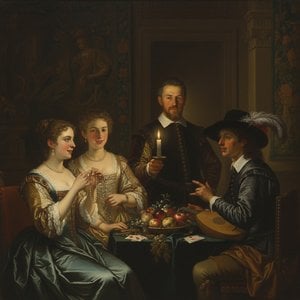
Merry Company

Explore Gerard van Honthorst’s ‘Merry Company,’ a dramatic Baroque oil painting featuring intense emotion & chiaroscuro. A captivating scene of sorrow & urgency, showcasing his masterful technique.

Découvrez Gerard van Honthorst (1590-1656), maître de l'âge d'or néerlandais & figure clé du caravagisme utrechtien ! Portraits, scènes bibliques & son influence baroque.

Giclées et impressions d'art

Impressions giclées ou sur toile de qualité musée, avec une production rapide et des finitions au choix. (Commander la reproduction peinte à la main Commander la reproduction peinte à la mainAcheter l'image haute résolution Acheter l'image haute résolution)

P118B $10
P118H $10
P118W $10
P438Z $10
P508JH $12
P508YH $12
P805H $10
P805Z $10
P919BZ $10
P919G $10
P919XJ $10
P959ZH $10
P968JZ $12
W106C $8
W218G $10
W218JH $8
W218Y $10
W307PJ $10
W316G $10
W316PJ $8
W316Y $10
W398PJ $8
W4111J $10
W500HY $15
W500JH $15
W692G $12
W849H $8
W940BG $15
W953PJ $8

Format standard
sur mesure
CM
INCH

Choisissez parmi nos formats prédéfinis qui respectent les proportions originales de l’œuvre.

largeur
hauteur

Vous pouvez saisir vos propres dimensions pour vous adapter à un cadre ou à un espace spécifique. Si la taille sélectionnée ne correspond pas aux proportions de l'image originale, nous recadrerons l'œuvre ou étendrons l'image avec une bordure en miroir ou une couleur unie. Une maquette numérique vous sera envoyée pour approbation avant le début de la production.
Veuillez noter que l'aperçu à l'écran ne reflète pas le recadrage ou l'extension réelle. Seule la maquette montrera avec précision la composition finale.
Bien que des tailles personnalisées soient disponibles, nous vous recommandons de choisir une dimension dans la liste prédéfinie afin de préserver les proportions originales.

Livraison dans le monde entier () en 2 semaines au lieu des 4/5 semaines habituelles. (6 septembre)

why_choose_icon
Livraison express gratuite dans le monde entier

why_choose_icon
Toile de lin de qualité supérieure
why_choose_icon
Assurance transport complète
why_choose_icon
Garantie de remboursement des droits de douane
why_choose_icon
Garantie de fidélité des couleurs
why_choose_icon
Politique de retour de 60 jours (uniquement en cas de défaut)
why_choose_icon
Garantie de remboursement à 100%
why_choose_icon
Offre de tarifs dégressifs

Prix total

$ 68

reproduction

Merry Company

Giclées et impressions d'art

Format de la reproduction

-

Prix total

$ 68

Informations clés

  • Subject or theme: Genre scene
  • Medium: Oil on canvas
  • Artistic style: Realistic
  • Notable elements or techniques: Dramatic chiaroscuro, tenebrism
  • Movement: Baroque
  • Location: Alte Pinakothek
  • Artist: Gerard van Honthorst

A Dance in Shadow: The Luminous Drama of Honthorst’s Merry Company

In the quiet, amber-hued corners of the Dutch Golden Age, few works capture the pulse of human connection as viscerally as Gerard van Honthorst’s “Merry Company.” Completed in 1622, this masterpiece is far more than a mere snapshot of a tavern gathering; it is a carefully orchestrated tableau of light, social intimacy, and the subtle, flickering drama inherent in life's fleeting moments. As one gazes upon the canvas, the viewer is immediately pulled into a world where the boundaries between celebration and melancholy blur, held together by the artist’s unparalleled command over chiaroscuro.

The scene unfolds within a richly appointed space, perhaps a well-established tavern, where a group of figures is gathered around a table laden with the remnants of a feast. Wine goblets catch the light, and platters of delicacies sit amidst the conversation, suggesting a recent bout of revelry. At the heart of this composition lies a profound tension; while the title suggests merriment, there is an underlying sense of urgency and perhaps even a touch of sorrow. The figures—an elderly woman, a bearded man, and younger companions—are caught in a moment of intense emotional exchange, their faces illuminated by a theatrical, directional light that seems to emerge from an unseen source, casting deep, velvety shadows that swallow the periphery of the room.

The Mastery of the Night: Technique and Tenebrism

To understand the brilliance of “Merry Company,” one must recognize the influence of the Italian master Caravaggio upon Honthorst. During his formative years in Rome, Honthorst embraced tenebrism, a technique characterized by the bold juxtaposition of intense light against impenetrable darkness. This earned him the evocative nickname “Gherardo delle Notti”—Gerard of the Nights. In this painting, the technique is used not merely for aesthetic flair but to sculpt the very air around the subjects. The light does not simply illuminate; it carves forms out of the gloom, creating a palpable sense of three-dimensional space through masterful foreshortening and delicate glazing.

The artist’s meticulous attention to texture invites a tactile experience for the viewer. One can almost feel the weight of the heavy drapery, the cool smoothness of the pewter goblets, and the warmth of the skin under the candlelight. Through painstaking brushwork, Honthorst achieves a level of realism that transcends mere representation, turning a genre scene into a psychological study. The pyramidal structure of the composition, with figures positioned to draw the eye upward and inward, ensures that the viewer’s gaze wanders through the layers of light and shadow, discovering new details in every corner of this nocturnal feast.

A Timeless Inspiration for the Modern Collector

For the discerning collector or interior designer, a reproduction of “Merry Company” offers much more than a decorative element; it provides a focal point of profound character. The painting’s ability to command attention through its dramatic contrasts makes it an ideal centerpiece for spaces that value depth, history, and atmosphere. Whether placed in a contemporary gallery-style room or a classic study, the work brings with it an aura of sophisticated mystery and the enduring elegance of the Baroque era.

Owning a piece that echoes Honthorst’s vision is an invitation to contemplate the beauty found in the shadows. It serves as a reminder of the Dutch Golden Age's fascination with capturing the ephemeral—the way light hits a glass, the way a face falls into thought, and the way a shared moment can feel both monumental and fleeting. This artwork is not just a window into the 17th century; it is a timeless exploration of the human spirit, rendered in the most magnificent light.


Biographie de l'artiste

Première jeunesse et formation

Gérard van Honthorst, peintre néerlandais important de l'âge d'or néerlandais, est né le 4 novembre 1590 à Utrecht. Il était le fils d’un peintre décorateur et a initialement été formé sous la direction de son père. Plus tard, il a poursuivi sa formation artistique sous Abraham Bloemaert.

Carrière et influences

La carrière précoce de van Honthorst a impliqué une visite à Rome, où il a été fortement influencé par le style de Caravage. Cette influence se manifeste dans ses œuvres ultérieures, en particulier dans son utilisation de scènes éclairées artificiellement, ce qui lui a valu le surnom de « Gherardo delle Notti » ou « Gérard des nuits ». À son retour aux Pays-Bas, van Honthorst est devenu un peintre portraitiste de premier plan.

Commandes notables et mécénat

Le travail de van Honthorst était très demandé, avec des mécènes notables tels que Vincenzo Giustiniani, qui l’a chargé de peindre « Christ devant le grand prêtre », exposé à la National Gallery de Londres. Il a également travaillé pour Cosme II de Médicis, grand-duc de Toscane, et était un favori auprès de la République néerlandaise et à l’étranger.

Héritage et vie ultérieure

En 1620, van Honthorst est retourné à Utrecht, où il a bâti une réputation considérable. En 1623, année de son mariage, il était devenu président de la guilde Saint-Luc d’Utrecht. Son succès a conduit à des recommandations par Sir Dudley Carleton pour l'Earl of Arundel et Lord Dorchester.

Œuvres clés et collaborations

  • La prise du Christ, une œuvre collaborative initialement attribuée à van Honthorst, aujourd'hui reconnue comme l’œuvre d’un autre artiste.
  • Christ devant le grand prêtre, commandée par Vincenzo Giustiniani, met en valeur la capacité de van Honthorst à capturer des scènes éclairées artificiellement.
  • Des collaborations avec d’autres artistes, tels que Peter Paul Rubens, démontrent son influence sur le style baroque flamand.

Mouvement artistique et style

Van Honthorst faisait partie du mouvement des Utrecht Caravaggistes, caractérisé par l’utilisation d’un éclairage dramatique et d’une profondeur émotionnelle intense. Son travail reflète l’influence de la baroque italienne, tout en contribuant au développement de l'âge d'or néerlandais. Principaux liens :
Gérard van Honthorst

Gérard van Honthorst

1590 - 1656 , Pays-Bas

L'essentiel de l'artiste

  • Artistic Movement Or Style: Caravagisme d'Utrecht, Baroque
  • Artists Or Movements Influenced By This Artist:
    • Rembrandt van Rijn
    • Georges de la Tour
  • Artists Who Influenced This Artist:
    • Caravage
    • Abraham Bloemaert
  • Date Of Birth: 4 novembre 1590
  • Date Of Death: 27 avril 1656
  • Full Name: Gérard van Honthorst
  • Nationality: Néerlandais
  • Notable Artworks:
    • Christ avant le grand prêtre
    • La Prise du Christ
  • Place Of Birth (City And Country): Utrecht, Pays-Bas
Explorez des œuvres d'art classées par thèmes, styles et caractéristiques.