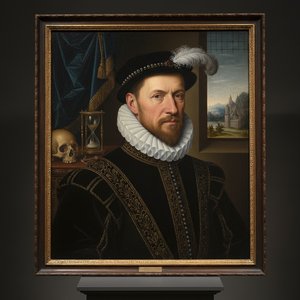
Hans von Aachen
Hans von Aachen (1552 – 4 March 1615) was a German painter who stood as one of the foremost representatives of Northern Mannerism, an artistic movement characterized by its dramatic intensity and refined stylistic conventions. Little is known about his formative years; however, it’s believed he honed his craft within the atelier of Leonardus Sievenhoven, a prominent Cologne artist whose workshop served as a crucible for shaping emerging talent.
Artistic Style and Influences
Von Aachen's oeuvre embodies the hallmarks of Mannerist painting—a deliberate departure from Renaissance ideals favoring expressive distortion and psychological depth. His canvases pulsate with vibrant hues, meticulously blended to convey emotion and heighten visual impact. Recurring motifs include elongated figures rendered with meticulous anatomical precision, intricate draperies imbued with textural detail, and compositions designed to generate tension and dynamism. Notably, his artistic vision was profoundly shaped by the monumental frescoes of El Greco (domenikos theotokopoulos), whose masterful use of chiaroscuro—the interplay between light and shadow—established a precedent for dramatic theatricality that resonated throughout von Aachen’s work.
Notable Works
His artistic output spanned diverse genres, reflecting his versatility as an artist. Among his most celebrated achievements are:
- The Crucifixion (1585): This monumental painting exemplifies von Aachen's mastery of color and lighting, capturing the pathos of Christ’s suffering with breathtaking realism. The composition is deliberately unsettling, emphasizing the vulnerability of the figure against a turbulent backdrop.
- The Last Judgment (1590): A testament to his compositional skill, ‘The Last Judgment’ presents a complex arrangement of figures—angels, saints, and sinners—within a single frame. Von Aachen skillfully balances disparate elements, creating an immersive experience for the viewer that underscores the themes of divine judgment and human mortality.
- Portrait of an Unknown Lady (1595): This portrait showcases von Aachen’s ability to convey subtle nuances of emotion through facial expression and gesture. The artist meticulously captures the sitter's gaze, conveying a sense of contemplative introspection—a hallmark of Mannerist portraiture.
Collections and Exhibitions
Von Aachen’s paintings reside in prestigious institutions across Europe, offering invaluable insights into the artistic landscape of his era:
- Gemäldegalerie Alte Meister, Dresden, Germany – This gallery houses an extensive collection of European paintings from the fifteenth to eighteenth centuries, including several masterpieces by von Aachen that illuminate the stylistic innovations of Northern Mannerism.
- Museum Ostdeutsche Galerie, Regensburg, Germany – The museum’s unique holdings encompass Eastern German art, providing a crucial perspective on artistic developments beyond the mainstream centers of Europe during von Aachen's lifetime.
Legacy
Hans von Aachen passed away in 1615, leaving behind an enduring legacy as one of the most influential painters of his time. His distinctive style—characterized by expressive distortion and psychological depth—continues to inspire artists today, cementing his place within the canon of European art history. His works serve as a poignant reminder of the Mannerist preoccupation with conveying emotion and exploring the complexities of human experience.