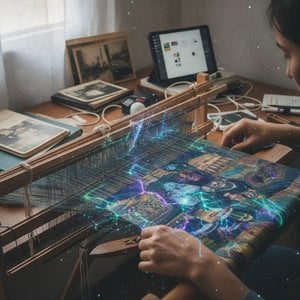
Maud Fredin-Fredholm: A Pioneer of Scandinavian Textile and Ceramic Art
Maud Fredin-Fredholm (1919–2013) stands as a cornerstone figure in mid-century Scandinavian design, celebrated primarily for her transformative contributions to textile artistry and collaborative ventures with ceramic manufacturers. Born in Gothenburg, Sweden, she possessed an innate artistic spirit that blossomed into a prolific career marked by innovation and a deep connection to Swedish folk traditions. Her legacy resides not merely in aesthetically pleasing patterns but also in establishing a distinctive visual language that continues to inspire designers today.Early Life and Artistic Beginnings
Details about Maud Fredin-Fredholm’s early life remain somewhat elusive, yet anecdotal evidence suggests she cultivated her passion for design from a young age—a dedication that would ultimately propel her toward remarkable achievements. Her formative years instilled within her a profound appreciation for craftsmanship and artistic exploration. Like many artists of her era, Fredin-Fredholm absorbed the principles of Bauhaus, recognizing its emphasis on functionality combined with artistic expression as crucial to shaping modern aesthetics. This foundational understanding fueled her desire to translate cultural heritage into contemporary visual forms—a pursuit that would define her entire artistic journey.Textile Designs: Knäckebröd and Snurran – Icons of Scandinavian Style
Fredin-Fredholm’s fame rests principally upon her iconic textile designs, particularly the ‘Knäckebröd’ (Crispbread) and ‘Snurran’ (Spinner) motifs. These patterns—characterized by bold geometric forms and vibrant hues—became synonymous with Scandinavian aesthetic sensibilities during the 1950s and 60s. The ‘Knäckebröd,’ resembling the traditional Swedish crispbread, embodies a playful juxtaposition of organic shapes against a striking chromatic backdrop. Researchers have noted that Fredin-Fredholm’s use of color was particularly innovative for its time, departing from prevailing pastel palettes to embrace bolder shades—a stylistic choice that resonated deeply with the sensibilities of the period. Similarly, the ‘Snurran,’ referencing the spinning wheel used in Swedish rural life, captures the essence of heritage while maintaining a modern sensibility. Her collaboration with Rörstrand and Bobergs Fajansfabrik ensured that these designs weren’t confined to fabric; they flourished on ceramic surfaces, amplifying their visual impact and cementing Fredin-Fredholm's position as a pivotal figure in shaping Scandinavian design history.Collaboration and Ceramic Innovation
Recognizing the potential to extend her artistic vision beyond woven fabrics, Maud Fredin-Fredholm skillfully adapted her distinctive motifs—particularly those derived from Swedish folk art—to ceramic creations. This endeavor resulted in a captivating fusion of tradition and innovation, where bold colors and geometric forms breathed new life into familiar shapes. Her ceramics achieved considerable acclaim for their aesthetic merit and contributed significantly to the broader evolution of Scandinavian ceramic design. The resulting pieces showcased her meticulous attention to detail and her ability to translate symbolic imagery into tangible artistic expression—a testament to her versatility as an artist.Legacy and Historical Significance
Maud Fredin-Fredholm’s influence extends far beyond her immediate artistic output. She served as an inspiration to subsequent generations of designers, demonstrating how cultural heritage could be reimagined within a contemporary framework. Her enduring appeal lies in her ability to capture the spirit of Swedish folk art—a celebration of natural forms and vibrant colors—while simultaneously upholding principles of minimalist elegance. Today, Fredin-Fredholm’s textile designs continue to adorn homes across Scandinavia and internationally, testifying to their timeless beauty and enduring relevance. She remains a celebrated figure within the annals of Scandinavian design history, embodying creativity, collaboration, and an unwavering commitment to artistic excellence. Her work continues to be studied by scholars examining the development of mid-century modern aesthetics and serves as a reminder that art can transcend temporal boundaries—inspiring designers today with its bold vision and enduring beauty.Kysymykset ja vastaukset
Mistä löydän Maud Barbro Fredin Fredholm's teokset ryhmiteltynä taidesuuntauksen mukaan?
Maud Barbro Fredin Fredholmn edustamat taidesuuntaukset löytyvät artistin Kaikki taidesuuntaukset -sivulta, jossa teokset on ryhmitelty tyylisuuntien mukaan.
Voinko tutkia Maud Barbro Fredin Fredholm teoksia avainsanojen avulla?
Löytääksesi tiettyyn teemaan liittyviä Maud Barbro Fredin Fredholm teoksia, käytä taiteilijan Avainsanojen mukaan -sivua, joka ryhmittelee teokset avainsanojen mukaan.
Onko Maud Barbro Fredin Fredholm teoksista saatavilla aikajana?
Maud Barbro Fredin Fredholm'n teokset ovat nähtävissä aikajärjestyksessä artistin Teosten aikajana -sivulla.