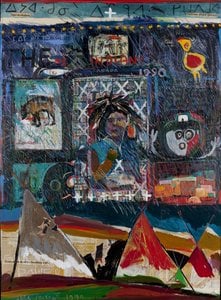
Jane Ash Poitras: Bridging Tradition and Modernity in Cree Art
Born in 1951 in Fort Chipewyan, Alberta – a landscape deeply intertwined with the Cree way of life – Jane Ash Poitras is a profoundly significant figure in contemporary Canadian art. Her work isn’t simply about depicting Indigenous subjects; it's an intricate dialogue between ancestral knowledge and the visual language of mainstream artistic traditions. Poitras masterfully employs techniques borrowed from Dada, Abstract Expressionism, and Pop Art to explore themes of identity, cultural preservation, and the complex relationship between Aboriginal people and Canadian society. Her journey, marked by both personal hardship and artistic triumph, offers a compelling lens through which to understand the evolving narrative of Indigenous representation in Canada.
Early Life and Artistic Foundations
Poitras’s early life was shaped by profound loss – her mother succumbed to tuberculosis when she was just six years old. Following this tragedy, she was adopted into a German household in Edmonton, Alberta, where she grew up within a Catholic environment. Despite these formative experiences, Poitras sought solace and expression through art. She initially pursued a scientific path, earning a Bachelor of Science degree in microbiology from the University of Alberta before dedicating herself fully to her artistic ambitions. This diverse background—combining scientific rigor with an innate curiosity – profoundly informs her approach to both subject matter and technique. Her formal training included a Bachelor of Fine Arts degree specializing in printmaking from the University of Alberta, followed by a Master’s degree at Columbia University, where she encountered the influential work of artists like Mark Rothko and Cy Twombly, whose explorations of color, form, and emotional resonance would later become central to her own artistic vocabulary.
A Language of Symbolism and Narrative
Poitras’s art is characterized by a layered complexity that invites extended contemplation. She frequently incorporates symbolic objects – an eagle feather representing sacredness, a five-dollar bill referencing treaty annuities—into her compositions, imbuing them with layers of historical and cultural meaning. Her work isn't merely decorative; it actively engages with the legacy of colonialism and the ongoing struggle for Indigenous rights. Pieces like “A Sacred Prayer for a Sacred Island” (1991) powerfully demonstrate this approach, using seemingly disparate elements to create a potent statement about the intersection of spirituality and socio-political realities. Poitras’s process is deeply intuitive, often beginning with an initial concept but remaining open to unexpected developments as the artwork evolves. She describes it as “a spiritual act,” acknowledging that each step in the creative journey can reveal unforeseen choices and ultimately shape the final outcome.
Major Works and Recognition
Poitras’s artistic output is substantial, encompassing over 60 solo exhibitions and numerous group shows. Her work has been recognized nationally and internationally, finding a place in prestigious collections including those of the National Gallery of Canada, the Royal Ontario Museum, and the Brooklyn Museum. Notable pieces like “Potato Peeling 101 to Ethnobotany 101” (2004), a monumental triptych measuring over 25 feet long by 9 feet high, powerfully depicts the preservation of traditional knowledge in the face of assimilation policies. The sheer scale of these works underscores Poitras’s ambition and her desire to create immersive experiences for viewers. Her commitment to mentorship is also noteworthy; she has guided numerous young apprentice artists from Indigenous backgrounds, fostering a new generation of talent.
Legacy and Continuing Influence
Jane Ash Poitras's impact extends far beyond the confines of her studio. Her work serves as a vital bridge between traditional Cree culture and contemporary art practices, prompting critical dialogue about Indigenous identity, history, and representation. Recognized with numerous accolades including an Order of Canada in 2017 and a Queen Elizabeth II Diamond Jubilee Medal, she continues to be a respected voice within the Canadian art world. Her ongoing lectures and residencies ensure that her artistic vision remains accessible and relevant, solidifying her position as one of the most important contemporary Indigenous artists working today. Poitras’s legacy lies not only in the beauty of her artwork but also in its profound ability to challenge viewers to confront complex issues with empathy and understanding.
Kysymykset ja vastaukset
Mistä voin selata Jane Ash Poitras's teoksia tunnelman mukaan järjestettynä?
Taiteilijan Tunnelmallinen huone -sivulla Jane Ash Poitras:n teokset on järjestetty niiden tunnelman mukaan.
Mistä löytää Jane Ash Poitras's teokset ryhmiteltynä avainsanojen mukaan?
Jane Ash Poitras-taiteilijan Avainsanojen mukaan -sivu ryhmittelee taiteilijan teokset niiden avainsanojen mukaan.
Mistä voin nähdä Jane Ash Poitras's teokset 3D-galleriassa?
Virtuaalikäynti on mahdollista: Jane Ash Poitras-taiteilijan 3D-galleria-sivu esittelee teoksia kolmiulotteisessa galleriassa.