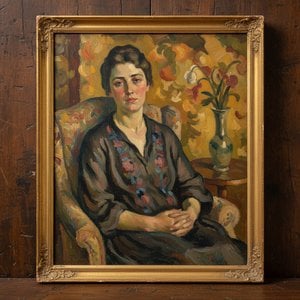
Istvan Desi Huber: A Visionary of Transylvanian Expressionism
Istvan Desi Huber (1895-1944) stands as a pivotal figure in Romanian art history, particularly recognized for his distinctive contribution to the expressionist movement within Transylvania. Born in Aiud, Romania, Huber’s artistic journey unfolded against the backdrop of Austro-Hungarian rule and Hungarian cultural influence – experiences that profoundly shaped his worldview and creative output. His work transcends mere representation; it delves into psychological landscapes and emotional resonance, capturing the spirit of a region grappling with social change and artistic innovation.
Early Life & Education:
Huber’s formative years were marked by exposure to Hungarian cultural traditions and academic training at Cluj University (Kolozsvár), where he studied painting under Mihály Kereszty, a prominent Hungarian Expressionist painter who instilled in him the principles of bold color palettes and emotive brushwork. This mentorship proved instrumental in establishing Huber's artistic style.
Artistic Style & Technique: Embracing Emotion Through Texture
Huber’s artistic signature is characterized by a masterful blend of expressionist techniques and folk art influences. He favored thick impasto—applying paint thickly onto the canvas—creating palpable textural surfaces that conveyed dynamism and immediacy. His landscapes, particularly those depicting Transylvanian vistas, are imbued with vibrant hues – reds, yellows, and greens – mirroring the fiery sunsets and lush meadows of his homeland. Recurring motifs included stylized figures representing rural life, reflecting a deep connection to Romanian traditions. Huber’s meticulous attention to detail combined with an intuitive understanding of color psychology resulted in artworks that powerfully communicated emotion and atmosphere.
Notable Paintings:
Among his most celebrated pieces are ‘Romanian Young Wife,’ a surreal portrait blending folk art elements with expressionist sensibilities, and ‘Old Field-quard,’ which showcases Huber’s ability to capture the essence of rural landscapes through textured brushstrokes. These works exemplify his commitment to exploring psychological depth alongside visual beauty.
Influences & Artistic Development
Huber's artistic development was significantly impacted by European Expressionism, spearheaded by artists like Edvard Munch and Ernst Ludwig Kirchner. However, he skillfully adapted these influences to resonate with Romanian cultural identity. The Hungarian Expressionist movement served as a catalyst for Huber’s experimentation with color and form, propelling him toward a uniquely personal aesthetic. Furthermore, his engagement with folk art traditions—evident in his depictions of rural life—added another layer of complexity to his artistic vision.
Historical Significance & Legacy
Despite facing challenges during World War II, Huber’s oeuvre continues to inspire admiration for its expressive power and stylistic originality. His paintings represent a crucial juncture in Romanian art history, marking the transition from academic realism to emotionally charged abstraction. Huber's contribution to Transylvanian Expressionism solidified his place as one of Romania’s foremost artists of the 20th century—a testament to his unwavering dedication to artistic exploration and cultural preservation.
WahooArt.com:n toimitus
Taidevisakysely
Jokaisessa kysymyksessä on vain yksi oikea vastaus.
Explore the captivating world of József Rippl-Rónai, a pioneering Hungarian painter. Discover his intimate portraits, unique style blending Impressionism & Symbolism, and lasting legacy in modern art history.
Explore the life & art of Franz Xaver Winterhalter, the celebrated court painter of the 19th century. Discover his exquisite portraits of royalty and aristocracy – a symbol of prestige and refined taste.
Explore the life & art of Philip de László, master portraitist of European aristocracy. Discover his stunning paintings, royal commissions, and enduring legacy. A guide for discerning collectors.