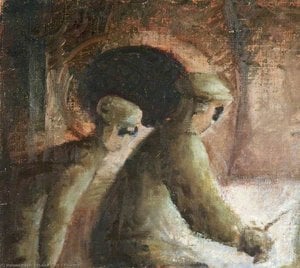
Hubert Cook: A Chronicle of Industrial Britain
Hubert Cook (1901-1966) wasn’t a name immediately recognized in the annals of British art, yet his canvases offer a remarkably poignant and enduring portrait of 20th-century industrial life. Born in Swindon, Wiltshire – a town deeply intertwined with the burgeoning railway industry – Cook's artistic journey was shaped by the very landscapes he depicted: sprawling factories, bustling railway yards, and the everyday lives of those who toiled within them. His work transcends mere documentation; it’s imbued with a deep sense of social realism and a subtle, almost melancholic beauty that continues to resonate today.
Cook's early life was rooted in the heartland of British manufacturing. He began his artistic training at Swindon School of Art, absorbing the atmosphere of a town built on industry – a place where steam engines roared, metal rang, and the rhythms of production dictated daily existence. This formative experience profoundly influenced his subject matter, leading him to capture the gritty reality of factory work and the social fabric woven around it. Unlike many artists of his time who focused on grand historical narratives or idealized landscapes, Cook chose to depict the often-overlooked world of the working class, offering a rare glimpse into their lives and struggles.
The Palette of Progress: Style and Technique
Cook’s artistic style is characterized by a deliberate restraint and a remarkable ability to convey atmosphere through subtle tonal shifts. He largely eschewed bright colors, favoring instead a muted palette dominated by browns, greys, ochres, and blues – mirroring the industrial environment he so faithfully rendered. His brushwork is often loose and expressive, creating a sense of movement and dynamism within his scenes. He employed a technique reminiscent of early Impressionism, focusing on capturing fleeting moments of light and shadow, particularly in depictions of smoke rising from chimneys or reflecting off metal surfaces. This attention to detail, combined with his masterful use of color, allows him to evoke the textures and moods of industrial Britain with remarkable precision.
A key element of Cook’s style is his ability to imbue even the most mundane subjects – a railway worker shoveling coal, a foundry scene filled with molten metal – with a sense of dignity and humanity. He wasn't interested in glorifying industry; rather, he sought to portray its impact on individuals, capturing their weariness, resilience, and quiet determination.
Subjects of the Machine Age
Cook’s oeuvre is dominated by scenes of industrial activity – railway works, foundries, mills, and workshops. He meticulously documented the machinery, the workers, and the surrounding environment, creating a comprehensive visual record of Britain's industrial heartland. His most celebrated works include “Roger’s Lido,” a captivating depiction of a public swimming pool in Knaresborough, Yorkshire – an unexpected subject that nonetheless reveals Cook’s keen eye for composition and his ability to find beauty in the commonplace. Other notable paintings depict scenes from Swindon railway yards, showcasing the intricate network of tracks, signals, and workers involved in transporting goods across the nation.
Beyond these iconic images, Cook also painted scenes of everyday life – market squares, pubs, and rural landscapes – offering a broader perspective on the social and cultural context of industrial Britain. These works demonstrate his versatility as an artist and his ability to capture the essence of a particular place or time.
Legacy and Historical Significance
Hubert Cook’s work holds significant historical value, providing invaluable insights into the lives and experiences of working-class Britons during the early 20th century. His paintings offer a stark contrast to the idealized depictions of industrial progress often presented by contemporary artists and journalists. By focusing on the realities of factory life and the struggles faced by ordinary people, Cook challenged conventional notions of beauty and heroism.
While he didn’t achieve widespread fame during his lifetime, Cook's work has gained increasing recognition in recent years, particularly among scholars of British social history and art. His paintings are now housed in various collections, including the Swindon Museum & Art Gallery, testament to their enduring artistic merit and historical importance. Hubert Cook remains a vital voice in understanding the complexities of industrial Britain – an artist who captured not just the sights but also the spirit of a nation transformed by progress.
Kysymykset ja vastaukset
Voinko selata Hubert Cook teoksia tyylisuuntien mukaan?
Hubert Cookn edustamat taidesuuntaukset löytyvät artistin Kaikki taidesuuntaukset -sivulta, jossa teokset on ryhmitelty tyylisuuntien mukaan.
Mistä löytää Hubert Cook teokset järjestettynä värin mukaan?
Hubert Cook:n teoksia voi tutkia värin perusteella artistin Värispektri -sivulla.
Kuinka monta Hubert Cook teosta on katseltavissa?
Voit selata taiteilijan Hubert Cook 7 teosta teosta sivulla Kaikki teokset.