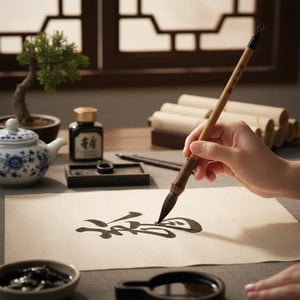
The Eccentric Spirit of Yangzhou
In the bustling atmosphere of the Qing dynasty, a man emerged from the Jiangdu District with a spirit that refused to conform to the rigid expectations of his era. Born in 1688, Gao Xiang lived through a period of profound cultural shifts, finding his place among the celebrated Eight Eccentrics of Yangzhou. He was a man of many talents, moving between the delicate precision of a painter and the rhythmic discipline of a calligrapher. His life was not one of quiet contemplation alone; he was also a cutter, a man whose hands were accustomed to the sharp, decisive movements required by his craft.
His presence in the art circles of the time was marked by a certain defiance. Rather than following the established paths of his predecessors, he sought a way to express the internal landscape of the mind. This drive led him to develop a style that was deeply personal, often characterized by a sense of individualistic vigor that set him apart from the more traditionalists of the imperial court.
Artistic Lineage and Technique
The brushwork of Gao Xiang was shaped by the shadows of those who came before him. He drew strength and inspiration from the works of Shitao and Hongren, absorbing their approaches to ink and space to forge his own path. His compositions often utilized ink and color on paper, creating scenes that felt both grounded in nature and untethered from reality. In his hands, a simple hanging scroll could transform a subject into something far more complex than its physical form.
His technical mastery was evident in the way he handled his tools, often leaving behind distinct marks of his identity. His work frequently featured:
- The use of ink and color on paper to create depth and texture.
- Specific inscriptions and signatures that identified his hand.
- The application of personal seals, such as those marked Gao Xiang Zhi Yin and Xi Tang.
- A focus on botanical subjects, such as the peony and magnolia.
A Legacy in Ink
By the time of his passing in 1753, Gao Xiang had established himself as a significant figure in the history of Chinese painting. His ability to blend the roles of painter and calligrapher allowed him to approach the paper with a unique fluidity. He did not merely depict the world; he interpreted it through a lens of personal eccentricity that challenged the viewer to see beyond the surface. His works remain as physical traces of a life lived with intention, captured in the delicate balance of ink and the deliberate stroke of the brush.
Kysymykset ja vastaukset
Mistä voin nähdä Gao Xiang'n teokset aikajärjestyksessä?
Gao Xiang'n teokset ovat nähtävissä aikajärjestyksessä artistin Teosten aikajana -sivulla.
Miten löydän teoksia artistilta Gao Xiang tietyn väripaletin mukaan?
Löytääksesi taiteilijan Gao Xiang teoksia tietyssä väripaletissa, käytä hänen Väripalettien mukaan -sivuaan.
Voinko tutkia Gao Xiang teoksia värispektrin mukaan?
Gao Xiang-taiteilijan Värispektri järjestää teokset niiden värin mukaan.