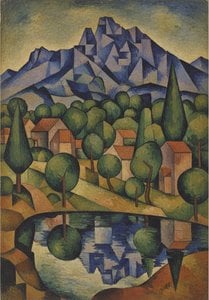
The Lyon Impressionist
To look at the surviving works of Adrien Bas is to witness a specific, localized rebellion against academic rigidity. Born in Lyon in 1884, Bas did not seek the global stage of Paris, but instead focused his technical energy on the light and atmosphere of his home region. His training at the École nationale supérieure des beaux-arts de Lyon under Pierre Bonnaud provided him with a solid foundation, yet his later output moved far beyond the classroom. He was a painter of the immediate and the tangible.
His development was marked by a shift from traditional structures toward a more spontaneous, light-driven approach. After 1916, the influence of Paul Cézanne became evident in his compositions, though he maintained a clear connection to the softer, more fluid sensibilities of Auguste Renoir. This tension between structural weight and luminous fluidity defines his best work. He was not interested in mere decoration; he sought the actual behavior of light on surfaces.
Technique and Subject Matter
Bas operated with a dual mastery of oil and pastel. While many of his contemporaries focused on the permanence of canvas, Bas often favored the immediacy of pochades—quick sketches that captured a fleeting moment before it vanished. This preference for spontaneity led him to destroy much of his own finished work, leaving behind a fragmented but potent record of his vision. His brushwork was broad and generous, characterized by a firm, sweeping touch that avoided the delicate, thin layers typical of watercolorists.
His subject matter remained grounded in the geography of Lyon and its surroundings. He focused on specific locales:
- The Saône River: He captured the transparency of water and the heavy presence of mist along its banks.
- Local Landscapes: Areas such as Villeurbanne, La Mulatière, Fourvière, and La Villette provided the structural bones for his compositions.
- Still-lifes and Interiors: Beyond the outdoors, he applied his technical skill to flowers, interiors, and portraits, often using light to create an intimate atmosphere.
The Ziniars and Artistic Legacy
In 1920, Bas became a central figure in a movement that challenged the status quo of the Lyonnais art scene. Alongside artists like Louis Bouquet, Pierre Combet-Descombes, and Étienne Morillon, he formed the society known as Les Ziniars. This group was explicitly opposed to Academicism, pushing for a more modern, innovative approach to painting in the region. His participation in the Salon d'automne de Lyon helped cement this collective identity until the group dissolved around 1924.
His career was cut short by tuberculosis, leading to his death in 1925 at the age of 41. Despite the brevity of his life, his impact on the local school of painting remains measurable through the works held in the Musée des Beaux-Arts de Lyon. He left behind a body of work that rejected the stale traditions of his era in favor of a more direct, sensory engagement with the world.
Kysymykset ja vastaukset
Missä ja minä vuonna Adrien Bas on syntynyt?
Adrien Bas syntyi 3rd arrondissement of Lyonssä vuonna 1884.
Onko Adrien Bas teoksista saatavilla 3D-virtuaalikierrosta?
Virtuaalikäynti on mahdollista: Adrien Bas-taiteilijan 3D-galleria-sivu esittelee teoksia kolmiulotteisessa galleriassa.
Mistä Adrien Bas on kotoisin?
Adrien Bas on syntynyt France.
Miten löydän tietyn teeman mukaisia Adrien Bas teoksia?
Löytääksesi tiettyyn teemaan liittyviä Adrien Bas teoksia, käytä taiteilijan Avainsanojen mukaan -sivua, joka ryhmittelee teokset avainsanojen mukaan.