


Museolaatuisia giclée- tai kankaitaulun tulosteita nopealla tuotannolla ja joustavilla viimeistelyvaihtoehdoilla. ( Osta käsinmaalattu taideteos Siirry digitaaliseen kuvaan)





























Valitse valmiista mitoistamme sellaiset, jotka vastaavat teoksen alkuperäisiä mittasuhteita.

Syötä tarvitsemasi leveys ja korkeus, jotta tuloste sopii kehyksiisi tai seinällesi. Tulostetta voidaan vain leikata, sitä ei voida koskaan suurentaa alkuperäistä kuvaa suuremmaksi, joten eri muotoinen koko aiheuttaa osan kuvasta katoamisen. Lähetämme sinulle digitaalisen mallikuvan hyväksyttäväksi ennen kuin aloitamme tulostuksen. Tällä sivulla näkyvä kuva ei näytä lopullista rajausta — vain mallikuva näyttää sen.
Maailmanlaajuinen toimitus () 2 viikossa tavallisen 4–5 viikon sijaan. (17 marraskuu)
William Morris
Replikaatin koko
The room falls away, leaving only the weight of a single, dignified gaze. An elderly man emerges from a deep, indistinct darkness, his presence defined by the way light claims his features. This is a study of gravity and wisdom, where the chiaroscuro technique pulls the subject forward from a void of black and umber. His forehead catches a soft glow, leading the eye down to the steady, contemplative expression held within his eyes. A voluminous, silvery-grey beard flows downward, its thick, bushy texture rendered with smooth, deliberate brushwork that captures every individual strand of hair. The warmth of the skin, touched by subtle ochre highlights, contrasts against the cool shadows that swallow the edges of his form. He sits in a moment of profound stillness, a man whose very posture suggests a lifetime of thought and quiet authority.
The artist employs a meticulous approach to texture and light to build this bust portrait. Every stroke serves to define the physical reality of the subject, moving beyond mere likeness to capture a sense of character. The composition relies on a careful balance of light and shadow to create a three-dimensional presence that feels tangible.
This portrait reflects the traditions of 19th-century academic portraiture, where the goal is to capture the essence of the individual through realistic detail and dramatic lighting. The subject's serious demeanor and the somber palette create an atmosphere of solemnity. There is a sense of weight here, not just in the physical presence of the man, but in the historical gravity of his expression. The technique avoids harsh lines, opting instead for a seamless integration of light and shadow that makes the subject feel as though he is breathing within the frame. It is a quiet, powerful encounter with a man who seems to exist in a space between memory and the present moment.
Teoksen William Blake Richmond:n "William Morris" yleinen tunnelma on Dramatic. Tunnelma kuvaa teoksen yleistä ilmapiiriä.
Teos "William Morris" on ladattavissa: teoksen Lataa digitaalinen kuva -sivulta löytyy korkearesoluutioinen digitaalinen kuvalataus.
William Blake Richmond:n "William Morris" yhdistää Earthy väripaletin ja Somber tunnelman.

Sir William Blake Richmond was a British painter, sculptor, and designer of stained glass and mosaic. Born in London, United Kingdom, he was the son of the portrait painter George Richmond and Julia Tatham. His artistic journey began with private tutoring at home, followed by three years of studying drawing and painting at the Royal Academy of Art starting in 1858. A significant period of his development occurred during a six-week tour of Italy, where he viewed the works of Old Masters such as Michelangelo, Tintoretto, and Giotto.
Richmond achieved early success as a portrait painter, exhibiting his first major work at the Royal Academy in 1861. His talent led to his election as an Associate of the Royal Academy in 1888 and a Royal Academician in 1895. Beyond portraiture, he was a prolific designer of monumental decorations, most notably the mosaics in the quire and apse of St Paul's Cathedral in London.
His work in mosaic design was characterized by a vibrant treatment using jagged, irregular glass set at angles to catch the light. This technique, influenced by Byzantine and early Christian styles, involved a collaboration with glassmakers James Powell and Sons to develop new colors and materials. These innovations expanded the palette available to artists within the Arts and Crafts movement. His stained-glass designs, such as those in St Mary's, Stretton, utilized thick, streaked glass to mimic the sparkling effects of his mosaic work.
In addition to his visual arts, Richmond was a sculptor and an environmental advocate. His notable sculptural works include:
Furthermore, he was an early advocate for clean air in London, founding the Coal Smoke Abatement Society in 1898 to address the darkness caused by coal smoke.

1842 - 1921 , United Kingdom
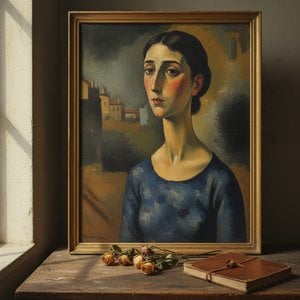
Delve into the haunting beauty of Amedeo Modigliani's portraits. Explore the intersection of Expressionism and Modernism through an expert analysis of his iconic elongated forms, melancholic gazes, and profound influence on art history.

Explore the dramatic mastery of Baroque chiaroscuro and light. Discover the profound power of shadow in art history now.

Explore the profound beauty of figure painting through an art historian's lens. Discover the techniques, anatomy, and mastery behind iconic human form artworks, from classical realism to romanticism, curated for the discerning art enthusiast and collector.

Explore 25 iconic William Blake masterpieces of the Romantic Age. Discover museum-quality art at WahooArt.com.

Master the science of anatomical precision and chiaroscuro in fine art portraiture. Explore the masters of realism today.
 Esikatselu

 Jaa teos
 Jaa
 Tiedot
 Opas


 Lataa kuva
 Samanlaisia kohteita
 Röntgenkuvaus
 Diaesitys
 Kysymykset ja vastaukset

 Tilastot


 Lue lisää









 Lasivaihtoehto on saatavilla vain alle 110 cm kokoisille teoksille


