A Symphony of Color and Form: Exploring Kandinsky’s 1914 Vision
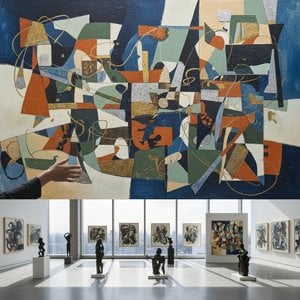
“Improvisation. Gorge” (1914) by Wassily Kandinsky stands as a cornerstone of abstract art, encapsulating the fervent spirit of early expressionism and marking a decisive break from representational painting. Currently residing in the Städtische Galerie im Lenbachhaus, Munich, this monumental canvas pulsates with dynamism—a testament to Kandinsky’s pioneering theories concerning the profound connection between color and spirituality.
The Genesis of Abstraction: Style & Historical Context
Painted during a period brimming with artistic innovation, “Improvisation. Gorge” embodies the core tenets of the *Der Blaue Reiter* (The Blue Rider) movement alongside artists like Franz Marc and August Macke. These trailblazers rejected the conventions of depicting reality, driven by an unwavering belief in art’s capacity to transcend visual perception and tap into deeper realms of consciousness. Influenced heavily by Theosophy and Kandinsky's own spiritual convictions, he sought to create paintings that communicated directly with the viewer’s soul—a radical departure from traditional artistic pursuits.
Decoding the Visual Language: Composition & Technique
The artwork presents a mesmerizing vortex of geometric shapes – triangles, rectangles, curves, and amorphous forms – interwoven across the expansive canvas. There is no discernible focal point; instead, the eye wanders freely through this intricate network, invited to immerse itself in its harmonious complexity. Kandinsky’s masterful manipulation of oil paint—characterized by expressive brushstrokes—lays down washes and glazes with meticulous care, generating subtle tonal variations and a palpable textural richness. The deliberate eschewal of perspective and the bold juxtaposition of color contrasts – fiery reds colliding with cool blues – generate visual tension and convey an undeniable sense of movement.
Notably, impasto is employed in certain areas, adding substantial depth and tactile quality to the surface. This technique underscores Kandinsky’s commitment to conveying emotion through materiality.
Symbolism & Emotional Resonance
Despite its utter lack of recognizable imagery, “Improvisation Gorge” overflows with symbolic significance—open to interpretation yet undeniably evocative. The swirling shapes may represent the turbulence of inner experience, mirroring Kandinsky’s own explorations into psychological states. Similarly, the contrasting hues – reds symbolizing passion and energy alongside blues embodying tranquility and contemplation – communicate opposing forces in a captivating interplay.
Further Research & Context
Kandinsky's exploration of color theory—influenced by Goethe’s scientific investigations—was central to his artistic vision. He meticulously studied the relationship between pigment and emotion, striving to translate subjective experience into visual form. “Improvisation Gorge” exemplifies this approach perfectly, demonstrating how art can communicate beyond mere representation.
The Lenbachhaus houses a significant collection of Kandinsky’s works, offering visitors an unparalleled opportunity to appreciate his groundbreaking contribution to modern art. Alongside fellow Blue Rider artists like Marc and Macke, Kandinsky championed the transformative potential of abstraction—a legacy that continues to inspire artists and collectors worldwide.
Don't miss the chance to own a stunning reproduction of “Improvisation Gorge” – available at WahooArt.com!



 Esikatselu
 Osta printti
 Jaa
Jaa Jaa
Jaa
 Tarkemmat tiedot

 Lataa
Lataa
 Samanlaisia
 Röntgenkuva
 Diaesitys


 Näytä lisää






































 Lasivaihtoehto on saatavilla vain alle 110 cm kokoisina teoksina