A Golden Vision in the Australian Bush
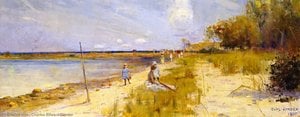
In the shimmering heat of the Victorian goldfields, where the air vibrates with both hope and hardship, Walter Herbert Withers captured a moment of profound human endeavor. “Seeking for Gold – Cradling,” painted in 1893, is far more than a mere historical record; it is a poetic immersion into the soul of the Australian frontier. The scene unfolds within a shallow creek bed, where two men are locked in a rhythmic, diligent dance with the earth. As they operate the gold cradle—a primitive yet essential wooden apparatus designed to sift precious grains from the silt—the viewer is drawn into their quiet world of determination. There is a palpable sense of focus in their movements, a shared silence that speaks to the solitary nature of the pioneer's struggle against the elements.
Withers, a master of the Heidelberg School, utilizes the hallmarks of Impressionism to breathe life into this rugged landscape. Rather than clinging to rigid, photographic precision, he employs loose, spirited brushstrokes that allow the light to dance across the canvas. The technique prioritizes the ephemeral quality of the atmosphere, capturing how the brilliant Australian sun pierces through the canopy to illuminate the creek. This mastery of plein air sensibilities ensures that the painting feels alive, as if the warmth of the afternoon could be felt by anyone standing before it. The interplay of light and shadow does not merely define form; it creates a sense of movement, suggesting the flowing water and the shifting dust of the mining site.
The Symphony of Light and Earth
The color palette of this masterpiece is a deliberate study in warmth and resilience. Dominated by sun-drenched ochres, deep earthy browns, and radiant golds, the work evokes an overwhelming sense of optimism. These warm hues are not merely descriptive of the soil and the sunlight; they serve as a symbolic heartbeat for the painting, representing the very prosperity the miners seek. Amidst these heavy, grounded tones, the subtle presence of nature—such as the birds gliding through the sky above—adds a layer of tranquil continuity to the scene, reminding us that while man seeks to extract wealth from the land, the landscape remains an enduring, majestic force.
For the discerning collector or interior designer, this artwork offers a sophisticated anchor for any space. Its historical gravity and emotional depth make it a perfect centerpiece for rooms that value character and storytelling. Whether placed in a sunlit study to evoke a sense of adventure or in a contemporary living area to provide a warm, organic contrast to modern minimalism, the painting brings with it an aura of timelessness. To possess a reproduction of this work is to hold a fragment of Australian history—a tribute to the enduring human spirit and the beautiful, untamed light of the Antipodes.



 Esikatselu
 Vaihda tulosteeseen
 Jaa
Jaa Jaa
Jaa
 Tarkemmat tiedot

 Lataa
Lataa
 Samanlaisia
 Röntgenkuva
 Diaesitys
 Tilastot


 Näytä lisää






































 Lasivaihtoehto on saatavilla vain alle 110 cm kokoisina teoksina