Federico da Montefeltro: A Renaissance Portrait of Power and Reflection
Piero della Francesca’s “Portrait of Federico da Montefeltro,” painted in 1465, is far more than a simple likeness; it's a meticulously constructed meditation on leadership, perception, and the very nature of representation within the vibrant tapestry of Renaissance Italy. Housed within the hallowed halls of the Galleria degli Uffizi in Florence, this tempera painting – measuring just 47 x 33 centimeters – transcends its modest dimensions to offer an unparalleled glimpse into the world of Duke Federico da Montefeltro himself, a man whose shrewd intellect and carefully cultivated image were as formidable as his military prowess. The work isn’t merely a portrait; it's a stage upon which the Duke presents a controlled, almost enigmatic, version of himself, inviting us to contemplate the artifice inherent in portraying power – an invitation that continues to resonate centuries later.
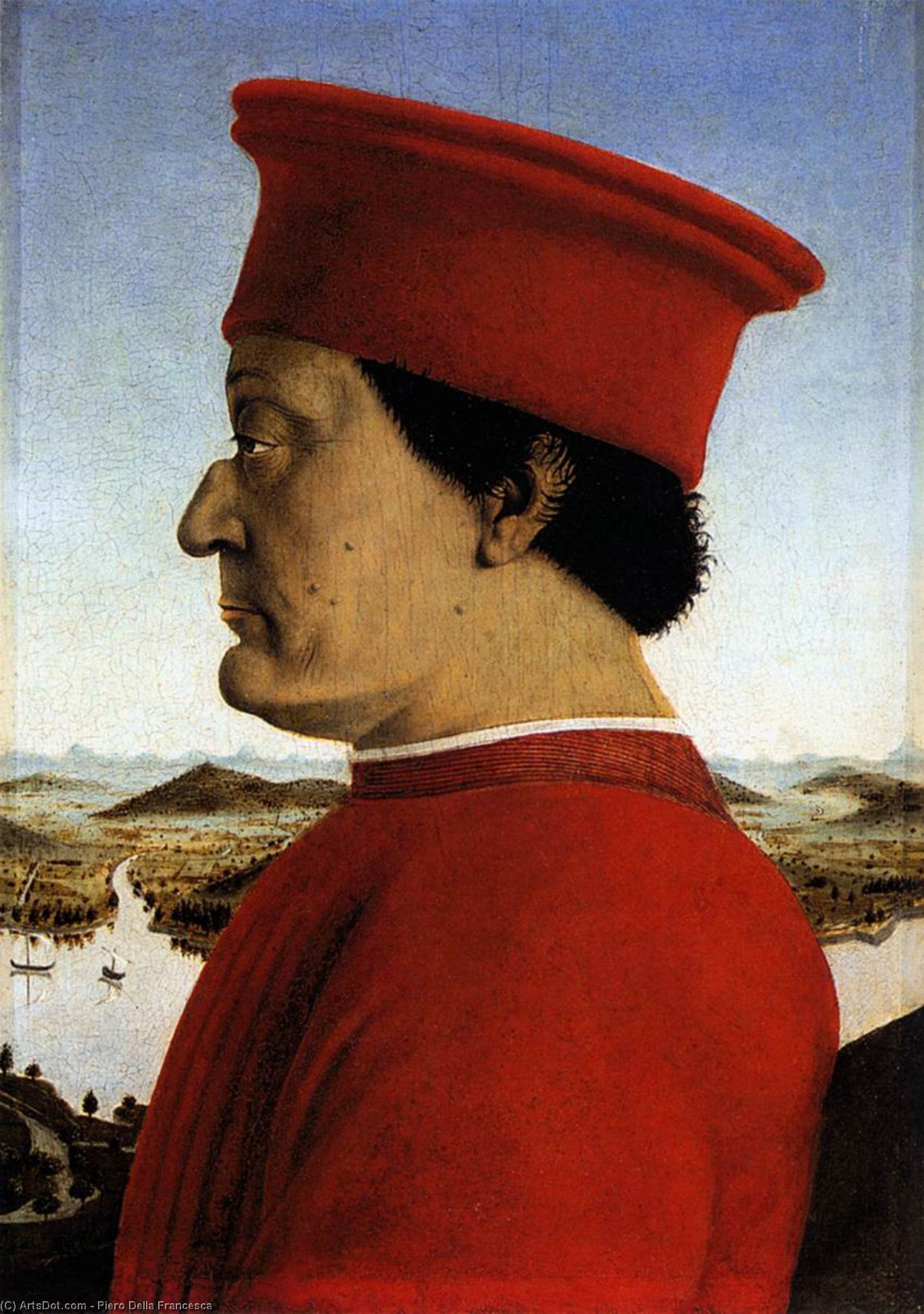
At first glance, the painting exudes a remarkable serenity. Federico da Montefeltro stands before a placid body of water, his gaze subtly downward, suggesting introspection rather than arrogance. This deliberate choice by Piero is immediately striking; it challenges the conventional notion of portraiture, which typically sought to capture the subject in an idealized, heroic pose. The crimson hat, adorned with a vibrant feather – a potent symbol of his status as a condottiero (mercenary leader) and military commander – isn’t merely decorative; it's a carefully chosen emblem of authority, instantly recognizable within the context of 15th-century Italy. The background, featuring boats gliding across the water, subtly anchors the scene in a tangible reality while simultaneously creating an atmosphere of contemplative stillness – a deliberate juxtaposition that speaks volumes about Federico’s character and his desire to project an image of both strength and measured restraint.
Piero della Francesca's Revolutionary Technique
What truly elevates “Portrait of Federico da Montefeltro” is Piero della Francesca’s mastery of technique. He was renowned throughout Italy for his innovative use of geometric forms, perspective, and a profound understanding of light and shadow – principles he applied with breathtaking precision to this single portrait. This work exemplifies a radical departure from the prevailing Gothic style, embracing instead the classical ideals of balance, proportion, and clarity that were gaining momentum during the Renaissance. Notice how Piero employs linear perspective to create an illusion of depth – the receding shoreline, the distant boats – drawing the viewer’s eye into the composition with remarkable effectiveness. This meticulous attention to detail wasn't simply about realism; it was a deliberate strategy to impose order and control onto the image, mirroring Federico’s own approach to governance.
The choice of tempera paint allowed for an extraordinary level of detail and luminosity previously unseen in portraiture. Each brushstroke is deliberate, contributing to the overall sense of stillness and control. The subtle gradations of color, particularly in Federico’s robes – a rich, deep crimson that commands attention – demonstrate Piero’s exceptional skill in rendering texture and light. Furthermore, the meticulous attention to anatomical accuracy – particularly evident in Federico’s hands, rendered with an almost unsettling realism – reflects a deep understanding of human form, honed through years of observation and study. This isn't merely a depiction of a man; it’s a carefully constructed representation of power, intellect, and authority.
Federico da Montefeltro: A Man of Renaissance Significance
Understanding “Portrait of Federico da Montefeltro” requires placing it within its historical context. Federico da Montefeltro was a pivotal figure in the Italian Renaissance, not just for his military leadership – he commanded armies and negotiated treaties with remarkable skill – but also for his patronage of the arts and sciences. He established Urbino as a center of learning and culture, commissioning elaborate libraries filled with ancient texts and attracting scholars from across Europe. The portrait itself is believed to have been commissioned by Federico himself or his family, serving as both a visual representation of his power and a testament to his intellectual pursuits – a man who valued knowledge and beauty alongside military strength.
Beyond the surface details, the painting offers a poignant reflection on the complexities of leadership. Federico’s contemplative gaze hints at the burdens of command – the constant vigilance required to maintain order and defend one's territory. The serene backdrop contrasts sharply with the turbulent realities of his life as a condottiero, suggesting a desire for peace and stability amidst the chaos of war. The painting isn’t simply a portrait; it’s a carefully crafted statement about the qualities of a successful ruler – intelligence, restraint, and an understanding of the delicate balance between power and diplomacy.
Enduring Legacy and Artistic Influence
“Portrait of Federico da Montefeltro” remains an enduring masterpiece, profoundly influencing generations of artists who followed in Piero della Francesca’s footsteps. Its influence can be seen in the works of Raphael, Titian, and countless others. The painting's meticulous realism, combined with its psychological depth, established a new standard for portraiture – one that prioritized clarity, precision, and the portrayal of individual character. Today, it continues to captivate viewers at the Galleria degli Uffizi, serving as a powerful reminder of the artistic brilliance of the Renaissance and the enduring legacy of Piero della Francesca. For those seeking to delve deeper into this remarkable artwork or explore other masterpieces by Piero della Francesca, we invite you to visit Piero Della Francesca: Portrait of Federico da Montefeltro on WahooArt. Additionally, the Galleria degli Uffizi is featured in The Uffizi Gallery, Florence Italy, providing insights into the museum's rich history and collection.
Photo Description: The image is a painting of a man wearing a red hat with a feather on it. The man appears to be looking downward as he stands in front of a body of water. He is dressed in a red robe, which gives the impression that he might be a religious figure or an important personage. In addition to the main subject, there are several boats visible in the background, some of them floating on the water and others resting near the shore. The presence of these boats suggests that this scene may take place by the water's edge, possibly during a time when boating was an important mode of transportation or leisure activity.
Size: 47 x 33 cm
Date: 1465
Artist Information
Artist: Piero della Francesca
Birth Year: 1415
Death Year: 1492
Birth City: San Sepolcro
Birth Country: Italy
Biography:
A Tuscan Visionary: The Life and Art of Piero della Francesca
Born around 1415 in the quiet Umbrian town of Sansepolcro, Piero di Benedetto de’ Franceschi – known to history as Piero della Francesca – emerged from a relatively obscure background to become one of the most intellectually rigorous and profoundly influential painters of the Early Renaissance. Unlike many of his contemporaries whose lives are richly documented, Piero remains somewhat enigmatic; details about his family and early training are scarce. What *is* certain is that he possessed an extraordinary mind, equally captivated by the emerging artistic currents of Florence and the precise languages of mathematics and geometry. His father was a shoemaker and tanner, providing Piero with a stable if unostentatious upbringing, and it’s believed his initial artistic education occurred locally, absorbing the traditions of central Italian painting before the seismic shifts initiated by Masaccio and Brunelleschi. This



 Esikatselu
 Osta printti
 Jaa
Jaa Jaa
Jaa
 Tarkemmat tiedot

 Lataa
Lataa
 Samanlaisia
 Röntgenkuva
 Diaesitys


 Näytä lisää






































 Lasivaihtoehto on saatavilla vain alle 110 cm kokoisina teoksina





