A Vision of Devotion: The Right Wing of the Crucifixion Triptych
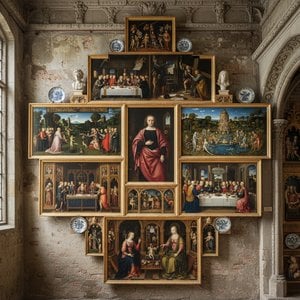
In the quiet, hallowed halls of the Kunsthistorisches Museum in Vienna, there exists a fragment of a much larger divine drama—a moment of profound intimacy captured within the right wing of Rogier van der Weyden’s Crucifixion Triptych. Created around 1445, this panel serves as more than just a religious illustration; it is a window into the soul of the Burgundian Renaissance. The scene presents Saint Veronica, a figure of immense spiritual significance, holding the miraculous image of Christ's face. As she gazes upon the cloth, the viewer is invited to share in her reverence, witnessing a silent dialogue between the earthly and the divine that has captivated hearts for over five centuries.
The artistry of Van der Weyden is nothing short of transformative. A master of the Early Netherlandish tradition, he utilized the burgeoning potential of oil paint on oak panel to achieve a level of luminosity that feels almost supernatural. Every brushstroke serves the purpose of heightened realism, yet it is a realism infused with spiritual weight. Notice the way the light catches the textures of her crimson garments, creating deep, velvety shadows and brilliant highlights that suggest a tangible, three-dimensional presence. His technique allows for an exquisite rendering of detail—from the subtle folds of drapery to the delicate, sorrowful expression on the saint's face—ensuring that the physical world feels as vibrant and heavy with meaning as the spiritual one.
The Language of Grief and Grace
Beyond its technical brilliance, the painting is a masterclass in emotional storytelling. Van der Wey Weyden was renowned for his ability to translate human suffering into a language of profound compassion. In this specific panel, the composition directs our focus toward the concept of the Imago Christi—the image of Christ. The way Saint Veronica holds the cloth is not merely an act of preservation, but one of deep, empathetic connection. This sense of "agonizing tenderness" is a hallmark of his style, where the physical anatomy of the figures is used to convey the weight of grief and the strength of unwavering faith.
For the discerning collector or interior designer, bringing a high-quality reproduction of this masterpiece into a space offers more than mere decoration; it introduces a focal point of contemplative beauty. The rich, saturated palette and the dramatic interplay of light and shadow provide a sophisticated aesthetic that complements both classical and contemporary settings. Whether placed in a library, a study, or a grand salon, this work serves as an enduring symbol of resilience and devotion, offering a timeless elegance that transcends the era of its creation.



 Esikatselu
 Vaihda tulosteeseen
 Jaa
Jaa Jaa
Jaa
 Tarkemmat tiedot

 Lataa
Lataa
 Samanlaisia
 Röntgenkuva
 Diaesitys
 Tilastot


 Näytä lisää






































 Lasivaihtoehto on saatavilla vain alle 110 cm kokoisina teoksina