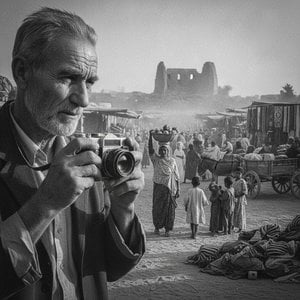
Raymond Depardon: A Life in Images
Raymond Depardon is a renowned French photographer, photojournalist, and documentary filmmaker whose career spans over six decades. Born in Villefranche-sur-Saône, France, in 1942, Depardon has become synonymous with humanistic storytelling through visual media, particularly his compassionate depictions of conflict zones and everyday life.
Early Life and Career Beginnings
Depardon’s journey into the world of photography began in the early 1960s. He quickly gravitated towards photojournalism, driven by a desire to document the realities unfolding around him. This led him to some of the most turbulent regions globally, including Algeria, Vietnam, Biafra, and Chad. These early experiences profoundly shaped his artistic vision and established a commitment to portraying human suffering with dignity and empathy.
Founding Gamma and Joining Magnum Photos
In 1966, Depardon co-founded the photojournalism agency Gamma, playing a pivotal role in its development. He served as its director from 1973 before leaving in 1977 to associate with Magnum Photos. He became a full member of Magnum in 1979, solidifying his position among the world’s leading photojournalists and documentary filmmakers.
Artistic Development and Style
Depardon's style is characterized by its directness, intimacy, and unwavering focus on human subjects. He often employs a cinéma vérité or direct cinema approach in his filmmaking, minimizing intervention to allow events to unfold naturally. His photographic work similarly prioritizes observation and authenticity. He avoids sensationalism, instead opting for nuanced portrayals that reveal the complexities of human experience.
Major Works and Achievements
- Photojournalism: Depardon’s extensive body of photojournalistic work documents conflicts, political events, and social issues across continents.
- Documentary Films: He has directed numerous acclaimed documentaries, including films exploring the French countryside (La France) and intimate portraits of individuals (Hear Them Speak).
- “The Seed of the Sacred Fig” (2024): This film earned him the prestigious Palme d'Or at the Cannes Film Festival, further cementing his legacy.
Influences and Historical Significance
While Depardon’s work is distinctly his own, he draws inspiration from masters of documentary photography and filmmaking who prioritize ethical representation and social commentary. His influence can be seen in the work of contemporary photojournalists and filmmakers committed to humanistic storytelling.
Depardon's historical significance lies in his ability to bear witness to pivotal moments in modern history while maintaining a profound respect for his subjects. He has consistently challenged conventional approaches to visual journalism, advocating for a more compassionate and nuanced understanding of the world around us. His work serves as a powerful reminder of the importance of empathy, observation, and ethical storytelling.



 Esikatselu
 Osta käsintehty maalaus
 Jaa
Jaa Jaa
Jaa
 Tarkemmat tiedot

 Lataa
Lataa
 Samanlaisia
 Röntgenkuva
 Diaesitys
 Tilastot


 Näytä lisää






































 Lasivaihtoehto on saatavilla vain alle 110 cm kokoisina teoksina