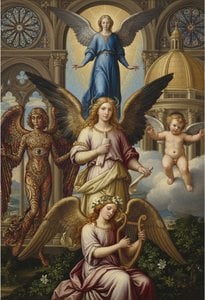
A Celestial Embrace: Exploring Roerich’s “Plafond”
Nicholas Roemerich's "Plafond," painted in 1913, is more than just a depiction of the night sky; it’s a profound meditation on humanity’s place within the vastness of the cosmos. This remarkable work, brimming with intricate detail and imbued with a spiritual sensibility, exemplifies Roerich’s unique artistic vision – one that seamlessly blended scientific observation with deeply held philosophical and religious beliefs. The painting immediately draws the eye to its central focus: a luminous circle dominated by a youthful figure, often interpreted as an angelic child or nascent human spirit, surrounded by a swirling tapestry of stars and planets.
- Subject Matter: The primary subject is a meticulously rendered night sky, capturing the beauty and mystery of celestial bodies.
- Central Figure: A prominent baby angel or child figure serves as the focal point, symbolizing innocence, potential, and connection to the divine.
- Composition: The overall composition creates a sense of depth and movement, drawing the viewer into the heart of the universe.
Roerich’s Visionary Style and Technique
Roerich was deeply influenced by both Russian Orthodox spirituality and his extensive travels – particularly to Central Asia and Tibet – where he encountered ancient symbols and beliefs related to the cosmos. “Plafond” reflects this influence through its use of vibrant, almost iridescent colors, achieved through a technique known as ‘verlona,’ which Roerich developed himself. This method involved layering thin glazes of paint, creating an ethereal glow that seems to emanate from within the canvas. The meticulous detail in depicting constellations and planets demonstrates his dedication to scientific accuracy, reflecting his belief that art should be informed by knowledge.
The painting’s texture is rich and tactile, achieved through multiple layers of paint built up over time. This technique not only adds depth but also contributes to the overall sense of wonder and awe evoked by the scene. The brushwork is precise yet fluid, conveying both a scientific understanding of celestial mechanics and an emotional connection to the beauty of the universe.
Symbolism and Historical Context
"Plafond" was created during a period of significant intellectual and spiritual ferment in early 20th-century Russia. Roerich’s work aligns with broader trends of interest in esoteric knowledge, comparative religion, and the search for universal truths. The painting's symbolism is rich with layers of meaning, referencing ancient myths, religious iconography, and philosophical concepts related to creation, humanity’s destiny, and the interconnectedness of all things. The title itself, “Plafond,” suggests a ceiling or dome – a traditional symbol of heaven or the cosmos – further emphasizing the painting's spiritual dimension.
Painted in 1913, just before World War I dramatically reshaped Europe, "Plafond" represents a moment of relative peace and optimism within Roerich’s artistic trajectory. It stands as a testament to his enduring belief in humanity’s potential for harmony and understanding.
Emotional Impact and Artistic Legacy
"Plafond" possesses a powerful emotional impact, inviting viewers to contemplate their place in the universe and to connect with something larger than themselves. The painting's luminous quality and evocative imagery create a sense of serenity and wonder, while its complex symbolism encourages deeper reflection. Nicholas Roerich’s work continues to resonate today, demonstrating his mastery of technique, his profound spiritual vision, and his enduring legacy as one of the 20th century’s most important artists.
Kysymykset ja vastaukset
Mitä Nikolai Roerich:n "Plafond" esittää ja millainen on sen tunnelma?
Nikolai Roerich:n "Plafond" yhdistää night sky, celestial bodies, angel figure, nicholas roerich, cosmic wonder, symbolic art, russian artist-aiheet Ethereal-tunnelmaan.
Mihin käyttöön Nikolai Roerich:n "Plafond" -teoksen reproduktio soveltuu?
Nikolai Roerich:n "Plafond"-teoksen suositeltu käyttötarkoitus on Statement. Se soveltuu kuitenkin myös muihin tarkoituksiin.
Mistä voin ostaa digitaalisen kuvan teoksesta Nikolai Roerich:n "Plafond"?
Teoksen Nikolai Roerich:n "Plafond" digitaalisen kuvan voi ostaa sen Digitaalinen teos -sivulta: korkearesoluutioinen digitaalinen kuvalataus.



 Esikatselu
 Osta käsinmaalattu taideteos
 Jaa teos
 Jaa
Jaa
 Tiedot
 Opas
Opas

 Lataa kuva
 Samanlaisia kohteita
 Röntgenkuvaus
 Diaesitys
 Q&A
Q&A Tilastot

 Lue lisää






































 Lasivaihtoehto on saatavilla vain alle 110 cm kokoisille teoksille