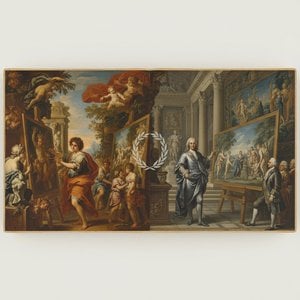
Michel Dorigny’s “L’Asie”: A Window into Baroque Serenity
Michel Dorigny's "L’Asie," painted in 1653, is more than just a depiction of an allegorical scene; it’s a meticulously crafted meditation on prosperity, dominion, and the quiet grandeur characteristic of the French Baroque. Born in Saint-Quentin, Dorigny was deeply influenced by the humanist scholarship prevalent at the Académie de peinture et de sculpture, grounding his artistic practice in classical principles while embracing the dynamism of the era. This painting, now housed within the Louvre Museum, offers a rare glimpse into a world where idealized beauty and symbolic weight converge to create an enduring image of power and grace.
The composition immediately draws the eye to a reclining female figure, embodying Asia itself. Her posture is one of serene authority, her gaze direct yet contemplative. Above her, an angel, rendered with delicate precision, extends branches laden with laurel leaves – a potent symbol of victory, honor, and divine recognition. The scene unfolds within a richly ornamented interior, suggesting a royal court or a grand palace, further reinforcing the theme of imperial power. Dorigny’s skill lies not merely in replicating reality but in imbuing it with layers of meaning through carefully chosen elements.
A Symphony of Color and Technique
Dorigny's masterful technique is immediately apparent in the painting’s luminous quality and subtle gradations of tone. He employs a restrained palette dominated by muted pinks, blues, creams, and yellows – colors that evoke a sense of age and tranquility, as if reflecting upon centuries of history. The brushstrokes are deliberate yet refined, creating a smooth surface punctuated by delicate highlights that capture the play of light on fabric and skin. The artist’s use of layering—a hallmark of Baroque painting—builds depth and richness, allowing the eye to wander across the intricate details of the drapery and the angel's wings.
Notably, Dorigny demonstrates a keen understanding of perspective, though it is somewhat flattened compared to later Renaissance approaches. This deliberate choice contributes to the overall atmosphere of serenity, avoiding jarring contrasts and maintaining a sense of harmonious balance. The composition’s verticality emphasizes the figure’s centrality, while the surrounding elements serve to amplify her importance within the scene.
Symbolism and Historical Context
“L’Asie” is deeply rooted in the symbolic language of its time. The laurel branches, a traditional emblem of victory and honor, suggest Asia's dominion and prosperity. The crown adorning the figure further reinforces this notion of imperial authority, while the pearls scattered around her symbolize wealth, purity, and divine favor. These symbols, combined with the allegorical representation of the continent itself, create a complex tapestry of meaning that speaks to the political and cultural climate of 17th-century France.
Painted during the reign of Louis XIV, “L’Asie” reflects the grandeur and ambition of the French monarchy. The Baroque style, with its emphasis on drama, emotion, and opulent decoration, was favored by the court as a means of projecting power and prestige. Dorigny's work exemplifies this trend, offering a visually stunning representation of an idealized vision of Asia—a testament to both artistic skill and historical context.
A Timeless Appeal
“L’Asie” endures not merely as a beautiful painting but as a poignant meditation on power, prosperity, and the enduring allure of classical ideals. Dorigny's meticulous attention to detail, combined with his masterful use of color and symbolism, creates an image that is both captivating and deeply resonant. It invites viewers to contemplate the complexities of human ambition and the timeless beauty of the Baroque aesthetic. Reproductions of this remarkable work offer a chance to bring this serene vision into any space, evoking a sense of quiet grandeur and historical significance.



 Esikatselu
 Osta printti
 Jaa
Jaa Jaa
Jaa
 Tarkemmat tiedot

 Lataa
Lataa
 Samanlaisia
 Röntgenkuva
 Diaesitys


 Näytä lisää






































 Lasivaihtoehto on saatavilla vain alle 110 cm kokoisina teoksina