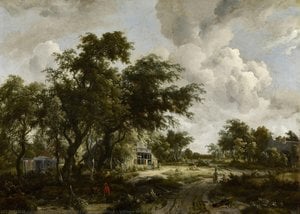
A Serene Woodland Vision – Unveiling “La Forêt de Chênes”
Meindert Hobbema’s “La Forêt de Chênes,” a captivating landscape painting from the late 17th century, isn't merely a depiction of a forest; it’s an immersive experience. Painted during a period of relative obscurity for the artist himself, yet increasingly appreciated in later decades, this work embodies the quiet grandeur and atmospheric depth that defined the Dutch Golden Age. Hobbema, a devoted pupil of Jacob van Ruysdael, masterfully captures the essence of the Dutch countryside – not through dramatic vistas or heroic figures, but with an exquisite sensitivity to light, texture, and the subtle poetry of nature. The painting transports us to a cool, dappled woodland, where sunlight filters through the dense canopy, casting long shadows and illuminating patches of moss-covered earth.

The Language of Light and Shadow – Technique and Style
Hobbema’s technique is characterized by a remarkable layering of paint, creating an astonishingly realistic sense of depth and texture. He employs atmospheric perspective with exquisite precision—distant trees fade into a hazy blue-grey, while the foreground oaks stand proud and detailed, their rough bark rendered with meticulous care. The brushstrokes are visible yet controlled, contributing to the painting’s overall sense of realism without sacrificing elegance. The color palette is predominantly earthy – deep greens, browns, and greys dominate, punctuated by subtle hints of yellow and orange in the foliage, suggesting a late afternoon sun. This masterful use of light and shadow isn't simply decorative; it evokes a profound feeling of tranquility and solitude. The composition itself—a winding path leading into the heart of the forest—draws the viewer’s eye deeper into this serene world.
A Dutch Golden Age Masterpiece – Historical Context
“La Forêt de Chênes” is a quintessential example of the Dutch Golden Age landscape tradition. Following in the footsteps of Jacob van Ruysdael, Hobbema focused on capturing the beauty of the Netherlands’ rural landscapes—not grand historical scenes or mythological narratives, but intimate glimpses into everyday life and the natural world. During this period, the Dutch Republic was experiencing a flourishing economy and a burgeoning artistic scene, and landscape painting became increasingly popular as a means of celebrating the country's prosperity and its connection to nature. Hobbema’s work reflects this cultural shift, offering a contemplative escape from the bustle of urban life.
Symbolism and Emotional Resonance – More Than Just a Landscape
Beyond its technical brilliance, “La Forêt de Chênes” resonates with deeper symbolic meaning. The towering oaks, often associated with strength, longevity, and wisdom, stand as silent witnesses to the passage of time. The winding path invites us on a journey of discovery, suggesting a connection between humanity and nature. The painting’s overall mood is one of peaceful contemplation—a reminder of the beauty and serenity that can be found in the natural world. It's a scene designed not just to be observed, but to be felt – a quiet invitation to slow down, breathe deeply, and connect with something larger than ourselves.
Bringing “La Forêt de Chênes” into Your Space
Reproductions of Hobbema’s “La Forêt de Chênes” offer a beautiful way to bring this timeless masterpiece into your home or office. Whether you choose a large-scale canvas print or a smaller metal poster, the painting's atmospheric depth and serene beauty will undoubtedly enhance any space. Consider framing it in a natural wood frame to complement the artwork’s earthy tones, or displaying it alongside other landscape paintings from the Dutch Golden Age for a cohesive and visually stunning collection.



 Esikatselu
 Osta käsintehty maalaus
 Jaa
Jaa Jaa
Jaa
 Tarkemmat tiedot

 Lataa
Lataa
 Samanlaisia
 Röntgenkuva
 Diaesitys
 Stats
Stats

 Näytä lisää






































 Lasivaihtoehto on saatavilla vain alle 110 cm kokoisina teoksina