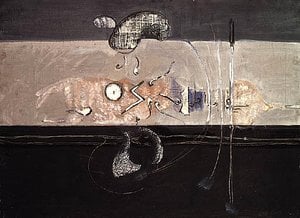
Tällä sivulla esitettyä taideteosta suojaa tekijänoikeuslaki, mikä tarkoittaa, ettemme voi laillisesti luoda tai myydä täsmälleen samanlaista jäljennöstä. Tämä suoja toteutetaan kansainvälisten sopimusten, kuten esimerkiksi Berne-konventio ja kansallisilla laeilla, mukaan lukien niillä määritellyt Yhdysvaltain tekijänoikeuslaki – Luku 17. Kaikki oikeudet pidätetään. Luvaton kopiointi tai jäljittely on kielletty.
Tämä menetelmä noudattaa täysin tekijänoikeussäännöksiä, sillä se ei sisällä suojatun taideteoksen kopioimista tai jäljentämistä. Sen sijaan kyseessä on luova uudelleentulkinta – uusi maalaus, joka ammentaa vaikutteita alkuperäisestä, mutta ei ole sen identtinen kopio.
Museolaatuisia giclée- tai kankaitaulun tulosteita nopealla tuotannolla ja joustavilla viimeistelyvaihtoehdoilla. ( Osta käsinmaalattu taideteos Siirry digitaaliseen kuvaan)
Valitse valmiista mitoistamme sellaiset, jotka vastaavat teoksen alkuperäisiä mittasuhteita.

Syötä tarvitsemasi leveys ja korkeus, jotta tuloste sopii kehyksiisi tai seinällesi. Tulostetta voidaan vain leikata, sitä ei voida koskaan suurentaa alkuperäistä kuvaa suuremmaksi, joten eri muotoinen koko aiheuttaa osan kuvasta katoamisen. Lähetämme sinulle digitaalisen mallikuvan hyväksyttäväksi ennen kuin aloitamme tulostuksen. Tällä sivulla näkyvä kuva ei näytä lopullista rajausta — vain mallikuva näyttää sen.
Maailmanlaajuinen toimitus () 2 viikossa tavallisen 4–5 viikon sijaan. (14 marraskuu)
Bathroom Composition
Replikaatin koko

John Keates, born March 30th, 1773, in Wells, Somerset, was a British schoolmaster whose artistic legacy extends far beyond his modest academic pursuits. He stands as a pivotal figure within the Pre-Raphaelite Brotherhood—a movement that championed idealized beauty and meticulous observation—and his paintings offer a unique glimpse into the aesthetic sensibilities of Victorian England.
Early Life & Education: Keates’s upbringing in a stable-keeper’s family instilled in him an appreciation for craftsmanship and detail, shaping his artistic approach. He excelled at Eton College, demonstrating exceptional talent in Latin and Greek—subjects considered crucial for cultivating intellectual rigor.
Cambridge Years & Literary Influences: Keates pursued his studies at Cambridge University, earning prestigious accolades including the Browne Medal and Craven Scholarship. His exposure to Romantic poets like Wordsworth and Coleridge profoundly impacted his worldview and artistic vision, fostering a fascination with nature’s sublime grandeur.
Career as Schoolmaster & Artistic Development: Following graduation, Keates embarked on a career as a schoolteacher—a profession he embraced wholeheartedly—and honed his artistic skills through meticulous observation of the natural world. His landscapes, characterized by serene compositions and subtle tonal gradations, exemplify the Pre-Raphaelite commitment to capturing fleeting moments of beauty.
The Pre-Raphaelite Brotherhood & Artistic Style: Keates joined the Pre-Raphaelite Brotherhood in 1848—a collective dedicated to reviving artistic ideals considered lost under the influence of Michelangelo and Raphael. His paintings reflect this movement’s stylistic hallmarks: luminous color palettes, precise draughtsmanship, and a preoccupation with mythological subjects—particularly those rooted in classical antiquity.
Notable Works & Legacy: Keates produced approximately 150 paintings during his lifetime, showcasing an impressive range of subject matter—from Venetian interiors to Tuscan landscapes—and demonstrating remarkable technical proficiency. His work continues to inspire admiration for its understated elegance and profound sensitivity to the visual arts, securing his place as one of the Pre-Raphaelite Brotherhood’s most distinguished practitioners.
Keates' fascination with Italy—particularly Venice—fueled his artistic endeavors. He traveled extensively throughout Europe during his formative years, immersing himself in the cultural milieu of the Renaissance and Baroque periods. This experience profoundly shaped his aesthetic sensibilities, informing his compositional choices and color palettes.
Tuscan Landscapes: Conversely, Keates' Tuscan landscapes convey a sense of tranquility and contemplative beauty. His canvases depict rolling hills bathed in golden sunlight—a deliberate homage to Raphael’s idealized depictions of Arcadia—reflecting the Pre-Raphaelite yearning for pastoral serenity.
Keates’s artistic sensibilities were undeniably shaped by his admiration for Raphael—the Renaissance painter whose frescoes in the Vatican adorned with mythological subjects served as a model for Pre-Raphaelite artists. He sought to emulate Raphael’s mastery of color and form, striving to achieve an aesthetic ideal rooted in classical antiquity.
Color Palette & Compositional Harmony: Like Raphael, Keates favored luminous color palettes—particularly golds and reds—creating canvases that shimmered with radiant brilliance. He meticulously crafted compositions—often employing symmetrical arrangements—to convey a sense of balance and harmony—reflecting the Pre-Raphaelite belief in visual order.
“SI RO MA MAU” stands as Keates’s most celebrated painting—a monumental landscape that embodies the Pre-Raphaelite commitment to capturing atmospheric perspective and conveying profound emotional resonance. The artwork is notable for its masterful depiction of a Tuscan hillside bathed in golden sunlight.
Emotional Expression: The painting’s serene composition—characterized by horizontal lines and gentle curves—evokes a sense of tranquility and contemplative beauty—reflecting Keates’s profound sensitivity to the visual arts. Its muted color palette—dominated by golds and browns—contributes to an overall mood of solemn grandeur.
John Keates' artistic legacy endures as a testament to his unwavering dedication to craftsmanship, observation, and imaginative exploration. His paintings—characterized by understated elegance and profound emotional depth—continue to captivate audiences worldwide—affirming his place as one of the Pre-Raphaelite Brotherhood’s most distinguished practitioners.

Englanti

Transform your bathroom with icons from Van Eyck to Warhol. Find curated museum-quality art on WahooArt.com. Explore the full collection online.

Discover how curated masterworks transform hotel interiors into immersive brand journeys. Explore the neuroaesthetics of hospitality, from bespoke oil reproductions to large-scale murals, designed to elevate guest experience and drive luxury brand loyalty through intentional art curation.
 Esikatselu
 Jaa teos
 Jaa
Jaa
 Tiedot
 Opas
Opas

 Lataa kuva
 Samanlaisia kohteita
 Röntgenkuvaus
 Diaesitys
 Kysymykset ja vastaukset
 Tilastot
 Lue lisää






































 Lasivaihtoehto on saatavilla vain alle 110 cm kokoisille teoksille