Taiteilijan elämäkerta
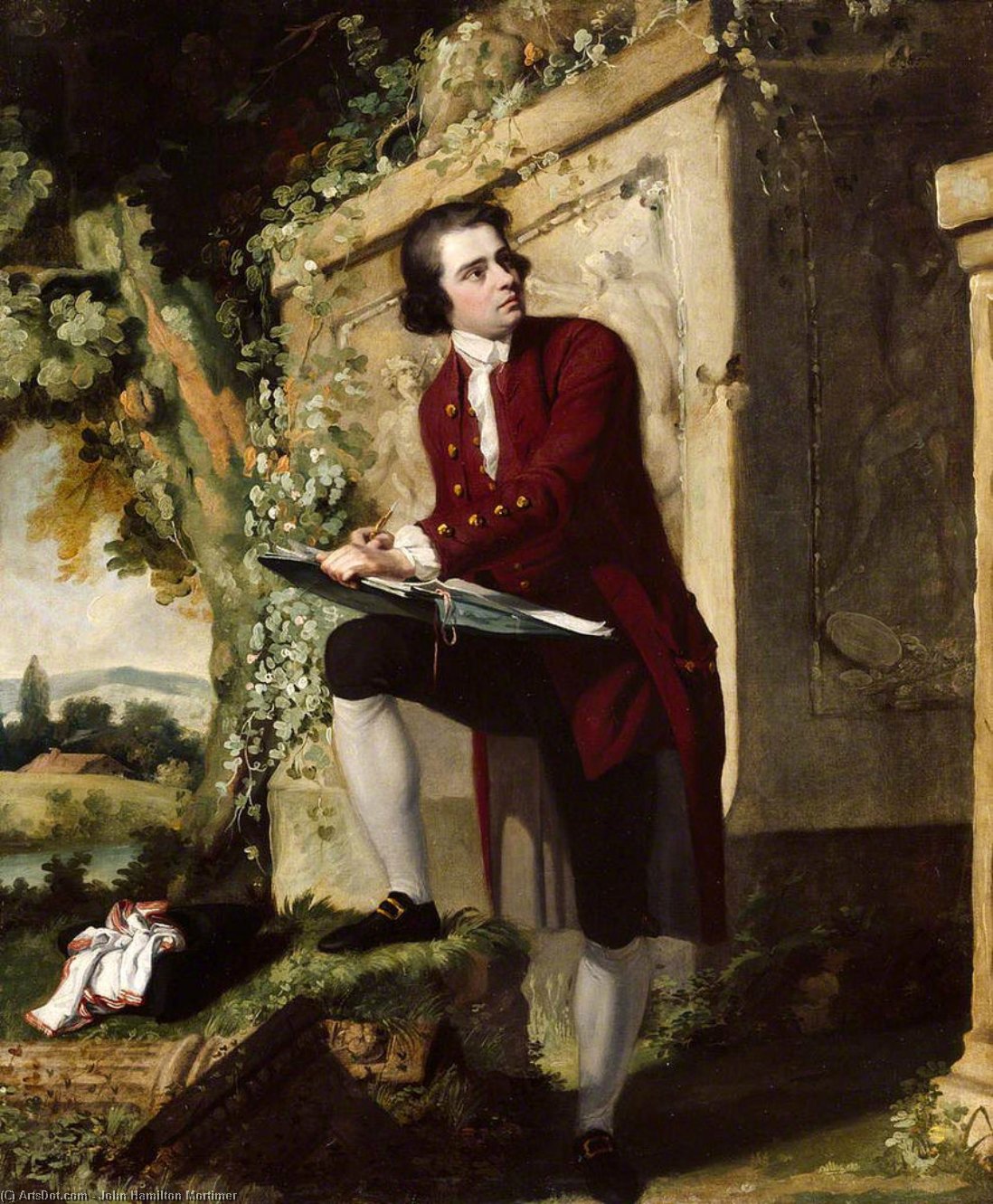
John Hamilton Mortimer (1740–1779): Bridging Classical Tradition and Romantic Vision
John Hamilton Mortimer, a name perhaps less instantly recognizable than his contemporaries like Reynolds or Wright of Derby, nevertheless occupies a significant and fascinating niche within the landscape of 18th-century British art. Born in Eastbourne in 1740, Mortimer’s brief but intensely productive life—he died at just thirty-nine years old—was marked by artistic ambition, a restless spirit, and an evolving style that mirrored the shifting tastes of his era. His father, Thomas Mortimer, a customs officer with mercantile interests, provided a stable if unremarkable background for a young man destined to pursue a path steeped in creativity. By 1757, Mortimer had already gravitated towards London, enrolling at the prestigious Duke of Richmond’s Academy, where he forged a lifelong friendship with Joseph Wright, a bond that would prove mutually supportive throughout their careers. This early immersion into the artistic milieu fostered not only technical skill but also an awareness of the burgeoning intellectual currents shaping British art. He studied alongside other promising talents like Thomas Jones and William Pars at St Martin’s Lane Academy, further honing his abilities under the tutelage of masters such as Cipriani, Robert Edge Pine, and Sir Joshua Reynolds himself.
### Early Influences and Artistic Training
Mortimer's formative years were characterized by a dedication to classical principles. He began his artistic education at the Duke of Richmond’s Academy, absorbing the lessons of influential instructors who championed the ideals of antiquity. This grounding in Greco-Roman art instilled within him a meticulous attention to detail and an understanding of compositional balance—qualities that would permeate his subsequent paintings. Notably, he befriended Joseph Wright, whose groundbreaking landscapes captivated audiences with their dramatic realism and masterful use of light and shadow. Their collaboration cemented Mortimer’s commitment to capturing the grandeur of nature while simultaneously exploring its emotional resonance. Furthermore, he honed his skills at St Martin's Lane Academy alongside fellow artists like Thomas Jones and William Pars, absorbing techniques from masters who prioritized accuracy and expressive power. The influence of Giovanni Battista Cipriani, Robert Edge Pine, and Sir Joshua Reynolds—luminaries of the British art world—shaped Mortimer’s artistic vision and solidified his position within a vibrant intellectual community.
### From Michelangelo to Salvator Rosa: A Shift Towards Romantic Expression
Mortimer's initial output demonstrated a profound respect for classical tradition, evidenced by his studies after Michelangelo’s *Bacchus* and subsequent life drawings. These works showcased his mastery of anatomical accuracy and his ability to convey emotion through subtle gestures and facial expressions—skills honed under the guidance of Reynolds himself. However, Mortimer wasn’t content with merely replicating established styles; he possessed a keen sensitivity to evolving aesthetic preferences. Recognizing the burgeoning Romantic movement, he embraced the bold vision of Salvator Rosa, the Neapolitan painter celebrated for his wild, untamed scenes of outlaws and dramatic landscapes. This fascination with Rosa's expressive approach profoundly impacted Mortimer’s artistic style, prompting him to move away from the polished elegance favored by earlier generations towards depictions of rugged terrains populated by rebellious figures—a stylistic choice that foreshadowed the dominant aesthetic sensibilities of the coming century.
### Collaborative Projects and Decorative Commissions
Mortimer actively engaged in collaborative endeavors with fellow artists, bolstering his reputation and expanding his artistic repertoire. He frequently contributed figure work to compositions by Thomas Jones, notably on ambitious canvases like *A Land Storm, with the Story of Dido and Aeneas*, *The Death of Orpheus*, and a pair of paintings inspired by Milton’s *Allegro* and *Penseroso*. These collaborations underscored his versatility and willingness to contribute his skills to larger artistic undertakings. Moreover, he played a pivotal role in decorating Brocket Hall, Hertfordshire, alongside Francis Wheatley and James Durno—a prestigious commission that showcased his talent for creating immersive visual experiences. His involvement in this project cemented his standing within the art world and demonstrated his ability to translate conceptual ideas into compelling aesthetic realities.
### Legacy: A Pioneer of Romantic Landscape Painting
Despite his untimely demise at age 39, Mortimer left an indelible mark on British art history. His paintings—characterized by their dramatic compositions, expressive brushwork, and exploration of complex themes—offer a captivating glimpse into the artistic sensibilities of his time. He bridged the gap between classical traditions and the emerging Romantic movement, paving the way for future generations to embrace emotion, imagination, and narrative in their work. While initially dismissed by critics like Horace Walpole as merely an imitator of Salvator Rosa, Mortimer’s oeuvre has since garnered renewed appreciation—a testament to his enduring artistic vision and a recognition of his contribution to the evolution of British landscape painting. His works continue to inspire artists and captivate audiences today, securing his place as a pivotal figure in the history of Romantic art.



 Esikatselu
 Osta käsintehty maalaus
 Jaa
Jaa Jaa
Jaa
 Tarkemmat tiedot

 Lataa
Lataa
 Samanlaisia
 Röntgenkuva
 Diaesitys
 Näytä lisää






































 Lasivaihtoehto on saatavilla vain alle 110 cm kokoisina teoksina





