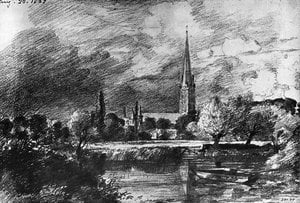
A Pastoral Vision: Unveiling Constable’s ‘Landscape Evening’
John Constable's *Landscape Evening*, painted in 1812, is more than just a depiction of the English countryside; it’s an embodiment of Romantic ideals and a testament to the artist’s profound connection with nature. This oil on canvas (31 x 49 cm) invites viewers into a tranquil world where light, atmosphere, and emotion converge, offering a respite from the burgeoning industrialization of its time.
Subject & Composition: A Harmony of Rural Life
The painting presents a quintessential English scene – a gently undulating field dotted with grazing cattle. Constable masterfully arranges these elements to create a sense of depth and spaciousness. The cows, rendered with varying degrees of detail depending on their distance from the viewer, populate the foreground and recede into the middle ground. Two horses add further life to the landscape, subtly positioned to balance the composition. A winding path suggests human presence without explicitly featuring figures, emphasizing nature’s dominance. The horizon line is low, allowing the expansive sky to command attention, a characteristic feature of Constable's work.
Style & Technique: Romanticism in Brushstrokes
*Landscape Evening* exemplifies the principles of English Romanticism. Unlike the precise, classical landscapes that preceded it, Constable’s approach is characterized by *expressive brushwork* and an emphasis on capturing fleeting atmospheric effects. He doesn't strive for photographic realism but rather seeks to convey his subjective experience of the scene – the feeling of warmth, peace, and connection with the natural world. His technique involves layering paint in loose, visible strokes, creating a textured surface that seems to shimmer with light. This approach would heavily influence later movements like Impressionism.
Light & Atmosphere: The Essence of Romantic Feeling
The painting’s most striking feature is its masterful use of light. A warm, golden glow emanates from the evening sky, bathing the landscape in a soft radiance. Constable expertly renders the subtle gradations of light and shadow, highlighting the textures of the field and the forms of the animals. This interplay of light isn't merely descriptive; it’s *emotional*. It evokes a sense of tranquility, nostalgia, and reverence for nature’s beauty. The atmospheric perspective – where distant objects appear paler and less defined – further enhances the illusion of depth and creates a dreamlike quality.
Historical Context & Constable’s Place in Art History
Constable emerged during a period of significant social and political change. While Britain was undergoing rapid industrialization, artists like Constable sought solace and inspiration in the countryside. His work represented a deliberate rejection of the increasingly urbanized world and a celebration of traditional rural life. He challenged the established hierarchy of subject matter within painting, elevating landscapes to the same status as historical or portraiture paintings. Though initially met with resistance from some critics, his influence grew steadily, particularly in France where he inspired artists of the Barbizon School.
Symbolism & Emotional Impact
While not overtly symbolic, *Landscape Evening* resonates with deeper meanings. The grazing cattle represent abundance and pastoral harmony. The peacefulness of the scene suggests a longing for simpler times and a connection to the land. For Constable, nature wasn’t just a subject; it was a source of spiritual renewal and emotional sustenance. The painting invites viewers to share in this experience, offering a moment of quiet contemplation and escape from the pressures of modern life.
Constable's Other Notable Works
- Cenotaph to the Memory of Sir Joshua Reynolds: A grand commemorative work showcasing Constable’s skill in composition and historical painting.
- The Entrance to Fen Lane: Another evocative landscape demonstrating his mastery of light and atmosphere.
- A View near Flatford Mill: Perhaps his most famous work, capturing the idyllic beauty of the Stour Valley.
Conclusion: A Timeless Masterpiece
John Constable’s *Landscape Evening* remains a captivating and enduring work of art. Its serene beauty, masterful technique, and profound emotional resonance continue to inspire viewers today. It is a testament to the power of landscape painting to evoke feelings of peace, tranquility, and connection with the natural world – qualities that are as relevant now as they were in 1812.