


x


Käsinmaalattu öljyväri kankaalle haluamassasi koossa ja kehyksissä, taiteilijoidemme valmistamana tilauksesta.





























Valitse valmiista mitoistamme sellaiset, jotka vastaavat teoksen alkuperäisiä mittasuhteita.

Voit syöttää omat mitat sopimaan tiettyyn kehykseen tai tilaan. Jos valitsemasi koko ei vastaa alkuperäisen kuvan mittasuhteita, rajaamme taideteoksen tai jatkamme maalausta käsin maalatuilla elementeillä. Digitaalinen esikatselu lähetetään hyväksyttäväksi ennen tuotannon aloittamista.
Huomioithan, että näytöllä oleva esikatselu ei vastaa todellista rajausta tai jatkamista. Vain digitaalinen mallikuva näyttää lopullisen sommittelun tarkasti.
Vaikka mittatilaustyöt ovat mahdollisia, suosittelemme valitsemaan mitan ennalta määritetystä listasta alkuperäisten mittasuhteiden säilyttämiseksi.
Maailmanlaajuinen toimitus () 3–4 viikossa tavallisen 5 viikon sijaan. (1 heinäkuu). Laadusta ei tingitä.


Villa Falconieri
Replikaatin koko
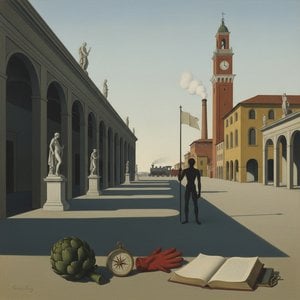
Giorgio de Chirico's Villa Falconieri isn’t merely a depiction of an Italian estate; it’s a meticulously crafted portal into a realm of unsettling beauty, a visual distillation of memory and melancholy. Painted in 1920, this oil on canvas transports the viewer to a space simultaneously familiar and profoundly strange – a place where classical grandeur collides with the disquieting logic of dreams. The painting immediately establishes an atmosphere of profound stillness, punctuated by sharp contrasts between light and shadow, creating a sense of suspended time, as if the scene is caught in an eternal afternoon.
The composition itself is a masterclass in controlled disorientation. A stately villa, its façade hinting at centuries of history, dominates the center, yet it’s subtly obscured by the towering presence of cypress trees – symbols deeply rooted in Italian culture, often associated with mourning and remembrance. These dark sentinels frame the building, casting long, dramatic shadows that stretch across the meticulously rendered landscape. The placement of two small figures—a man engaged in a mundane task and another seemingly lost in thought—adds a human element to this otherwise monumental scene, inviting us to contemplate our own place within this enigmatic space. The perspective is deliberately skewed, creating an unsettling sense of depth and drawing the eye into the painting’s heart.
De Chirico's style during this period—often referred to as “metaphysical art”—is instantly recognizable. It’s a synthesis of realism and surrealism, where everyday objects are imbued with symbolic weight and placed within illogical spatial arrangements. Notice the meticulous detail in the stonework of the villa, contrasted against the slightly blurred quality of the distant landscape – a technique that contributes to the painting's dreamlike atmosphere. The visible brushstrokes, applied with a deliberate looseness, add texture and a sense of immediacy, as if the artist is inviting us into his creative process.
The color palette is deliberately restrained, dominated by cool blues, greens, and grays – colors that evoke a sense of twilight or early morning. Subtle touches of warmer tones—in the stonework and the figures’ clothing—provide moments of visual relief, preventing the scene from becoming entirely bleak. The sky itself shifts between pale blues and deep indigos, mirroring the emotional complexity of the artwork.
Villa Falconieri is steeped in symbolism, reflecting de Chirico’s fascination with mythology, philosophy, and the subconscious. The villa itself represents a bygone era of aristocratic grandeur, while the cypress trees evoke themes of mortality and remembrance. The figures in the foreground are deliberately ambiguous, their actions suggesting contemplation or perhaps even alienation – mirroring the anxieties of modern life that were prevalent at the time. De Chirico drew heavily from the writings of philosophers like Schopenhauer and Nietzsche, exploring ideas of irrationality, the nature of reality, and the subjective experience of time.
Painted in 1920, during a period of significant social and political upheaval in Europe, the artwork can be interpreted as a reflection on the loss of tradition and the anxieties associated with modernity. The painting’s unsettling atmosphere speaks to a deeper sense of unease—a feeling that something is fundamentally out of place or missing.
Villa Falconieri remains one of de Chirico's most iconic works, exemplifying his unique ability to capture the essence of dreamlike visions. It’s a painting that rewards repeated viewing, revealing new layers of meaning and emotional resonance with each encounter. Reproductions of this artwork offer a powerful way to bring its haunting beauty into your home or office—a reminder of the enduring power of art to transport us beyond the confines of reality.


1888 - 1978 , Suomi

Explore the dramatic power of Baroque landscape painting! Discover Rembrandt, Vermeer & Caravaggio's techniques, symbolism & lasting influence. Expert insights for art lovers & collectors at WahooArt.

Discover the captivating world of Georges de La Tour, a Baroque master renowned for his dramatic chiaroscuro & spiritual realism. Explore key works, influences, and his remarkable rediscovery. Learn more at WahooArt.

Discover art selection strategies for stunning Mediterranean villa interiors. Expert guidance on harmonizing space, light & legacy. Elevate your home with timeless elegance – curated collections & bespoke solutions.
Explore the captivating world of Giorgio de Chirico and his groundbreaking Metaphysical painting movement. Discover the philosophical depths & surreal imagery that influenced generations of artists. Learn more at WahooArt.

Explore the dramatic world of Baroque art! Discover iconic masters like Caravaggio & Rembrandt, their techniques, and the movement's lasting impact. Expert insights for collectors & enthusiasts at WahooArt.


Pysy ajan tasalla uusimmista taideuutisista, eksklusiivisista tarjouksista ja sisustusideoista.
Kerro meille projektistasi, niin taideasiantuntijamme tarjoavat sinulle kolme henkilökohtaista taidesuositusta.
Anna meidän kuratoida 3 vaihtoehtoa juuri sinulle – Ilmaiseksi!
 Tilaa painos
 Jaa
Jaa Jaa
Jaa
 Details

 Lataa
Lataa
 Samanlaisia
 X-Ray
X-Ray Diaesitys








 Lue lisää
 Lasivaihtoehto on saatavilla vain alle 110 cm kokoisina teoksina


