Oil On Canvas
WallArt
Dutch Baroque Painting
1665
29.0 x 24.0 cm
Ermitažin museoMuseolaatuisia giclée- tai kankaitaulun tulosteita nopealla tuotannolla ja joustavilla viimeistelyvaihtoehdoilla. ( Osta käsintehty maalaus
Siirry digitaaliseen kuvaan)
Valitse valmiista mitoistamme sellaiset, jotka vastaavat teoksen alkuperäisiä mittasuhteita.
Voit syöttää omat mitat sopiaksesi tiettyyn kehykseen tai tilaan. Jos valittu koko ei vastaa alkuperäisen kuvan mittasuhteita, rajaamme teosta tai laajennamme kuvaa peilatulla tai yhtenäisellä reunalla. Digitaalinen mallikuva lähetetään hyväksyttäväksi ennen tuotannon aloittamista.
Huomaathan, että näytöllä näkyvä esikatselu ei vastaa lopullista rajausta tai laajennusta. Vain mallikuva näyttää lopullisen sommittelun tarkasti.
Vaikka räätälöityjä kokoja on saatavilla, suosittelemme valitsemaan mitat valmiista listasta alkuperäisten mittasuhteiden säilyttämiseksi.
Toimitus maailmanlaajuisesti () kahdessa viikossa tavallisen 4–5 viikon sijaan. (10 syyskuu)
The Violinist
Replikaatin koko
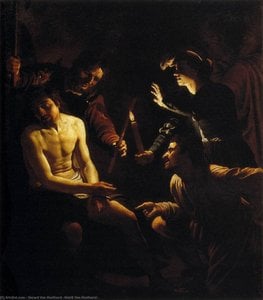
Gerard ter Borch’s “The Violinist,” painted circa 1665, stands as a quintessential example of Dutch genre painting during its golden age—a period characterized by meticulous observation of everyday life and an unparalleled mastery of light and texture. More than just a portrait, it's a carefully crafted tableau that invites contemplation on human emotion and artistic skill.
Captured in the Baroque style, Terborch’s technique is remarkable for its realism. He eschewed grand theatrical gestures, opting instead for a quiet scene focused on a single figure—a man seated at a table with two cups and bowls—engaged in playing the violin. The artist's meticulous attention to detail is evident in every brushstroke; observe how light dances across the varnished surface of the violin, illuminating its contours and creating an illusion of depth that transcends mere representation.
The painting emerged during a time when Dutch society was grappling with intellectual currents influenced by the Enlightenment. Terborch’s work reflects this shift towards rationalism while simultaneously retaining elements of traditional artistic conventions. Unlike earlier portraits that prioritized status and lineage, “The Violinist” delves into psychological nuance—the violinist's gaze is direct, conveying both concentration and perhaps a hint of melancholy. This focus on inner experience aligns with the broader humanist spirit of the era.
Music held profound significance in seventeenth-century Dutch culture, symbolizing intellect, refinement, and spiritual contemplation. The violin itself serves as a potent emblem—a tool for artistic expression and a conduit to emotion. Its placement on the table alongside simple objects like cups and bowls underscores Terborch’s intention to portray not just an individual but also his inner world. The careful arrangement contributes to the overall sense of serenity and understated beauty.
Terborch's genius lies in his ability to convey fleeting emotions with remarkable precision. “The Violinist” isn’t about grand pronouncements; it’s about capturing a single, contemplative moment—a man absorbed in his craft. The artist skillfully utilizes chiaroscuro—the dramatic interplay of light and shadow—to heighten the emotional resonance of the scene. This technique draws viewers into the violinist's inner life, prompting reflection on themes of solitude, passion, and artistic devotion.
According to Arthur K. Wheelock Jr., Ter Borch “established a new framework for subject matter, taking people into the sanctum of the home”, showing the figures’ uncertainties and expertly hinting at their inner lives. His influence as a painter, however, was later surpassed by Vermeer.
Gerard ter Borch was born in December 1617 in Zwolle in the province of Overijssel in the Dutch Republic. He received an excellent education from his father Gerard ter Borch the Elder, also an artist, and developed his talent very early.
The inscription on a study of a head proves that Ter Borch was at Amsterdam in 1632, where he studied possibly under Willem Cornelisz Duyster or Pieter Codde. Duyster's influence can be traced in a picture bearing the date 1638, in the lonides Bequest (Victoria and Albert Museum). In 1634 he studied under Pieter de Molijn in Haarlem.
- **The Letter**: A masterpiece showcasing ter Borch’s skill in capturing texture and light.
- **The Gallant Conversation**: Engraved by Johann Georg Wille, this piece exemplifies the artist's ability to convey nuanced emotions.
- **Man on horseback (1634)**: An early work demonstrating ter Borch’s emerging talent.
- **Adrian Pauw’s arrival in Münster (1646)**: A significant piece that highlights the artist's narrative capabilities.
- The Hermitage: With six of his works, it boasts one of the largest collections.
- Berlin Museum: Features six pieces, showcasing ter Borch’s international appeal.
- Getty Center: Three of his paintings are part of this esteemed collection.
Ter Borch's influence on Dutch painters like Gabriel Metsu, Gerrit Dou, Eglon van der Neer, and Johannes Vermeer is well-documented. His innovative approach to genre painting has made him a pivotal figure in the history of art.

1617 - 1681 , Alankomaat