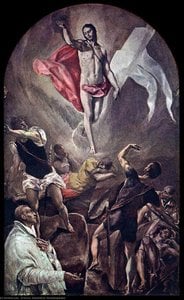
The Resurrection of Christ – A Baroque Masterpiece by Gerard Seghers
Gerard Seghers’s “La Résurrection du Christ” is not merely a depiction of a biblical event; it's a visceral embodiment of faith, triumph, and divine grace. Painted in the early 17th century during a period of intense religious fervor within the Flemish Baroque movement, this monumental work transcends its historical context to resonate powerfully with viewers today. Seghers, deeply influenced by the dramatic innovations of Caravaggio, masterfully employs light, color, and dynamic composition to convey the profound spiritual significance of Christ’s resurrection – a moment that fundamentally reshaped Christian belief.
The painting immediately commands attention through its sheer scale and theatrical intensity. Centered within a pyramidal structure, Christ ascends from an open tomb, his figure bathed in a radiant light that seems to emanate directly from the heavens. This isn’t a gentle, serene ascension; it's a forceful surge upwards, conveying both physical movement and spiritual elevation. The composition is deliberately crowded, teeming with figures – angels bearing banners adorned with crosses, grieving women, and onlookers rendered in varying states of awe and disbelief. Seghers skillfully uses overlapping forms and dramatic foreshortening to create a sense of depth and immediacy, pulling the viewer directly into the heart of the scene.
A Symphony of Color and Light – Baroque Techniques
Seghers’s mastery lies in his command of color and light—elements central to the Baroque aesthetic. He employs a rich, saturated palette dominated by deep reds, earthy browns, and shimmering golds, evoking both earthly passion and divine splendor. The stark contrasts between light and shadow, or *chiaroscuro*, are particularly striking, highlighting Christ’s luminous form while simultaneously casting dramatic shadows across the surrounding figures. This technique not only adds depth and volume but also imbues the scene with a palpable sense of drama and emotional intensity. Notice how the golden hues of the angels' garments contrast sharply with the somber tones of the tomb, further emphasizing Christ’s victory over death.
The artist’s brushwork is deliberately visible, contributing to the painting’s textured surface and conveying a sense of immediacy and energy. Layers of paint are applied in broad strokes, creating a dynamic interplay between smooth areas and rougher textures – particularly evident in the drapery and the stone of the tomb. This technique, characteristic of Baroque art, adds a layer of physicality to the scene, making it feel both monumental and intensely human.
Symbolism and Spiritual Resonance
Beyond its visual drama, “La Résurrection du Christ” is laden with symbolic meaning. The flag bearing the cross is a potent emblem of Christian faith, representing the sacrifice and resurrection of Jesus. The angels, depicted as messengers of divine grace, symbolize God’s intervention in human affairs. The expressions on the faces of the onlookers – ranging from profound grief to ecstatic joy – reflect the diverse range of emotions evoked by this pivotal event. The inclusion of the grieving women, traditionally Mary Magdalene and Mary at the tomb, underscores the personal impact of Christ's resurrection on humanity.
Interestingly, the painting’s roots lie in a complex interplay of artistic influences. Seghers was deeply influenced by Caravaggio’s dramatic use of light and shadow, as well as Bartolomeo Manfredi, another prominent Caravaggisti painter. However, Seghers developed his own distinctive style, characterized by a greater emphasis on composition and a more refined handling of color. The painting's historical context is also significant; it was created during a period of intense religious debate and reform within the Catholic Church, reflecting the era’s fervent spiritual atmosphere.
A Legacy of Dramatic Faith
“La Résurrection du Christ” stands as a testament to Gerard Seghers’s artistic genius and his profound understanding of Christian iconography. It's more than just a historical depiction; it’s an emotionally charged meditation on faith, sacrifice, and the promise of eternal life. The painting continues to captivate viewers with its dramatic intensity, masterful technique, and enduring symbolism – a powerful reminder of the transformative power of Christ’s resurrection.



 Esikatselu
 Vaihda tulosteeseen
 Jaa
Jaa Jaa
Jaa
 Tarkemmat tiedot

 Lataa
Lataa
 Samanlaisia
 Röntgenkuva
 Diaesitys
 Tilastot

 Näytä lisää