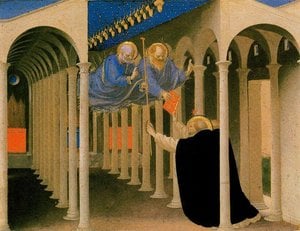
St Peter (1450) by Fra Carnevale, hand-painted oil painting reproduction by a master artist
Esikatselu Esikatsele AR-tilassa Vaihda tulosteeseen Siirry digitaaliseen kuvaan Jaa teos
Tiedot Opas Lisää suosikkeihin Lataa kuva Samanlaisia kohteita Röntgenkuvaus Diaesitys Q&A Tilastot

St Peter Hand-painted oil painting reproduction

Mitat
141.0 x 46.0 cm

Admire Fra Carnevale's 'St Peter,' a captivating 15th-century tempera painting showcasing the apostle’s solemnity and masterful use of light & shadow. A Renaissance masterpiece from Urbino.

Salaperäinen Fra Carnevale (n. 1420–1484) oli urbinolainen renessanssimaalari, tunnettu arkkitehtonisten taustojen ja perspektiivin mestaruudestaan. Hänen teoksensa vaikuttivat Bramanteseen ja Rafaeliin.

Käsinmaalattu öljyvärinen jäljennös

Käsinmaalattu öljyväri kankaalle haluamassasi koossa ja kehyksissä, taiteilijoidemme valmistamana tilauksesta. ( Vaihda tulosteeseen Siirry digitaaliseen kuvaan)

Corner sample of the P118B picture frame: valettu polystyreeni, 5 cm wide and 3 cm thick
P118B €10
Corner sample of the P118H picture frame: valettu polystyreeni, 5 cm wide and 3 cm thick
P118H €10
Corner sample of the P118W picture frame: valettu polystyreeni, 5 cm wide and 3 cm thick
P118W €10
Corner sample of the P438Z picture frame: valettu polystyreeni, 5.5 cm wide and 3.5 cm thick
P438Z €10
Corner sample of the P508JH picture frame: valettu polystyreeni, 7 cm wide and 3.5 cm thick
P508JH €12
Corner sample of the P508YH picture frame: valettu polystyreeni, 7 cm wide and 3.5 cm thick
P508YH €12
Corner sample of the P805H picture frame: valettu polystyreeni, 5 cm wide and 3.5 cm thick
P805H €10
Corner sample of the P805Z picture frame: valettu polystyreeni, 5 cm wide and 3.5 cm thick
P805Z €10
Corner sample of the P919BZ picture frame: valettu polystyreeni, 7 cm wide and 3.5 cm thick
P919BZ €10
Corner sample of the P919G picture frame: valettu polystyreeni, 7 cm wide and 3.5 cm thick
P919G €10
Corner sample of the P919XJ picture frame: valettu polystyreeni, 7 cm wide and 3.5 cm thick
P919XJ €10
Corner sample of the P959ZH picture frame: valettu polystyreeni, 5 cm wide and 3 cm thick
P959ZH €10
Corner sample of the P968JZ picture frame: valettu polystyreeni, 6 cm wide and 4 cm thick
P968JZ €12
Corner sample of the W106C picture frame: massiivipuu, 5 cm wide and 3 cm thick
W106C €8
Corner sample of the W218G picture frame: massiivipuu, 5 cm wide and 3 cm thick
W218G €10
Corner sample of the W218JH picture frame: massiivipuu, 5 cm wide and 3 cm thick
W218JH €8
Corner sample of the W218Y picture frame: massiivipuu, 5 cm wide and 3 cm thick
W218Y €10
Corner sample of the W307PJ picture frame: massiivipuu, 6 cm wide and 3 cm thick
W307PJ €10
Corner sample of the W316G picture frame: massiivipuu, 6 cm wide and 3 cm thick
W316G €10
Corner sample of the W316PJ picture frame: massiivipuu, 6 cm wide and 3 cm thick
W316PJ €8
Corner sample of the W316Y picture frame: massiivipuu, 6 cm wide and 3 cm thick
W316Y €10
Corner sample of the W398PJ picture frame: massiivipuu, 5 cm wide and 3 cm thick
W398PJ €8
Corner sample of the W4111J picture frame: massiivipuu, 6.5 cm wide and 3.5 cm thick
W4111J €10
Corner sample of the W500HY picture frame: massiivipuu, 7 cm wide and 5 cm thick
W500HY €15
Corner sample of the W500JH picture frame: massiivipuu, 7 cm wide and 5 cm thick
W500JH €15
Corner sample of the W692G picture frame: massiivipuu, 8 cm wide and 4 cm thick
W692G €12
Corner sample of the W849H picture frame: massiivipuu, 5 cm wide and 3 cm thick
W849H €8
Corner sample of the W940BG picture frame: massiivipuu, 7.5 cm wide and 4.5 cm thick
W940BG €15
Corner sample of the W953PJ picture frame: massiivipuu, 6 cm wide and 3.5 cm thick
W953PJ €8

Vakiokoko
räätälöity
CM
INCH

Valitse valmiista mitoistamme sellaiset, jotka vastaavat teoksen alkuperäisiä mittasuhteita.

leveys
korkeus

Kirjoita tarvitsemasi leveys ja korkeus, jotta teos sopii kehyksiisi tai seinällesi. Koska kyseessä on käsinmaalattu teos, taiteilija voi maalata hieman enemmän kuvan ympärille tai rajata sitä hieman, jos haluat eri muotoisen koon — valinta on sinun. Lähetämme sinulle digitaalisen mallikuvan hyväksyttäväksi ennen kuin maalaus alkaa. Tällä sivulla näkyvä kuva ei vastaa lopullista tulosta — vain mallikuva näyttää sen.

Esimerkkejä muokattavista asioista: Vaihda kasvot asiakkaan omaan valokuvaan; Lisää lemmikki (esim. korvaa kissa koiralla); Lisää taustalle piilotettu viesti; Muuta taustan maisemaa tai elementtejä.
Tilauksen jälkeen WahooArt.com -tiimi lähettää asiakkaalle sähköpostitse ohjeet ja esikatselukuvan

Maailmanlaajuinen toimitus () 3–4 viikossa tavallisen 5 viikon sijaan. (2 marraskuu). Laadusta ei tingitä.

Ilmainen pikatoimitus ympäri maailman
Korkealaatuinen pellavakangas
Kattava kuljetusvakuutus
Tulliveron palautustakuu
Takuu täydellisestä värien vastaavuudesta
100 päivän palautusoikeus (vain valmistusvirheet)
100% rahat takaisin -takuu
Määräalennus tarjolla

Kokonaishinta

€ 242

St Peter

Reproduktiotekniikka

Replikaatin koko

-

Kokonaishinta

€ 242

Pikaista tietoa

  • Notable elements: Architectural background
  • Title: St Peter
  • Year: 1450
  • Medium: Tempera on wood
  • Artistic style: Religious painting
  • Influences: Domenico Veneziano

The Enigmatic Figure of St. Peter

Fra Carnevale’s “St. Peter” is not merely a depiction of an apostle; it's a profound meditation on faith, leadership, and the very essence of human aspiration. Painted in 1450 during the vibrant heart of the Quattrocento Renaissance in Urbino, this tempera-on-wood panel offers a glimpse into the mind of an artist shrouded in mystery – a man whose output was remarkably small yet whose influence resonates through the works of his contemporaries and successors.

Fra Carnevale - St Peter

The painting immediately draws the eye to the figure of St. Peter, rendered in a three-quarter pose that was a hallmark of Renaissance portraiture – a technique designed to imbue the subject with both dignity and depth. He’s not presented as a triumphant warrior or a divine being, but rather as a man wrestling with his role, his responsibilities, and perhaps even his own mortality. The muted palette—primarily blues, browns, and ochres—creates an atmosphere of solemn contemplation, inviting the viewer to engage in a silent dialogue with the saint.

A Study in Perspective and Architectural Detail

Carnevale’s genius lies not just in his ability to capture human form but also in his masterful manipulation of perspective. While later scholars have debated the accuracy of his use, it's clear that he was deeply influenced by the burgeoning field of linear perspective, a revolutionary concept championed by artists like Filippo Brunelleschi and Leon Battista Alberti. The background architecture—a series of arches and columns—is meticulously rendered, creating an illusion of depth and space that anchors the figure of St. Peter within a carefully constructed world.

This architectural backdrop isn’t simply decorative; it speaks to Carnevale's own dual identity as both a painter and an architect. He was commissioned to design portals for San Domenico in Urbino, demonstrating his understanding of spatial relationships and the power of visual representation. The inclusion of this detailed architecture within the painting suggests that he viewed art as a means of exploring not just human experience but also the very structure of reality.

Symbolism and Spiritual Weight

The symbolism woven into “St. Peter” is rich and layered. St. Peter’s posture, with one hand holding a book—likely representing scripture or divine law—and the other grasping a key, immediately connects him to his roles as both teacher and guardian of heaven's gates. The key itself is a potent symbol of authority and access, reinforcing his position as the leader of the apostles and, according to Christian tradition, the first Pope.

The painting’s overall mood is one of quiet introspection. St. Peter isn’t depicted in an act of heroic action or divine revelation; instead, he appears lost in thought, contemplating his responsibilities and perhaps even wrestling with doubts. This vulnerability—this portrayal of a flawed human being grappling with profound spiritual questions—is what makes the painting so compelling and enduring.

A Legacy of Mystery

Fra Carnevale remains one of the most elusive figures in Renaissance art history, his life and career largely obscured by scarcity and controversy. Despite producing only nine confirmed works, his influence on artists like Bramante is undeniable. “St. Peter” stands as a testament to his extraordinary talent—a masterpiece that invites us to contemplate not just the image itself but also the enigmatic life of the artist who created it. Reproductions offer a remarkable opportunity to bring this captivating work into your home or office, allowing you to appreciate its beauty and symbolism for years to come.

Kysymykset ja vastaukset

Mitä tekniikkaa teoksessa "St Peter" on käytetty ja milloin se on luotu?

Teoksen Fra Carnevale:n "St Peter" tekniikka on Tempera, ja se on valmistettu vuonna 1450.

Mitä tekniikkaa teoksessa Fra Carnevale:n "St Peter" on käytetty?

Fra Carnevale käytti teoksessa "St Peter" Tempera-tekniikkaa. Tekniikka määrittelee alkuperäisen teoksen materiaalisen luonteen.

Miten voin hankkia teoksen Fra Carnevale:n "St Peter" digitaalisen tiedoston?

Teoksen Fra Carnevale:n "St Peter" digitaalisen kuvan voi ostaa sen Digitaalinen teos -sivulta: korkearesoluutioinen digitaalinen kuvalataus.


Taiteilijan elämäkerta

Urbinon renessanssin arvoituksellinen arkkitehti

Quattrocenton varjoisilla käytävillä harvalla hahmolla on samanlaista lumoavaa mystiikkaa kuin Fra Carnevalella. Hänen nimensä kuiskaillaan kunnioituksella ja salaperäisyydellä; Bartolomeo di Giovanni Corradino – historian tuntema luostarin nimellään – säilyy yhtenä italialaisen renessanssin vaikeimmin tavoitettavista mestareista. Urbinossa noin vuonna 1420 syntyneen elämä oli herkkä kudelma, joka oli punottu hengellisen omistautumisen ja syvän taiteellisen innovaation säikeistä. Dominikaanijärjestön jäsenenä Carnevale asettui ainutlaattiseen asemaan, jossa luostarin mietiskelevä hiljaisuus kohtasi humanismin nousevan älyllisen kurinalaisuuden. Vaikka vain yhdeksän teosta voidaan nykyään varmuudella liittää hänen käteensä, jokainen säilynyt teos toimii ikkunana mieleen, joka pyrki sovittamaan jumalallisen maailman fyysisen todellisuuden matemaattiseen tarkkuuteen.

Carnevalen taiteellinen polku muovautui aikansa suurissa taiteellisissa sulatusuuneissa. Hänen kasvuvuotensa Urbinossa Jacopo Veneton johdolla herättivät hänessä varhaisen kieinnon perspektiiviin, taidosta, josta tulisi hänen kypsän tyylinsä tunnusmerkki. Kuitenkin vasta matka Firenzeen noin vuonna 1445 sytytti todella hänen luovan henkensä. Uppoutuneena eläväiseen florentilaiseen ilmapiiriin hän opiskeli vaikutusvaltaisen Antonio Albertin alaisuudessa ja pääsi kuuluisaan Filippo Lippin työpajaan. Tämä oppipoikavuosi oli muutosvoimainen; Lippiltä Carnevale peritti mestarillinen värinkäyttö ja herkkä lähestymistapa sommitteluun, oppien tuomaan hahmoihin elämää hienovaraisilla sävyeroilla ja emotionaalisella syvyydellä.

Tilan ja pyhän kertomuksen mestaruus

Se, mikä erottaa Fra Carnevalen työn hänen aikalaisistaan, on hänen vertaansa vailla oleva kykynsä yhdistää monimutkaiset arkkitehtoniset ympäristöt pyhiin kertomuksiin. Hän ei ainoastaan maalannut taustoja; hän rakensi maailmoja. Hänen kankaillaan näkyy usein vaikuttavia, klassisvaikutteisia rakenteita, jotka heijastavat aikakauden humanistisia ihanteita ja kaiuttavat Urbinon herttuan palatsin loistoa sekä Leon Battista Albertin teoreettisia tutkimuksia. Teoksissa, kuten Neitsyt Marian syntymä, voi havaita hengästyttävän liiton keskiaikaisen yksityiskohtaisuuden ja renessanssin tilallisen logiikan välillä. Näissä paneeleissa saavutettu arkkitehtoninen syvyys viittaa syvälliseen geometrian ymmärrykseen, luoden näyttämön, jossa ihmeellinen tuntuu juurtuneen käsinkosketeltavaan ja mitattavaan todellisuuteen.

Hänen tekninen repertuaarinsa oli yhtä monipuolinen kuin hänen vaikutteetkin, ulottuen temperan kirkkaasta selkeydestä öljymaalausten rikkaaseen tekstuuriin. Teoksissa, kuten Pyhä Pietari, hän käytti valoa ja varjoa herättääkseen juhlallisuuden ja jumalallisen läsnäolon tunnun, kun taas hänen Allegorinen kohtaus -teoksensa esittelee rohkeaa alastomien hahmojen käyttöä klassisissa ympäminissä, heijastaen aikakauden kiehtovuutta uudelle löydettyihin kreikkalais-roomalaisiin ihanteisiin. Kyky navigoida dominikaanisen kutsumuksensa hartaan vaatimuksen ja tilaajien, kuten Federico Monteferron, hienostuneiden esteettisten vaatimusten välillä antoi hänelle mahdollisuuden luoda taidetta, joka oli samanaikaisesti hartauden ilmentymä ja älyllisesti stimuloivaa.

Perintö ja historiallinen kaiku

Vaikka hänen säilyneen tuotantonsa niukkuus on usein saanut tutkijat väittelemään tiettyjen teosten aitoudesta, Fra Carnevalen historiallista merkitystä ei voi liikaa korostaa. Hän toimi elintärkeänä siltana 1400-luvun varhaisten kokeilujen ja korkearesanssin täydellisyyden välillä, jonka mestarit kuten Bramante ja Raphael saavuttivat. Hänen keskittymisensä arkkitehtoniseen perspektiiviin ja klassisten motiivien integrointi tarjosivat perustavanlaatuisen suunnitelman seuraavalle sukupolvelle italialaisia taiteilijoita. Carnevalen tutkiminen on todistus hetkestä, jolloin keskiajan hengellinen intensiteetti alkoi sulautua renessanssin rakenteelliseen, ihmiskeskeiseen visioon.

Nykyään tämän arvoituksellisen munkin perintö elää niissä harvoissa ja arvokkaissa vision jäänteissä, jotka ovat säilyneet. Hän seisoo "arkkitehtimaalarin" voiman todistuksena – taiteilijana, joka näki jumalallisuuden eivät vain pyhimysten kasvoissa, vaan myös tilan mittasuhteissa, jossa he asuivat. Hänen elämänsä, vaikka se onkin verhottu historialliseen epävarmuuteen, jatkaa ihmeissään tekemistä muistuttaen meitä siitä, että jopa vaikeimmin tavoitettavat hahmot voivat jättää peruuttamattoman jäljen taidehistorian sieluun.

Fra Carnevale

Fra Carnevale

1420 - 1484 , Italia

Pähkinänkuoressa

  • Artistic Movement Or Style: Quattrocento
  • Artists Who Influenced This Artist:
    • Antonio Alberti
    • Dominico Veneziano
  • Date Of Birth: c. 1420
  • Date Of Death: 1484
  • Full Name: Bartolomeo di Giovanni Corradini
  • Nationality: Italian
  • Notable Artworks:
    • The Annunciation
    • Portrait of a Man
  • Place Of Birth: Urbino, Italy
Tutustu teoksiin, jotka on järjestetty aiheiden, tyylien ja ominaisuuksien mukaan.