x
Acrylic On Canvas
WallArt
Cubist Style
78.0 x 58.0 cmKäsinmaalattu öljyväri kankaalle haluamassasi koossa ja kehyksissä, taiteilijoidemme valmistamana tilauksesta.
Valitse valmiista mitoistamme sellaiset, jotka vastaavat teoksen alkuperäisiä mittasuhteita.
Voit syöttää omat mitat sopimaan tiettyyn kehykseen tai tilaan. Jos valitsemasi koko ei vastaa alkuperäisen kuvan mittasuhteita, rajaamme taideteoksen tai jatkamme maalausta käsin maalatuilla elementeillä. Digitaalinen esikatselu lähetetään hyväksyttäväksi ennen tuotannon aloittamista.
Huomioithan, että näytöllä oleva esikatselu ei vastaa todellista rajausta tai jatkamista. Vain digitaalinen mallikuva näyttää lopullisen sommittelun tarkasti.
Vaikka mittatilaustyöt ovat mahdollisia, suosittelemme valitsemaan mitan ennalta määritetystä listasta alkuperäisten mittasuhteiden säilyttämiseksi.
Maailmanlaajuinen toimitus () 3–4 viikossa tavallisen 5 viikon sijaan. (3 heinäkuu). Laadusta ei tingitä.
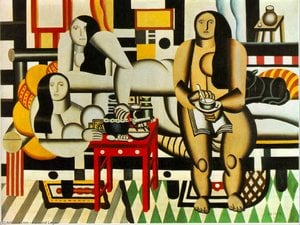
The workman sitting
Replikaatin koko
Fernand Léger’s “The Worker Sitting,” executed in 1926, stands as a cornerstone of Primitivism—a movement that sought to recapture the essence of raw emotion and instinct through simplified forms and bold colors. More than just a portrait, it's an emblem of Léger’s profound engagement with the burgeoning industrial landscape of his time, filtered through the lens of Cubist principles.
The artwork depicts a solitary workman seated on a chair, bathed in diffused light that emphasizes the flatness of the composition. Léger eschews traditional perspective, opting instead for overlapping geometric shapes—primarily squares and rectangles—to convey spatial relationships. These forms dominate both the chair itself and the backdrop, which features a prominent window framing an expanse of greenery. The deliberate asymmetry contributes to a dynamic visual rhythm, inviting contemplation rather than passive viewing.
Executed in ink on paper, Léger’s technique is characterized by thick, assertive outlines—the defining feature of Primitivism—that sculpt the figure and background with uncompromising precision. These lines aren't intended to mimic realistic contours; they serve as structural elements, constructing simplified forms that prioritize clarity and impact. The monochrome palette—a stark contrast between black and white—amplifies this effect, stripping away any illusion of depth or texture.
Beyond its formal qualities, “The Worker Sitting” resonates with a quiet dignity. Léger’s portrayal captures a moment of stillness amidst the bustle of industrial life – a posture suggesting reflection and observation. The workman's gaze directs towards the window, symbolizing perhaps an aspiration for connection with nature and a yearning for respite from the pressures of labor. Léger’s intention wasn’t to depict a specific individual but rather to embody the spirit of the working class—a subject he revisited repeatedly throughout his career.
As a precursor to Pop Art, Léger's work exemplifies a radical departure from academic conventions. He prioritized expressive simplification over meticulous detail, aligning with the broader artistic impulse to confront modernity head-on. “The Worker Sitting” remains an enduring testament to Léger’s ability to distill complex ideas into powerfully evocative visual language—a timeless image of human presence within the transformative forces shaping the twentieth century.
1881 - 1955 , Ranska
Kerro meille projektistasi, niin taideasiantuntijamme tarjoavat sinulle kolme henkilökohtaista taidesuositusta.
Anna meidän kuratoida 3 vaihtoehtoa juuri sinulle – Ilmaiseksi!