
Cubism · 1920
Composition on Fernand Léger (1881–1955)in teos. Se on peräisin vuodelta 1920. Se kuuluu Cubism-liikkeeseen. Se on valmistettu materiaalilla Oil On Canvas.

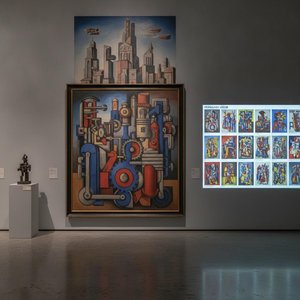
Fernand Léger's Composition, painted in 1920, isn’t a depiction of recognizable objects; it’s an immersion into the very *feeling* of modernity. Born amidst the rural landscapes of Argentan, Normandy, Léger possessed a unique perspective – one forged by his early life working with his father on the farm, juxtaposed against the burgeoning industrial world of Paris. This duality informs every facet of this work, creating a visual language that simultaneously celebrates and critiques the dynamism and fragmentation inherent in the machine age. The painting immediately commands attention not through narrative, but through its sheer geometric density: overlapping rectangles, circles, and subtly curved lines coalesce into an ambiguous spatial field, inviting the viewer to navigate a world where perspective is deliberately distorted.
The grayscale palette, punctuated by strategic bursts of yellow and red, isn’t merely decorative. The muted tones emphasize the flatness of the picture plane, pushing back against traditional notions of depth and realism. These vibrant accents – reminiscent of factory lights or signal flares – inject a vital energy into the composition, hinting at the underlying rhythms of industrial life. Léger masterfully employs angular lines to create a sense of fractured movement, mirroring the jarring yet compelling experience of navigating a rapidly changing urban landscape. The deliberate lack of strong shadows further contributes to this flattened effect, reinforcing the painting’s focus on form and structure rather than illusionistic representation.
Composition firmly establishes Léger as a pivotal figure in the development of Cubism, specifically within his own distinctive style known as “Tubism.” Rejecting the purely representational aims of earlier Cubists like Picasso and Braque, Léger sought to distill the essence of modern life – its mechanical forms, its streamlined shapes, and its relentless forward momentum – into a simplified visual vocabulary. The dominant geometric motifs—cylinders, cones, and cubes—are not merely abstract shapes; they are echoes of factory machinery, automobiles, and other symbols of industrial progress. This isn’t simply an aesthetic choice; Léger was deeply fascinated by the mechanics of the modern world, believing that art should reflect its underlying structure.
The painting's influence extends beyond Cubism, foreshadowing elements of Pop Art with its embrace of everyday objects and industrial imagery. Léger’s approach to color – a restrained palette punctuated by bold accents – anticipates the later work of artists like Andy Warhol. The deliberate simplification of forms, combined with a focus on texture (though subtly rendered through variations in tone), creates an image that is both visually arresting and intellectually stimulating. It's a testament to Léger’s ability to capture the spirit of his time—a period of unprecedented technological advancement and social transformation.
Examining the technique reveals a meticulous attention to detail. Léger employed precise brushwork, layering paint with remarkable control to achieve the desired tonal variations and create a sense of depth through overlapping forms. The use of oil paints on canvas lends a richness and durability to the work, ensuring its longevity. The composition’s seemingly flat appearance belies this careful construction; each shape is precisely defined, contributing to the overall sense of order within the chaotic arrangement.
Léger's legacy extends far beyond his own artistic output. He profoundly influenced subsequent generations of artists, particularly those interested in exploring the relationship between art and technology. His work continues to resonate today, offering a compelling meditation on the complexities of modernity and the enduring power of abstraction. Reproductions of Composition provide an accessible gateway into Léger’s world—a world where form, color, and movement converge to create a truly unforgettable visual experience.

Tekijänoikeudet: teos on vapaasti käytettävissä, taiteilija kuoli vuonna 1955.
Lisää kokoja, rajauksia ja viittauksia →Fernand Léger, Composition (1920). Tekijänoikeudet vapaat.
Valmistettu tietokantamme suuremmasta kuvasta alkuperäisen esikatselukuvan sijaan, joten resoluutio on vähintään 300 DPI. Digitaalinen asiantuntija tarkistaa värit alkuperäistä vasten ja retusoi tiedoston uskollisesti taiteilijan siveltimenvetoja noudattaen.
Osta korkearesoluutioinen kuva"Composition" on peräisin vuodelta 1920. Teoksen valmistumisajankohta sijoittaa sen Fernand Léger uran ja aikakauden kontekstiin.
Fernand Léger käytti teoksessa "Composition" Oil On Canvas-tekniikkaa. Tekniikka määrittelee alkuperäisen teoksen materiaalisen luonteen.
Teoksen "Composition" aiheina ovat geometric abstraction, modern composition, cubist forms, grayscale palette, industrial design, abstract shapes, 20th century art.
Fernand Léger:n "Composition" on vapaasti käytettävissä – tekijänoikeussuoja on päättynyt. Tämä tila määrittää, miten teoksen kuvaa saa käyttää uudelleen.
Teoksen "Composition" taiteilija on Fernand Léger. Teos on luetteloitu Fernand Léger nimellä.
Teoksen Fernand Léger:n "Composition" tyylisuunta on Cubism. Tämä luokittelu sijoittaa teoksen muiden samankaltaisten taiteilijoiden ja teosten joukkoon.
"Composition" edustaa taiteilijan Fernand Léger tuotantokautta Mature Period."
Kun "Composition" luotiin vuonna 1920, Fernand Léger (syntynyt 1881) oli 39 vuotias.
Fernand Légern teos "Composition" on vapaasti käytettävissä – tekijänoikeussuoja on päättynyt. Tekijänoikeusajat lasketaan taiteilijan kuolinvuodesta, ja Fernand Léger kuoli vuonna 1955.

1881–1955, Ranska
Fernand Légerin elämä Fernand Légerin tarina saa alkunsa Argentanin kylästä, joka sijaitsee Lower Normandian Ornen alueella. Hän saapui tähän maailmaan 4. helmikuuta 1881 ainoana poikana. Hänen varhaislapsuutensa muovautui Ranskan maaseudun hiljaisuudessa ja äitinsä, Marie-Adèle Daunoun, läsnäolossa.
Koko Fernand Léger -kokoelma, käsinmaalattu tilaustyönä → Taiteilijan esittelysivu Fernand Léger -taiteilijan mestariteokset
 25 Must-See Masterpieces at Centre Pompidou, Paris: A Modern Art GuideExplore 25 iconic masterpieces from Centre Pompidou. Discover the stories behind modern art legends. Explore the full collection online at …
 Steel & Soul: 10 Powerful Artworks That Capture the Industrial VibeExplore 10 iconic artworks that define the industrial aesthetic. From gritty urban landscapes to metallic textures, discover the stories be…
 Mastering the Machine Age: The 25 Best Artworks by Fernand LégerImmerse yourself in the vibrant world of Fernand Léger. Explore 25 iconic masterpieces of Cubism and Tubism, from bold geometric forms to m…
 Esikatselu

 Tulosta
 Jaa teos
 Jaa
 Teostiedot


 Lataa kuva
 Samanlaisia kohteita
 Röntgenkuvaus
 Diaesitys
 Kysymykset ja vastaukset

 Tilastot
 Kaupunki1919
 Mekaanikko1920
 Kolme naista1921
 Nudet metsässä1910
