Taiteilijan elämäkerta
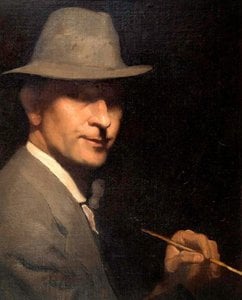
Elioth Gruner – Australian Landscape Painter Celebrated for Serene Depictions & Record Seven Wynne Prize Wins
Elioth Lauritz Leganyer Gruner, born December 16, 1882, in Gisborne, New Zealand, emerged from a family rooted in resilience and connection to the land—qualities that would profoundly shape his artistic vision. His father, Elliott Grüner, a Norwegian-born bailiff, instilled in him a steadfast spirit of determination alongside Mary Ann Brennan, his Irish mother, who nurtured his appreciation for beauty and observation. Their relocation to Sydney shortly after Elioth’s birth exposed him to an environment brimming with artistic fervor—a formative experience that ignited his lifelong passion for capturing the essence of the Australian landscape. Even as a young boy, Gruner demonstrated an innate talent for drawing, diligently cultivated by his mother who ensured he received instruction from Julian Ashton around twelve years old. However, fate dealt a cruel blow when both his father and older brother succumbed to illness, placing immense responsibilities upon him at just fourteen—a period marked by unwavering dedication to supporting his family while simultaneously pursuing his artistic pursuits with quiet perseverance.
Early Life & Artistic Beginnings – A Foundation of Observation
Gruner’s formative years were characterized by a deep immersion in the traditions of rural New Zealand and Australia. His father's practical experience as a bailiff instilled in him a grounded perspective, complementing Mary Ann Brennan’s nurturing influence—a combination that fostered his sensitivity to natural beauty and fueled his desire to translate it onto canvas. Recognizing his burgeoning talent, Ashton provided invaluable guidance, shaping Gruner’s artistic sensibilities and establishing a cornerstone for his future endeavors. The tragic loss of his family members underscored the importance of perseverance and reinforced his commitment to honoring their legacy through his art. From an early age, Gruner exhibited a remarkable aptitude for drawing—a passion nurtured by his mother who proactively arranged for lessons with Julian Ashton around twelve years old—demonstrating a dedication that would define his artistic journey.
Developing an Impressionistic Vision – Light and Atmosphere as Inspiration
Gruner’s artistic style is undeniably Impressionistic, though it evolved over time and absorbed influences from diverse sources. He possessed an extraordinary ability to capture the fleeting effects of light and atmosphere in the Australian bush—a skill that distinguishes his work from many contemporaries. This fascination with luminosity stemmed partly from Ashton's encouragement, bolstering his confidence and refining his artistic vision. Norman Lindsay’s admiration for Gruner’s artistry served as a catalyst for further growth—affirming his talent and reinforcing his commitment to pursuing excellence. A pivotal moment arrived between 1923 and 1925 when Gruner embarked on an extended journey to Europe—a transformative experience that broadened his artistic horizons and instilled in him a deeper understanding of European art traditions. During this period, he consciously simplified his compositions, prioritizing pattern and brushwork—reflecting the influence of Sir William Orpen’s constructive feedback. This deliberate stylistic shift underscored Gruner's willingness to adapt and refine his technique based on insightful observation.
Recognition & Major Achievements – Seven Wynne Prize Victories
Gruner’s unwavering dedication to his craft yielded remarkable results, culminating in seven prestigious Wynne Prizes—the most awarded by any Australian artist besides Hans Heysen—a feat that cemented his place as a titan of landscape painting and secured his enduring legacy within the annals of Australian art history. His triumphant paintings captivated audiences with their serene beauty and masterful rendering of light—establishing him as one of Australia’s foremost artistic voices. Notably, “Morning Light” (1916)—depicting a tranquil farmhouse scene bathed in golden sunlight—became Gruner's most celebrated work—a testament to his ability to convey the profound emotional resonance of the Australian landscape. Similarly, “Spring Frost” (1919)—capturing the delicate beauty of a frosty dawn over cattle pastures—earned him widespread acclaim and solidified his reputation as an artist who excelled at capturing ephemeral moments of natural splendor. The Art Gallery of New South Wales acquired "Morning Light," recognizing its artistic merit and enshrining it as a cornerstone of Australian landscape painting. Furthermore, Gruner’s commission by the AGNSW to paint “The Valley of the Tweed”—a monumental undertaking that showcased his technical prowess and artistic ambition—underscored his significance as a cultural icon.
Legacy & Enduring Appeal – A Timeless Vision
Elioth Gruner's influence extends far beyond his own lifetime, inspiring subsequent generations of artists and captivating audiences with his timeless vision of the Australian bush. His paintings continue to resonate deeply with viewers—evoking feelings of serenity, contemplation, and appreciation for the sublime beauty of nature. Gruner’s unwavering commitment to observation, coupled with his masterful technique—particularly his ability to capture light and atmosphere—established him as a singular figure in Australian art history. Recent scholarly research has reaffirmed his importance as a pioneer of Impressionism in Australia—demonstrating that his artistic legacy persists today. His paintings are not merely representations of places; they are evocative expressions of emotion and experience—a testament to Gruner’s profound understanding of the human condition and his enduring contribution to Australian culture.



 Esikatselu
 Osta käsintehty maalaus
 Jaa
Jaa Jaa
Jaa
 Tarkemmat tiedot

 Lataa
Lataa
 Samanlaisia
 Röntgenkuva
 Diaesitys
 Näytä lisää






































 Lasivaihtoehto on saatavilla vain alle 110 cm kokoisina teoksina