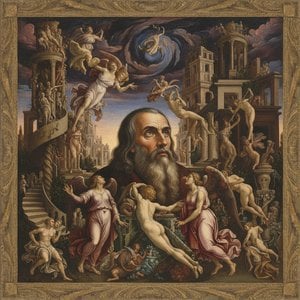
St Paul - A Masterpiece of Dramatic Expression
El Greco’s St Paul stands as a testament to the artist's unparalleled vision and mastery of Baroque painting. Created in 1614, this oil on canvas measuring 97 x 77 cm transcends mere representation, delving into profound psychological depth and conveying an overwhelming sense of spiritual fervor.
Displayed prominently at WahooArt.com, the painting depicts Saint Paul with arresting realism—his elongated figure dominates the composition, embodying a palpable tension between earthly struggle and divine grace.
Artist’s Background: Doménikos Theotokopoulos – A Pioneer of Expressionism
Doménikos Theotokópoulos, universally known as El Greco (meaning “the Greek”), was born in Crete around 1541, a descendant of Byzantine immigrants. His formative years were spent immersed within the traditions of Post-Byzantine art—a discipline characterized by meticulous detail and symbolic color palettes—before embarking on a transformative journey to Venice and Rome.
As documented extensively on Wikipedia, El Greco skillfully blended Byzantine influences with the stylistic innovations of Mannerism and Venetian Renaissance artists like Tintoretto and Titian. This daring fusion cemented his reputation as a precursor to both Expressionism and Cubism—movements that would revolutionize artistic expression centuries later.
Style and Significance: The Dramatic Language of Color and Light
The painting’s distinctive style is immediately recognizable through its dramatic use of color and lighting. Bold hues—particularly reds and yellows—are juxtaposed against muted tones, creating a palpable sense of depth and emotional intensity. This technique reflects El Greco's fascination with conveying psychological states rather than simply depicting physical reality.
The elongated figures characteristic of El Greco’s oeuvre are not merely stylistic flourishes; they serve as visual metaphors for spiritual aspiration—representing the human soul striving towards transcendence. The inclusion of a sword symbolizes vigilance and defense against evil, reinforcing the painting's overarching theme of faith and fortitude.
Legacy and Influence: Inspiration Beyond Time
El Greco’s work has resonated deeply with poets and writers throughout history. Rainer Maria Rilke and Nikos Kazantzakis recognized in his art a profound reflection of human experience—a confrontation with mortality and an unwavering belief in the power of spiritual transformation.
Furthermore, Museo de El Greco (Toledo, Spain) houses several of El Greco’s most celebrated masterpieces—including St Paul—providing visitors with an unparalleled opportunity to immerse themselves in the artist's visionary aesthetic.
As a professional art historian and salesman at WahooArt.com, I wholeheartedly encourage exploring El Greco’s artistic heritage – particularly his captivating depictions of biblical figures like Saint Peter and Mary Magdalene. Discovering these works offers a glimpse into the enduring power of art to inspire contemplation and elevate the human spirit.
Kysymykset ja vastaukset
Onko teoksella El Greco:n "st paul - -" pysty- vai vaakasuuntainen orientaatio?
El Greco:n "st paul - -" on Portrait-muotoinen sommitelma. Suhteet kannattaa tarkistaa ennen tulostekoon valitsemista.
Voinko nähdä röntgenkuvan teoksesta El Greco:n "st paul - -"?
Teosta "st paul - -" voi tutkia kerros kerrokselta sen Röntgentutkimus -sivulla, joka on konservointityön valupöytää mukaillen luotu interaktiivinen katselija ja sisältää yksitoista kuvan optista kerrosta.
Miten voin katsella teosta El Greco:n "st paul - -" diashow'na?
Katso kuvagalleria: El Greco:n "st paul - -" -teoksen Diaesitys -sivu.



 Esikatselu
 Osta käsinmaalattu taideteos
 Jaa teos
 Jaa
Jaa
 Tiedot
 Opas
Opas

 Lataa kuva
 Samanlaisia kohteita
 Röntgenkuvaus
 Diaesitys
 Q&A
Q&A Tilastot


 Lue lisää






































 Lasivaihtoehto on saatavilla vain alle 110 cm kokoisille teoksille