Taiteilijan elämäkerta
Edward William Godwin (1833 - 1886): Pioneering English Architect & Designer
Edward William Godwin, born in Bristol in 1833 and passing away in 1886, was a remarkably forward-thinking English architect and designer whose career spanned a period of intense stylistic transition. He wasn’t merely a participant in the Victorian aesthetic landscape; he actively shaped it, moving from the heavily ornamented “Ruskinian Gothic” favored in mid-Victorian Britain to embrace the burgeoning “Anglo-Japanese taste” that characterized the Aesthetic Movement. Godwin's influence resonates even today, subtly woven into the fabric of the Arts and Crafts movement which followed closely on his heels. His early successes included significant public commissions like the Guildhall in Northampton – a testament to his initial mastery of Ruskinian principles – and the Town Hall in Congleton, alongside restorative work at Dromore Castle in Limerick and Castle Ashby. These projects demonstrated a skill for reviving historical forms, but they were merely stepping stones towards a more radical vision. Godwin’s architectural training was largely self-directed, beginning with an apprenticeship to an engineer in Bristol before relocating to London around 1862 where he encountered the influential Gothic Revival designer William Burges. This encounter sparked a lifelong fascination with medieval costume, furniture and architecture, fueling his antiquarian interests.
Godwin's formative years were marked by an upbringing steeped in intellectual curiosity and artistic aspiration. Raised in Bristol’s affluent Godwin family—his father, a thriving leather merchant—he received an education that prioritized observation and independent thought. The sprawling gardens of Earl’s Mead Estate, where the Godwin household resided, provided him with an unparalleled environment for cultivating his passion for natural beauty and architectural form – a fascination that would define his entire artistic trajectory. Early exposure to William Burges' Gothic Revival designs profoundly impacted Godwin’s aesthetic sensibilities, fostering a lifelong devotion to reviving medieval grandeur while simultaneously questioning established conventions. This dual influence—Ruskinian Gothic combined with Burges’ dramatic interpretations of history—established the bedrock for Godwin’s distinctive architectural style.
His professional life commenced in Bristol under William Armstrong's tutelage, where he honed his drafting skills and gained invaluable experience in constructing ecclesiastical buildings. However, it was his relocation to London around 1862 that propelled him into the epicenter of Victorian artistic innovation—a city brimming with galleries, studios, and intellectual discourse. Here, Godwin encountered James McNeill Whistler, whose Impressionist aesthetic challenged prevailing notions of beauty and representation, forging a collaborative partnership that would produce some of Godwin’s most celebrated works. Their shared commitment to exploring new visual languages cemented their place as leaders in the Aesthetic Movement—a movement dedicated to elevating art beyond mere decoration and embracing subjective experience.
Godwin's architectural achievements stand as monuments to his visionary spirit and unwavering dedication to artistic excellence. The Guildhall in Northampton, conceived in Ruskinian Gothic style, exemplifies Godwin’s mastery of reviving historical forms while incorporating innovative decorative elements—a testament to his ability to synthesize tradition with modernity. Similarly, the Town Hall in Congleton showcases Godwin's skillful manipulation of light and space—creating a harmonious environment that reflects the spirit of its surroundings. His work at Dromore Castle and Castle Ashby demonstrated his meticulous attention to detail and his profound understanding of craftsmanship—resulting in buildings that embody both grandeur and understated elegance.
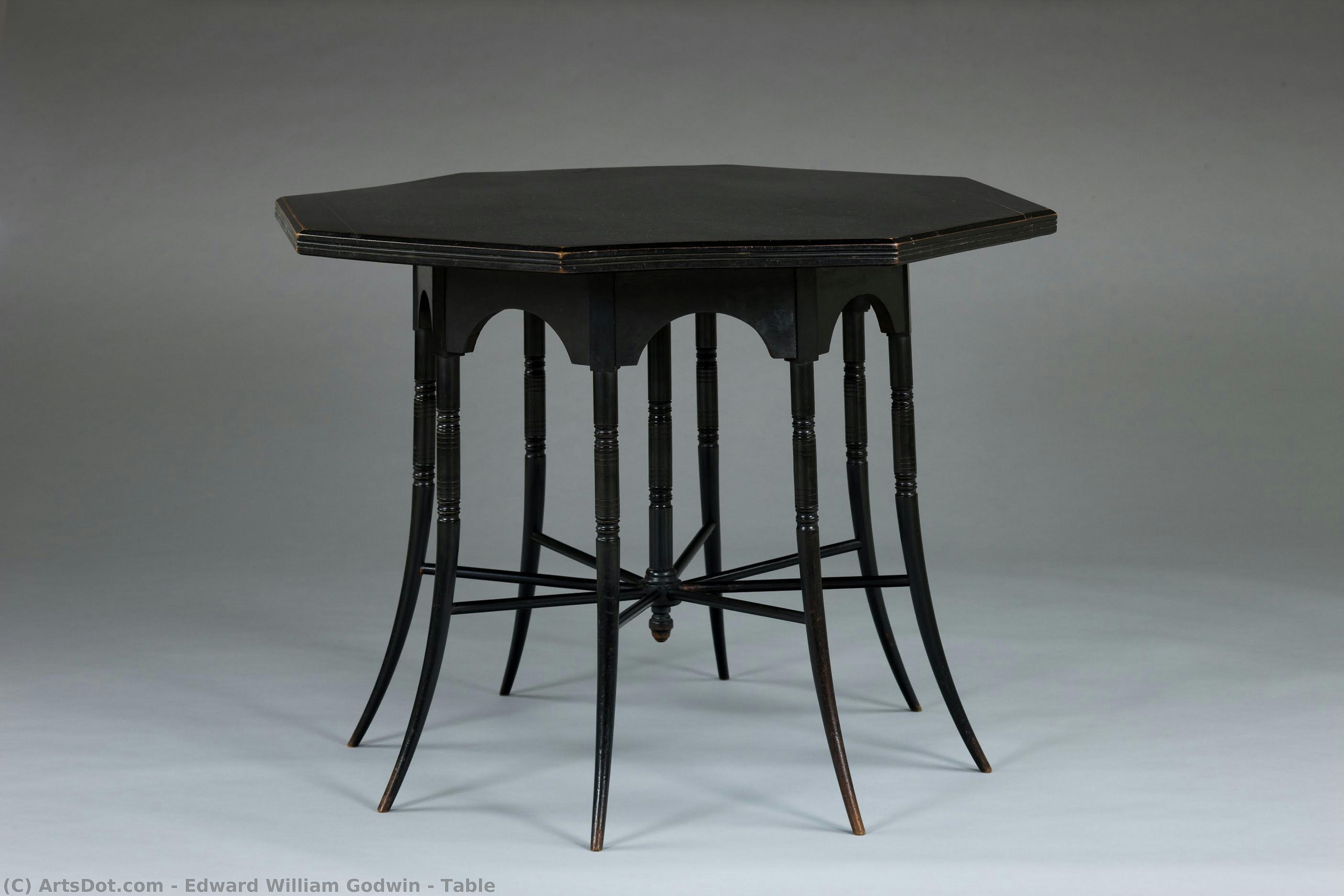
Godwin’s embrace of Japanese aesthetics represented a radical departure from Victorian stylistic norms. Inspired by the opening of Japan to Western trade, he embarked on a quest to comprehend and emulate the principles of Japanese design—a pursuit that yielded extraordinary results. His furniture designs—particularly those executed with an ebonized finish—became emblems of Anglo-Japanese style—characterized by slender lines, geometric shapes, and minimal ornamentation. The Butterfly Cabinet, created for Jeffrey & Co., exemplifies Godwin’s commitment to distilling Japanese aesthetic ideals into elegant domestic objects—a masterpiece that continues to inspire designers today. Collaborations with Whistler further enriched Godwin's artistic vision—resulting in the iconic White House on Tite Street—Chelsea—a building that challenged conventional architectural dogma and cemented Godwin’s reputation as a pioneer of modern design.
Godwin’s legacy extends beyond his buildings and furniture; it resides in his unwavering belief that art should serve humanity—that beauty should be accessible to all, and that craftsmanship should elevate the everyday experience. He championed the Arts and Crafts Movement's ethos of simplicity and functionality—rejecting ostentation and embracing natural materials—establishing himself as a pivotal figure in shaping Victorian design sensibilities. His influence endured into the 20th century, inspiring generations of artists and designers to pursue innovation while honoring tradition—a testament to Godwin’s enduring artistic vision.



 Esikatselu
 Osta käsintehty maalaus
 Jaa
Jaa Jaa
Jaa
 Tarkemmat tiedot

 Lataa
Lataa
 Samanlaisia
 Röntgenkuva
 Diaesitys
 Näytä lisää






































 Lasivaihtoehto on saatavilla vain alle 110 cm kokoisina teoksina





