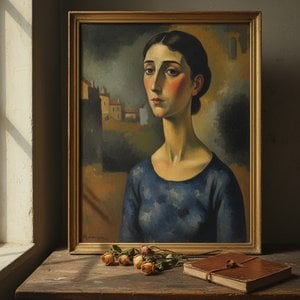
A Portrait of Melancholy: Unveiling Amedeo Modigliani’s “Maude Abrantes”
“Maude Abrantes,” painted by the tragically brilliant Amedeo Modigliani in an unknown year, is not merely a portrait; it's a distilled essence of longing and quiet contemplation. The work immediately draws you into its world – a space defined by muted blues, warm earth tones, and the subtly elongated forms that have become synonymous with Modigliani’s distinctive style. It’s a piece that whispers stories of a life lived on the fringes of artistic circles, marked by both profound beauty and an underlying sense of sorrow. The painting's power lies in its ability to evoke a feeling, rather than simply depict a subject; it feels less like a photograph and more like a captured moment of vulnerability.
The Language of Form: Modigliani’s Unique Vision
Modigliani’s artistic journey was deeply influenced by his travels to Paris, where he encountered the vibrant African art scene. This encounter profoundly shaped his approach to portraiture, moving away from traditional Renaissance ideals and embracing a more simplified, almost geometric aesthetic. Notice immediately the deliberate elongation of Maude Abrantes' neck – a hallmark of Modigliani’s style that subtly suggests an inner tension, a reaching for something beyond the confines of her physical form. The faces are not rendered with smooth transitions; instead, strong outlines define features, creating a graphic quality reminiscent of woodcuts or early printmaking. This deliberate simplification forces the viewer to focus intently on the subtle nuances of expression – the slight downturn of the mouth, the shadowed eyes that hint at unspoken thoughts.
Color and Emotion: A Palette of Quiet Despair
The color palette is deliberately restrained, contributing significantly to the painting’s melancholic atmosphere. The dominant blue of the background acts as a cool counterpoint to the warmer browns and oranges used for Maude's hair and clothing. These earthy tones evoke a sense of grounding, yet they are subtly muted, suggesting a world viewed through a veil of sadness. The skin tones – beige and pink – are not vibrant or luminous; rather, they possess a delicate fragility, mirroring the subject’s apparent emotional state. The limited range of colors amplifies the overall feeling of introspection and quiet despair, creating an atmosphere that is both haunting and deeply affecting.
Symbolism and Context: A Glimpse into Modigliani's World
While the precise identity of Maude Abrantes remains somewhat shrouded in mystery, it’s widely believed she was a close acquaintance of Modigliani. The painting is often interpreted as reflecting his own emotional state – a poignant exploration of loneliness and unfulfilled longing. The two figures in the background, partially obscured, add to this sense of isolation, suggesting a world beyond Maude's immediate experience. Considering Modigliani’s personal life—his struggles with illness, his tumultuous relationships, and his tragically short lifespan—the painting becomes not just an artistic statement but also a window into the artist’s soul. The elongated features, characteristic of his style, can be seen as symbolic representations of alienation or perhaps even a yearning for something unattainable.
WahooArt offers exquisite, hand-painted reproductions of “Maude Abrantes,” allowing you to bring this captivating portrait into your home or office. Each reproduction is meticulously crafted by skilled artists, ensuring the highest level of detail and fidelity to Modigliani’s original vision. Whether you are an art enthusiast, a collector, or simply seeking a piece that evokes emotion and contemplation, a WahooArt reproduction of “Maude Abrantes” is a timeless addition to any collection.



 Esikatselu
 Osta printti
 Jaa
Jaa Jaa
Jaa
 Tarkemmat tiedot

 Lataa
Lataa
 Samanlaisia
 Röntgenkuva
 Diaesitys
 Näytä lisää






































 Lasivaihtoehto on saatavilla vain alle 110 cm kokoisina teoksina