The Quiet Observer: The Life and Legacy of Howard Lloyd Roberts
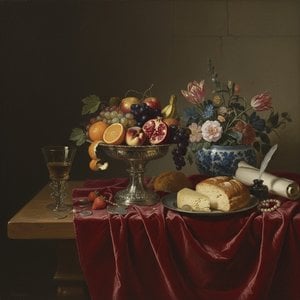
In the vast, often turbulent history of twentieth-century art, there exists a profound beauty in the stillness found within the works of Howard Lloyd Roberts. A British painter whose vision was shaped by an innate fascination with the world’s subtle details, Roberts possessed the rare ability to transform the mundane into the monumental. Born in Birkenhead, Cheshire, his early life laid the foundation for a career defined by meticulous observation and a deep, contemplative engagement with light and form. While many of his contemporaries sought to capture the grand narratives of war or the frantic energy of urban expansion, Roberts turned his gaze inward and toward the domestic, finding an infinite universe within the arrangement of a single vase or the soft drape of a linen cloth.
His artistic journey began in earnest at the Liverpool School of Art and Design. It was here that he honed the technical precision that would become his hallmark, initially exploring the expansive vistas of landscape painting before finding his true calling in the intimate realm of still life. This transition was not merely a change in subject matter but a profound shift in philosophy. Influenced by the structural integrity of Cézanne and the transformative color theories of Picasso, Roberts embraced a Post-Impressionist sensibility. He mastered the art of layering paint to create textures that felt tangible to the viewer, ensuring that every fruit bowl or floral arrangement possessed a weight and dignity that transcended its physical existence.
A Journey of Color and Light
The evolution of Roberts’ style is perhaps most vividly illustrated by his move beyond the borders of Britain. Seeking new inspirations, he established a studio in Mexico City, a period that would fundamentally alter his visual language. The transition from the soft, often muted tones of the English landscape to the vibrant, sun-drenched palette of Mexico acted as a catalyst for creative expansion. The terracotta reds of adobe architecture and the lush, emerald greens of the agave plants breathed a new vitality into his work.
During this Mexican period, his brushwork underwent a subtle but significant metamorphosis:
- Enhanced Tonal Range: His ability to manipulate light deepened, allowing for more dramatic contrasts between shadow and brilliance.
- Boldness of Stroke: The meticulous layering of his earlier years began to incorporate broader, more expressive strokes that captured the heat and energy of his new environment.
- Chromatic Experimentation: He moved toward a richer, more saturated use of color, integrating the warmth of the Mexican landscape into his classical compositions.
Despite these shifts toward greater boldness, Roberts never lost the "quiet" essence that defined his early career. Even in his most vibrant works, there remains an underlying sense of peace and a disciplined commitment to the essence of form. His self-portraits, equally significant to his oeuvre, offer a window into this introspective mind, revealing an artist who was as much a student of his own identity as he was of the objects surrounding him.
Artistic Significance and Enduring Impression
The historical significance of Howard Lloyd Roberts lies in his ability to bridge the gap between classical tradition and modern experimentation. He did not seek to disrupt the art world with shock or controversy; instead, he sought to enrich it through a relentless pursuit of aesthetic truth. His works, such as the notable Still Life held at the Amgueddfa Ceredigion Museum, serve as enduring testaments to the power of focused observation. Through his hands, a simple collection of bottles, cups, and papers becomes a choreographed dance of light and shadow.
Today, Roberts is remembered as a master of the contemplative. His legacy persists in the way he invites viewers to slow down, to breathe, and to find the extraordinary within the ordinary. In an era of constant motion, his paintings remain sanctuaries of stillness, reminding us that beauty does not always demand a loud voice; sometimes, it speaks most clearly in a whisper.
Küsimused ja vastused
Kui palju Howard Lloyd Roberts teoseid on kataloogis vaatamiseks saadaval?
Lehelt Kõik teosed saab vaadata 6 teost teost kunstnikult Howard Lloyd Roberts.
Kust saan vaadata Howard Lloyd Roberts teoseid 3D-galeriis?
Virtuaalne külastus on võimalik: Howard Lloyd Roberts lehekülg 3D muuseum tutvustab kunstniku teoseid koldimäärses galeriis.
Kust leida Howard Lloyd Roberts teoseid teemade järgi jaotatuna?
Lehekorral Teemade atlas on Howard Lloyd Roberts teosed jaotatud teema järgi.