The Monk of the Brush
Feiyin Tongrong lived a life defined by the quiet discipline of the monastery and the rhythmic motion of ink on paper. Born in Beijing, China, his early years were marked by loss; he lost his father when he was only six and his mother at eleven. These hardships led him to enter a monastery just two years later. He spent much of his life within the halls of various Chan monasteries, eventually serving as an abbot at Wanfusi on Mt. Huangbo. His path was one of deep study under several masters, including Huishan and Miyun Yuanwu, which shaped both his spiritual understanding and his hand.
His connection to the brush was not a separate pursuit from his religious life but an extension of it. For him, calligraphy was a form of moving meditation. The act of writing required a presence of mind that mirrored the focus needed for Zen practice. He did not merely write characters; he expressed the clarity and strength found through years of monastic training. This approach helped lay the stylistic foundation for the Ōbace-style calligraphy later practiced by Chinese-born monks in Japan.
Ink and Enlightenment
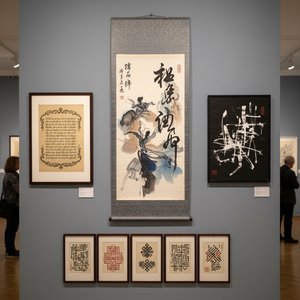
The work left behind by Feiyin Tongrong is characterized by a specific energy, where fluid curves meet sharp, angular strokes. His calligraphy often features cursive script that moves with a sense of sudden movement. In pieces such as his Chinese Verse on Spiritual Enlightenment, the characters appear dynamic and rapidly applied. These works often carry themes of Zen practice, focusing on the idea that enlightenment depends on an individual's own persistent efforts.
His writing often captured specific moments of spiritual insight:
- Four-Line Poem: A work using fluidly brushed characters to reflect Zen teachings.
- Chinese Poem on Zen Meditation: An exploration of clarity and the presence of the autumn moon.
- Poetic Phrases: Short, powerful inscriptions drawn from Buddhist scriptures that use economical brushwork to convey deep meaning.
Through these inscriptions, he shared a vision of wisdom that is both sudden and untrammeled. His ability to translate complex spiritual concepts into the physical movement of ink remains his most significant contribution to the tradition of Chan calligraphy.
Küsimused ja vastused
Kui palju Feiyin Tongrong teoseid on kataloogis vaatamiseks saadaval?
Lehelt Kõik teosed saab vaadata 2 teost teost kunstnikult Feiyin Tongrong.
Kas Feiyin Tongrong kohta on olemas kronoloogiline ülevaade?
Feiyin Tongrong looming kronoloogiline ülevaade on kättesaadav kunstniku Kronika lehel, kus teosed esituvad loovimissarjade järgi, peatükk peatükilt.
Millises ajaloolises perioodis töötas Feiyin Tongrong?
Feiyin Tongrong töötas Early Modern perioodil. See ajastu määratleb kunstniku tegevuse ajaloolisel kontekstil.