A Glimpse into Eighteenth-Century Grandeur
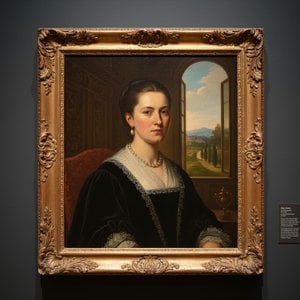
In the quiet, commanding presence of William Hogarth’s “George Arnold,” viewers are transported back to the structured elegance of 18th-century Britain. This captivating portrait presents an elderly gentleman in a three-quarter view, a composition that immediately establishes a sense of profound dignity and social importance. As one gazes upon the subject, his direct and steady eyes seem to invite a silent dialogue across the centuries, bridging the gap between the modern observer and the historical elite. The formal, seated pose is not merely a matter of convenience but a deliberate artistic choice intended to convey the weight of character and the stability of status.
The painting serves as a masterful window into the societal landscape of Hogarth’s era. While the artist is globally celebrated for his biting satirical series such as A Harlot’s Progress and A Rake’s Progress, this particular work reveals his exceptional prowess in classical portraiture. Here, there is no mockery, only a meticulous dedication to capturing the essence of a prominent individual. Through this piece, we encounter the refined atmosphere of a period defined by both burgeoning ambition and rigid social hierarchies, making it an exquisite centerpiece for any collection focused on historical realism.
Mastery of Light, Texture, and Symbolism
Technically, “George Arnold” is a triumph of the classical oil painting tradition. Hogarth employs a sophisticated layering of brushstrokes to achieve a remarkably smooth texture, lending a lifelike quality to the subject’s skin and the heavy fabrics of his attire. The use of directional lighting is particularly striking; it illuminates the man's face and upper body with a soft brilliance, while deep, intentional shadows wrap around the contours of his form to create a powerful sense of three-dimensionality. This interplay of light and dark—often referred to as chiaroscuro—is set against a dark, indistinct background, which serves to isolate the subject and focus all emotional energy upon his expression.
Every element of the subject's wardrobe acts as a silent narrator of his wealth and position. The rich blue coat, paired with an ornate waistcoat and delicate ruffled cuffs, speaks to the meticulous fashions of the 1700s. Even the powdered wig, a hallmark of the period’s upper class, functions as a potent symbol of social standing. For the discerning interior designer or collector, these details offer more than mere decoration; they provide a sense of structured elegance and historical depth. The painting does not just depict a man; it depicts an era of prestige, making it an ideal choice for creating a sophisticated, scholarly, or classically inspired atmosphere in any grand room.
An Emotional Resonance for the Modern Collector
Beyond the technical brilliance and the historical fascination, there is a profound emotional layer to this portrait that continues to resonate today. While the primary impression is one of composure and strength, a subtle hint of melancholy lingers within the subject's gaze—a reflection of the inevitable passage of time and the weight of a life lived through significant history. This complexity allows the artwork to transcend simple decoration, offering a contemplative presence that can anchor a room with both gravity and grace.
For those seeking to adorn their spaces with high-quality reproductions, “George Arnold” offers an unparalleled opportunity to possess a piece of British art history. Whether placed in a private study, a formal dining hall, or a curated gallery space, the painting’s ability to evoke both intimacy and grandeur makes it a timeless investment. It is a work that invites repeated viewing, revealing new nuances of texture, light, and human emotion with every encounter.
Küsimused ja vastused
Mille kohta on teos "George Arnold" ja milline on selle atmosfer?
Teos „George Arnold“, autor William Hogarth kujutab teemasid portraiture, elderly man, 18th century, dignified, formal, classicism, social status, wealthy ja selle meeleolu on Classic. Teema ja atmosfäär loovad koos teose terviku.
Kas teos "George Arnold" on saadaval kunstiprentina?
Teose „George Arnold“, autor William Hogarth trüket saab tellida otse lehelt see leht: kunstiprint puuvillalõikel}}^{\text{canvas}}$ või arhiveeritaval kangaspaberil.
Kas saan tellida teose "George Arnold" õli-reproduktsiooni?
Teos "George Arnold" on saadaval kujundis käsitsi maalatud õlireproduktsioon linaelapale. Tellimust saab esitada lehel see leht, kus on võimalik valida erinevad suurused.
Mis selgitab teose „George Arnold“, autor William Hogarth autoriõiguste olukorda?
Teose "George Arnold" tegiteks - avalikus õiguses – selle autoriõigud onหมดunud - tuleneb kunstniku surma aastast 1764.
Milleks pidustuseks on „George Arnold“, autor William Hogarth soovituslik kingitus?
„George Arnold“, autor William Hogarth on soovitatav kingitus jaoks Retirement. Teose reproduktsiooni saab anda kingitusena.
Millisele kunstnikule on teos "George Arnold" atribuutseeritud?
Teose "George Arnold" autoriks on mõeldud William Hogarth.
Kust William Hogarth korduvad teemad George Arnold kohta peegeldavad?
"George Arnold" kujutab teemasid portraiture, elderly man, 18th century, dignified, formal, classicism, social status, wealthy, samal ajal kui William Hogarth tuntud teemad on classical ideals, roman portraiture, 18th-century social hierarchy, wealth & status symbolism, hogarth's moral critiques, satirical observation of society, part of a series on human folly, detailed realism. Nende kahe võrdlemine näitab, kuidas teos seobub kunstniku tavalistega motiividega.



 Vaata sisu
 Telli käsitsi maalitud reproduktsioon
 Jaga teost
 Jaga
Jaga
 Detailid
 Õppekate juhend

 Laadi alla
 Sarnased teosed
 Röntgenuuring
 Slaidietendus
 Statistika

 Loe lähemalt






































 Klaasivalik on saadaval ainult kuni 110 cm suuruses teostes