Piet Mondrian: Architect of Geometric Harmony
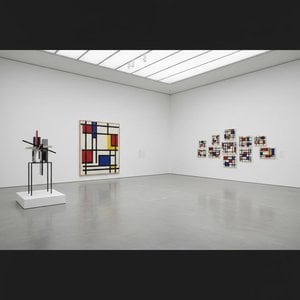
Piet Mondrian’s *Composition with Red, Blue and Yellow*, completed in 1937–42 during his time in New York City, stands as a cornerstone of abstract art. Born Pieter Cornelis Mondriaan in Amersfoort, Netherlands, he initially pursued landscape painting before embracing the radical simplification championed by De Stijl movement.
A Synthesis of Form and Color
Mondrian’s artistic evolution wasn't merely stylistic; it represented a profound philosophical shift. Influenced by Bauhaus principles and Wright’s architecture—particularly Broadacre City—he sought to express universal harmony through geometric abstraction. As he famously stated, “Art must be objective.” This conviction drove him away from representational imagery toward pure forms – rectangles and squares – arranged in orthogonal grids.
Technique: Precision and Controlled Brushwork
- The painting utilizes oil paint on canvas, applying thin layers of pigment with meticulous brushstrokes. Mondrian favored a technique that prioritized precision over spontaneity, achieving remarkable textural control.
- He employed masking tape to delineate the grid lines, ensuring absolute accuracy and maintaining visual stability. This careful process underscored his belief in rational order as opposed to emotional expression.
Historical Context: The Rise of Geometric Abstraction
Created amidst the burgeoning modernist movement, *Composition with Red, Blue and Yellow* reflects a broader trend toward rejecting illusionism. Artists like Mondrian and Kandinsky were actively dismantling traditional artistic conventions, exploring new ways to convey ideas and emotions without depicting recognizable subjects.
Symbolic Resonance: Beyond Mere Color
While seemingly simple in its visual vocabulary, the painting carries significant symbolic weight. The red square represents passion and energy—a counterbalance to the blue and yellow squares, which symbolize intellect and serenity. Together, they embody Mondrian’s vision of a balanced cosmos governed by fundamental geometric principles.
Emotional Impact: Tranquility Amidst Structure
Despite its austere appearance, *Composition with Red, Blue and Yellow* evokes a feeling of contemplative calm. The grid structure provides visual grounding, while the harmonious interplay of colors fosters a sense of serenity—a testament to Mondrian’s ability to distill complex ideas into aesthetically compelling forms.
The Influence of Bauhaus
Mondrian's artistic explorations were deeply impacted by the Bauhaus school in Germany. The Bauhaus movement championed functional design and geometric abstraction, mirroring Mondrian's own pursuit of universal harmony through simplified shapes and colors. This shared aesthetic vision solidified Bauhaus’s position as a pivotal force in shaping 20th-century art and architecture.
A Legacy of Geometric Minimalism
*Composition with Red, Blue and Yellow* remains an enduring symbol of modernist artistic innovation. Its unwavering commitment to geometric abstraction continues to inspire artists and designers today—a timeless masterpiece that exemplifies the power of visual simplicity to convey profound philosophical ideas.



 Vaata sisu
 Telli käsitsi maalitud reproduktsioon
 Jaga teost
 Jaga
Jaga
 Detailid
 Õppekate juhend

 Laadi alla
 Sarnased teosed
 Röntgenuuring
 Slaidietendus
 Statistika
 Loe lähemalt






































 Klaasivalik on saadaval ainult kuni 110 cm suuruses teostes