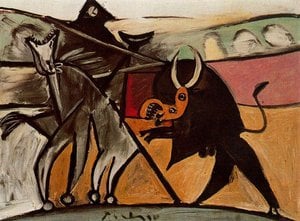
The Haunting Echoes of Conflict: Pablo Picasso’s *War*
Pablo Picasso's *War*, painted in 1937, isn’t merely a depiction of a battlefield; it’s a visceral scream against the brutality and senselessness of conflict. Born from the immediate aftermath of the bombing of Guernica during the Spanish Civil War – an event that shocked Europe and ignited international outrage – the painting transcends its specific historical context to become a timeless indictment of violence itself. It's a work saturated with grief, disorientation, and a profound sense of loss, rendered in Picasso’s signature fractured style, reflecting the shattered reality of war.
The monochrome palette—a stark blend of greys, blacks, and whites—immediately establishes an atmosphere of devastation. There's no romanticism here, no heroic grandeur; instead, we are confronted with a scene stripped bare of color, mirroring the emotional desolation at its core. The figures – a screaming woman cradling her dead child, a wounded horse writhing in agony, a dismembered soldier clutching a broken sword – are not individualized portraits but archetypes of suffering, embodying universal themes of loss and despair. Picasso deliberately avoids specific details, opting for symbolic representation that allows the painting to resonate across cultures and generations.
Cubism’s Fragmented Reality
Picasso's masterful use of Cubist techniques is central to *War*'s power. He dismantles forms, fracturing them into geometric shards and presenting multiple perspectives simultaneously. This fragmentation isn’t merely an aesthetic choice; it mirrors the psychological disorientation experienced by those caught in the chaos of war. The figures are not presented as solid, unified beings but rather as broken fragments, reflecting the shattered lives and fragmented realities left behind. The overlapping planes and distorted shapes create a sense of instability and unease, pulling the viewer into the heart of the scene’s turmoil.
Notice how Picasso employs sharp angles and jagged lines to convey violence and pain. The horse, perhaps the most iconic element of the painting, is rendered in agonizing detail – its body contorted, its mouth open in a silent scream. The bull, often interpreted as representing brutality or Spain itself, stands impassively amidst the carnage. Even the light source—a single, glaring eye-like shape—feels oppressive and accusatory, highlighting the horror of the scene.
Historical Context & Legacy
Painted in response to the bombing of Guernica, a Basque town deliberately targeted by Nazi German and Fascist Italian warplanes during the Spanish Civil War, *War* quickly became an emblem of anti-war sentiment. Picasso stipulated that the painting should not be displayed in Spain until democracy was restored, a testament to his commitment to freedom and justice. It traveled extensively throughout Europe and America, raising awareness about the horrors of the conflict and serving as a powerful symbol of resistance against fascism.
Today, *War* resides at the Museo Reina Sofía in Madrid, where it continues to captivate viewers with its raw emotional intensity. It remains a potent reminder of the devastating consequences of war and a testament to Picasso’s enduring legacy as one of art history's most revolutionary figures. Reproductions of this iconic work offer a tangible connection to this pivotal moment in history, allowing us to contemplate the timeless themes of suffering, loss, and the urgent need for peace.
Küsimused ja vastused
Kuhu Pablo Picasso loomingulise perioodi kuulub teos "War"?
"War" kujutab kunstniku Pablo Picasso loovperioodi Analytical Cubism.
Kas teoses "War" on nähtav tugev kerge-tume kontrast?
Teose "War" valgus-varjundite kontrast on Statement. Kontrast kirjeldab, kui teravalt erinevad heeled ja tumedad alad.
Kas ma saan näha teost „War“, autor Pablo Picasso erinevates valgustingimustes?
Teose „War“, autor Pablo Picasso Röntgenkiirgus leht on interaktiivne vaatur, mis võimaldab liikuda läbi teose üheksateist optilise kihti, sealhulgas röntgenlaadunäoga vaadet.
Milline ruum sobib kokku teose „War“, autor Pablo Picasso värvidega?
Teose „War“, autor Pablo Picasso Earthy toonid sobivad suurepäraselt selle soovituslikule ruumile: Living Room.
Milline suurus "War" minu toa jaoks sobib?
Soovitatav kombinatsioon teosele „War“, autor Pablo Picasso: Large trükis Living Room-s.
Kas teose „War“, autor Pablo Picasso pilt on vabalt reproduseeritav?
Teos "War" kuulub tegijateõiguste osas lubaalahenduse alla: on endiselt kaitstud autoriõigusega.
Kust teose „War“, autor Pablo Picasso külastajad pärit on?
Teose „War“, autor Pablo Picasso lehe Statistika lehel on esitatud avalikud külastusstatistika: selle teose kuutlikud külastused, võrdlus kunstniku kõige vaadatavamate teostega ning külastajate päritolu.
Kas teose "War" värvid on tugevad või pehmed?
Teose "War" värvitoon on Balanced. Intensiivsus kirjeldab värvide sileduse ja tugevuse määra.



 Vaata sisu
 Lülita trükkitoodetele
 Jaga teost
 Jaga
Jaga
 Detailid
 Õppekate juhend

 Laadi alla
 Sarnased teosed
 Röntgenuuring
 Slaidietendus
 Statistika
 Loe lähemalt






































 Klaasivalik on saadaval ainult kuni 110 cm suuruses teostes