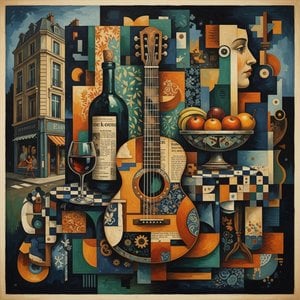
The Genesis of Fragmentation: Picasso's "Guitar" (1926)
Pablo Picasso’s “Guitar,” painted in 1926, isn’t merely a depiction of an instrument; it’s a distilled essence of Synthetic Cubism, a radical departure from the Analytical phase that preceded it. This work, rendered in muted blues and earthy tones, captures a moment of profound deconstruction and reconstruction – a visual puzzle where familiar forms are shattered and reassembled with startling precision. The painting immediately draws the eye to its central subject: a guitar, presented not as a unified object but as a collection of fragmented planes and geometric shapes. Picasso masterfully employs overlapping perspectives, creating an illusion of depth within a remarkably shallow space. It’s as if the guitar itself is dissolving into its constituent parts, mirroring the broader artistic concerns of the era – a questioning of reality and a celebration of subjective perception.
- Style: Synthetic Cubism - characterized by brighter colors, simplified forms, and a greater emphasis on collage-like arrangements.
- Technique: Picasso utilizes a technique of layering shapes and planes, creating an effect of simultaneous viewpoints. The brushstrokes are loose and expressive, contributing to the painting’s dynamic energy.
A Symphony of Objects: Context within Picasso's Artistic Journey
To understand “Guitar,” one must consider Picasso’s trajectory during this period. Following his groundbreaking work in Analytical Cubism (1907-1912), where objects were broken down into their basic geometric components, he moved towards Synthetic Cubism. This phase embraced a more optimistic and decorative approach, often incorporating elements of collage – as seen in works like “Still Life with Guitar” (1920). The presence of scattered books around the guitar suggests an intellectual environment, hinting at Picasso’s lifelong fascination with literature and his desire to integrate diverse artistic influences into his work. The painting's creation coincided with a period of relative stability for Picasso after the turmoil of World War I, reflecting a renewed interest in formal experimentation and a celebration of visual pleasure.
Historical Context: Painted in 1926, this piece exemplifies the shift towards Synthetic Cubism, a style that prioritized color and simplified forms over the analytical deconstruction of earlier works. It’s a pivotal moment in Picasso's artistic evolution, showcasing his mastery of new techniques and his willingness to challenge traditional notions of representation.
Symbolic Resonance: The Guitar as Metaphor
The guitar itself holds symbolic weight within the painting. It represents not just an instrument but also a vessel for emotion, memory, and perhaps even the artist’s own fragmented self. Its various positions – held aloft, resting on a table, surrounded by books – suggest a multiplicity of roles and experiences. The books contribute to this layered meaning, hinting at the intellectual pursuits and artistic inspirations that shaped Picasso's vision. The arrangement can be interpreted as an exploration of how objects relate to each other, creating a complex web of associations and meanings.
Bringing “Guitar” Home: A Reproduction for Collectors
WahooArt is proud to offer meticulously hand-painted reproductions of Pablo Picasso’s “Guitar.” Our artists recreate the painting's vibrant colors, dynamic composition, and intricate details with unparalleled skill. Whether you are a seasoned art collector or seeking to add a touch of modern genius to your interior space, our reproduction provides an authentic and captivating representation of this iconic work. Available in various sizes, our “Guitar” reproduction captures the essence of Picasso’s Synthetic Cubist vision – a testament to his revolutionary approach to form, color, and perspective. Explore more about this artwork here.
Küsimused ja vastused
Millised teemad teoses „Guitar“, autor Pablo Picasso esile tõelve?
Teos „Guitar“, autor Pablo Picasso kujutab: guitar, picasso, cubism, composition, geometric, blue background, 1926.
Kas on "Guitar" kuulus Synthetic Cubism suunaga teos?
Synthetic Cubism suunnas on teos "Guitar" Iconic populaarsusega.
Kas teose „Guitar“, autor Pablo Picasso pilt on vabalt reproduseeritav?
Teos „Guitar“, autor Pablo Picasso kuulub lubaõigusliku staatuse on endiselt kaitstud autoriõigusega alla. See staatus reguleerib teose pildi reprodüseerimise võimalusi.



 Vaata sisu
 Lülita trükkitoodetele
 Jaga teost
 Jaga
Jaga
 Detailid
 Õppekate juhend

 Laadi alla
 Sarnased teosed
 Röntgenuuring
 Slaidietendus
 Statistika


 Loe lähemalt






































 Klaasivalik on saadaval ainult kuni 110 cm suuruses teostes