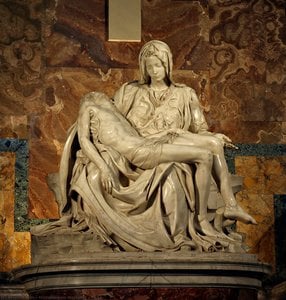
The Anatomy of Devotion: Unveiling a Renaissance Study
To gaze upon this preparatory study is to step directly into the intense, focused crucible of artistic genius. It is not a finished narrative, but rather a profound meditation—a skeleton rendered in pigment—that speaks volumes about the mind wrestling with form and divine proportion. The subject matter itself, though titled Study for Haman, transcends any single story; it becomes an exhaustive exploration of the human vessel. Here, the artist has meticulously charted the musculature, the subtle curve of the torso, and the foundational geometry of the limbs. This drawing is a testament to the Renaissance obsession with understanding man—not just as a spiritual being, but as a perfectly engineered machine of flesh and bone.
A Dialogue in Red Chalk: Technique and Materiality
The visual poetry of this piece resides deeply within its technique. Executed primarily in red chalk upon aged paper, the drawing possesses an immediate warmth that seems to emanate from the very surface. The artist has employed a masterful control over dry point methods, allowing the pressure of the chalk to create varying weights of line—from whisper-light suggestions of contour to deep, velvety cross-hatching that builds palpable shadow. Observe how the texture is built up; it is not merely shaded, but constructed through countless intersecting lines. This careful handling of pigment against the ground reveals an intellectual rigor, suggesting hours spent in quiet contemplation, where every stroke served a precise, structural purpose.
Historical Echoes and Artistic Lineage
Dating to around 1508, this work places us squarely within the vibrant currents of the High Renaissance. While the title connects it to a specific biblical narrative, its execution speaks more broadly to the era's commitment to naturalism and idealized form. The artist’s dedication to anatomical accuracy mirrors the intellectual ferment of the time, where art was inseparable from burgeoning scientific inquiry. For the collector or designer, this piece offers an unparalleled connection to that golden age—a tangible link to the masters who viewed the human body as both a subject for beauty and a puzzle awaiting perfect solution.
Symbolism and Emotional Resonance
Beyond its technical brilliance, there is a deep emotional resonance here. The fragmented nature of the composition invites the viewer into an act of completion; we are invited to mentally assemble the poses, to imagine the final, grand vision that these studies were meant to support. Symbolically, it speaks to the process of creation itself—the necessary stages of drafting, correction, and refinement before perfection can be achieved. Owning a reproduction of this study is not merely acquiring art; it is curating an atmosphere of deep thought, scholarly pursuit, and enduring human potential for any space.
Küsimused ja vastused
Kuidas on "Study for Haman" ajalooliselt positsioneeritud?
Teos „Study for Haman“, autor Michelangelo Morlaiter kuulub High Renaissance suunale, mis on osa Renaissance ajastust. Koos annavad need teosele selle koha kunstiajas.
Millises muuseumis on säilitatud originaal "Study for Haman"?
Teos „Study for Haman“, autor Michelangelo Morlaiter on näitustel Briti Muuseum, London, United Kingdom. Muuseumi keterangane viitab originaalteosele, mitte reproduktsioonidele.
Mida „Study for Haman“, autor Michelangelo Morlaiter kujutab?
Teos „Study for Haman“, autor Michelangelo Morlaiter kujutab: anatomy study, red chalk drawing, figure sketch, renaissance art, human form, preparatory work.



 Vaata sisu
 Lülita trükkitoodetele
 Jaga teost
 Jaga
Jaga
 Detailid
 Õppekate juhend

 Laadi alla
 Sarnased teosed
 Röntgenuuring
 Slaidietendus
 Statistika


 Loe lähemalt






































 Klaasivalik on saadaval ainult kuni 110 cm suuruses teostes