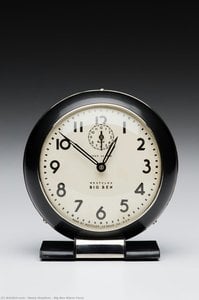
A Testament to Resilience: Exploring Margarete Heymann’s Wall Clock
The square wall clock crafted by Margarete Heymann-Loebenstein (later Marks) stands as more than just a functional timepiece; it embodies the spirit of modernist design intertwined with profound personal experience. Produced in the Haël Werkstätten for Artistic Ceramics during her exile from Nazi Germany, this piece exemplifies the Bauhaus aesthetic—characterized by geometric simplicity and honest material expression—while simultaneously reflecting Heymann’s unwavering dedication to artistic creation amidst turbulent times. Its unassuming appearance belies a complex narrative of innovation, displacement, and enduring beauty.
- Style & Form: The clock's design adheres strictly to Bauhaus principles, prioritizing orthogonal lines and balanced proportions. Rounded corners subtly soften the rigid geometry, introducing an element of humanist consideration into the otherwise austere aesthetic.
- Material & Technique: Constructed from ceramic material and encased in a metal frame, the clock utilizes slip casting—a technique perfected by Heymann—to achieve exceptional dimensional accuracy and surface smoothness. The uranium-based orange glaze imparts a luminous hue that captures ambient light, creating an ethereal glow.
- Numerals & Hands: The black numerals on the clock face are meticulously positioned in a circular arrangement, mirroring the Bauhaus fascination with mathematical precision. Similarly, the black hour and minute hands—crafted from metal—are deliberately designed to convey clarity and functionality.
The Haël Werkstätten for Artistic Ceramics served as a crucial refuge for Heymann during her exile, allowing her to continue her artistic pursuits despite the pervasive restrictions imposed by Nazi ideology. This workshop was founded in 1930 and quickly became renowned for its commitment to producing high-quality ceramic pieces that blended modernist design with traditional craftsmanship. The clock’s creation represents a triumph of creativity within challenging circumstances—a symbol of perseverance and an affirmation of artistic vision as a force for beauty and intellectual engagement.
- Symbolism: The orange glaze, chosen by Heymann herself, carries connotations of warmth, optimism, and vitality—counterbalancing the anxieties associated with exile. Its subtle luminosity speaks to the enduring power of art to illuminate even the darkest periods.
- Historical Context: Produced in the wake of the Bauhaus’s closure in 1932, the clock embodies the Bauhaus movement's legacy of experimentation and its unwavering belief in the transformative potential of design. It stands as a testament to the Bauhaus ethos—a commitment to functional beauty rooted in rational principles.
The image accompanying this description captures the clock’s captivating aesthetic with meticulous detail. The stark white background enhances the vibrancy of the orange glaze and emphasizes the clock's sculptural form, inviting viewers to contemplate its elegance and understated sophistication. Furthermore, the watermark “© 2014 Margarete Heymann-Löbenstein” underscores the artist’s enduring presence—a reminder that this remarkable piece continues to inspire admiration for its harmonious blend of form and technique. Its timeless appeal resonates with collectors and interior designers alike who appreciate objects imbued with both intellectual rigor and emotional resonance.
Further Exploration
For a deeper understanding of Margarete Heymann’s artistic journey, consider visiting the Jewish Museum Berlin's archive (
Jewish Object: Applied Arts Collection) where you can access documents detailing her life and work. Alternatively, explore her contributions to the Bauhaus movement (
Wall clock - Margarete Heymann-Loebenstein (later Marks)), showcasing her pioneering spirit and unwavering dedication to modernist design principles. Finally, delve into the broader context of Jewish art during the Weimar Republic (
Purchase a copy of Wall clock - Margarete Heymann) to appreciate the significance of this extraordinary artwork within its historical milieu.
Küsimused ja vastused
Millist emotsiooni „Wall clock“, autor Margarete Heymann edastab?
Teose „Wall clock“, autor Margarete Heymann kirjeldatud emotsionaalne toon on Reflective. See kokkuvõtab tunnet, mida teos väljendab.
Milline on teose „Wall clock“, autor Margarete Heymann visuaalne heledus?
Teel sündinud valgusest on teose „Wall clock“, autor Margarete Heymann ereonim brilliant.
Kuidas saan vaadata reproduktsiooni teosele „Wall clock“, autor Margarete Heymann?
Teostest „Wall clock“, autor Margarete Heymann eelvaade on saadaval teose Eelvaade lehel.
Millist atmosfääri teevad „Wall clock“, autor Margarete Heymann sisekujundusse?
Teose „Wall clock“, autor Margarete Heymann meeleolu on Serene ning seda soovitatakse ruumides, mis on Living Room. Meeleolu tähistab seda, mida teos ümbritsevale piirkonnale lisab.
Kuidas ma saan alla laadida teose „Wall clock“, autor Margarete Heymann pildi?
Teose „Wall clock“, autor Margarete Heymann tehes digitaalset pilti saab alla laadida selle Laadi alla lehelt vormatsis kõrge resolutsiooniga digitaalse pildi allalaadimine.
Milline on teose „Wall clock“, autor Margarete Heymann värvitoit?
Teose "Wall clock" värvipalett on koonuse方面 Subtle Color.
Miks on teose "Wall clock" autoriõiguste staatus selline, nagu see on?
Margarete Heymann teos "Wall clock" on on endiselt kaitstud autoriõigusega. Autoriõiguse kaitseajad arvutatakse alates kunstniku surmaõigustest ning Margarete Heymann suri aastal 1990.
Milleks on teose „Wall clock“, autor Margarete Heymann reproduktsiooni soovitatud kasutada?
Teose „Wall clock“, autor Margarete Heymann soovituslik kasutusviis on Accent. Seda saab kasutada ka muudel eesmärkidel.



 Vaata sisu
 Telli käsitsi maalitud reproduktsioon
 Jaga teost
 Jaga
Jaga
 Detailid
 Õppekate juhend

 Laadi alla
 Sarnased teosed
 Röntgenuuring
 Slaidietendus
 Statistika

 Loe lähemalt






































 Klaasivalik on saadaval ainult kuni 110 cm suuruses teostes