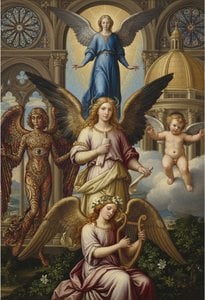
Marc Chagall’s “The Angel” – A Flight Through Memory and Myth
Marc Chagall’s “The Angel,” created in 1960, stands as a quintessential example of Naïve Art (Primitivism), encapsulating the artist's lifelong fascination with folklore, biblical narratives, and the dreamlike landscapes of his childhood in Vitebsk. Printed as part of Fernand Mourlot’s seminal lithograph catalogue raisonné – Volume I – this artwork transcends mere visual representation; it embodies Chagall’s profound engagement with universal themes of spirituality, hope, and transcendence.
The composition itself is strikingly simple yet powerfully evocative. Dominating the canvas is a bird—a recurring motif throughout Chagall's oeuvre—wings outstretched in an upward trajectory against a backdrop of luminous moonlight. Beneath this celestial figure hover two horses, their forms rendered with characteristic fluidity and expressive distortion – mirroring the turbulent emotions inherent in Chagall’s artistic vision.
A solitary human form occupies the lower left corner, seemingly grounded amidst the soaring imagery above. This figure is positioned deliberately to create a visual dialogue between earthly existence and divine aspiration—a central preoccupation of Chagall's artistic explorations. The artist skillfully employs hatching and cross-hatching techniques to build up tonal values, capturing the ethereal quality of moonlight and conveying a palpable sense of movement.
Symbolism Rooted in Vitebsk Folklore
“The Angel” is deeply embedded within Vitebsk’s cultural heritage. The bird symbolizes freedom and aspiration—a characteristic emblem of Hasidic Jewish tradition—while the horses represent strength, resilience, and the cyclical nature of life. Chagall frequently incorporated elements from Belarusian folklore into his paintings, drawing inspiration from myths and legends that resonate with primal emotions.
The moon serves as a beacon of illumination, guiding the viewer’s gaze upwards toward the heavens—a deliberate reference to biblical imagery and symbolizing divine grace. The horse on the right side is particularly notable for its expressive gesture, conveying both vulnerability and determination – mirroring Chagall's own artistic journey.
A Legacy of Dreamlike Impressionism
Chagall’s stylistic approach defies categorization, blending influences from Cubism, Fauvism, and Symbolism into a uniquely personal idiom. However, at its core lies an unwavering commitment to representation—albeit imbued with dreamlike color palettes and fantastical imagery. As he himself stated, “I wish my mythological floating figures and symbolism to be interpreted freely.”
"The Angel" exemplifies Chagall’s ability to transform observation into profound artistic expression – capturing not just what is seen but also what is felt—a testament to his enduring legacy as one of the most influential artists of the 20th century.
Küsimused ja vastused
Kuidas saan teoseid „An angel“, autor Mark Šagall vaadata diapositatsioonina?
Teost „An angel“, autor Mark Šagall saab vaadata diapositena teose Slideshow lehel.
Mida „An angel“, autor Mark Šagall kujutab?
Teose "An angel" teemad on flying figures, whimsical animals, vibrant hues, biblical inspirations, mythological symbolism, jewish folklore, dreamlike color.
Kui palju inimesi vaatab teost "An angel"?
Statistika teose „An angel“, autor Mark Šagall kohta on saadaval teose Statistika lehel: teose kuukaudsed külastused, kunstniku teoste külastused ning viimaste külastajate riikide ja keelte jaotus.



 Vaata sisu
 Telli käsitsi maalitud reproduktsioon
 Jaga teost
 Jaga
Jaga
 Detailid
 Õppekate juhend

 Laadi alla
 Sarnased teosed
 Röntgenuuring
 Slaidietendus
 Statistika


 Loe lähemalt






































 Klaasivalik on saadaval ainult kuni 110 cm suuruses teostes