Vaata sisu Vaata AR-eelvaadet Telli käsitsi maalitud reproduktsioon Ülemineku digitaalse pildi müügi kanalisse Jaga teost
Detailid Õppekate juhend Lisa lemmikutesse Laadi alla Sarnased teosed Röntgenuuring Slaidietendus Statistika

Untitled

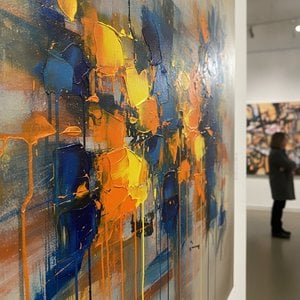
Experience 'Untitled' by Leon Tarasewicz – a vibrant, abstract panorama evoking Polish landscapes & iconographic traditions. Hand-painted reproduction available.

Leon Tarasewicz (b. 1957) is a renowned Polish painter known for vibrant, colorful landscapes reflecting the beauty & complex history of Poland's borderlands. Professor of Fine Arts & award-winning artist.

Sellel lehel kuvatav kunstiteos on kaitstud autoriõigusega, mis tähendab, et meil ei ole seaduslikku õigust luua või müüa identset reproduktsiooni. Seda kaitset rakendatakse rahvusvaheliste kokkulepete alusel, nagu näiteks Berne konventsioon ning riiklike seadustega, sealhulgas nendega, mida on sätestatud USA autoriõiguse seadus – 17. peatükk.

See meetod järgib täielikult autoriõiguse reegleid, kuna see ei põhine kaitstud kunstiteose kopeerimisel või dupliteerimisel. Selle asemel on tegu loova reinterpreetatsiooniga – uue maaldisega, mis on algteosest inspireeritud, kuid ei ole sellest identiline.

Giclée / Kunstiprint

Muuseumikvaliteediga giclée- või kangasprint kiire tootmisega ja paindlikud viimistlusvõimalused. ( Telli käsitsi maalitud reproduktsioon Ülemineku digitaalse pildi müügi kanalisse)

Corner sample of the P118B picture frame: vormitud polüstüreen, 5 cm wide and 3 cm thick
P118B €10
Corner sample of the P118H picture frame: vormitud polüstüreen, 5 cm wide and 3 cm thick
P118H €10
Corner sample of the P118W picture frame: vormitud polüstüreen, 5 cm wide and 3 cm thick
P118W €10
Corner sample of the P438Z picture frame: vormitud polüstüreen, 5.5 cm wide and 3.5 cm thick
P438Z €10
Corner sample of the P508JH picture frame: vormitud polüstüreen, 7 cm wide and 3.5 cm thick
P508JH €12
Corner sample of the P508YH picture frame: vormitud polüstüreen, 7 cm wide and 3.5 cm thick
P508YH €12
Corner sample of the P805H picture frame: vormitud polüstüreen, 5 cm wide and 3.5 cm thick
P805H €10
Corner sample of the P805Z picture frame: vormitud polüstüreen, 5 cm wide and 3.5 cm thick
P805Z €10
Corner sample of the P919BZ picture frame: vormitud polüstüreen, 7 cm wide and 3.5 cm thick
P919BZ €10
Corner sample of the P919G picture frame: vormitud polüstüreen, 7 cm wide and 3.5 cm thick
P919G €10
Corner sample of the P919XJ picture frame: vormitud polüstüreen, 7 cm wide and 3.5 cm thick
P919XJ €10
Corner sample of the P959ZH picture frame: vormitud polüstüreen, 5 cm wide and 3 cm thick
P959ZH €10
Corner sample of the P968JZ picture frame: vormitud polüstüreen, 6 cm wide and 4 cm thick
P968JZ €12
Corner sample of the W106C picture frame: tammepuu või massivpuit, 5 cm wide and 3 cm thick
W106C €8
Corner sample of the W218G picture frame: tammepuu või massivpuit, 5 cm wide and 3 cm thick
W218G €10
Corner sample of the W218JH picture frame: tammepuu või massivpuit, 5 cm wide and 3 cm thick
W218JH €8
Corner sample of the W218Y picture frame: tammepuu või massivpuit, 5 cm wide and 3 cm thick
W218Y €10
Corner sample of the W307PJ picture frame: tammepuu või massivpuit, 6 cm wide and 3 cm thick
W307PJ €10
Corner sample of the W316G picture frame: tammepuu või massivpuit, 6 cm wide and 3 cm thick
W316G €10
Corner sample of the W316PJ picture frame: tammepuu või massivpuit, 6 cm wide and 3 cm thick
W316PJ €8
Corner sample of the W316Y picture frame: tammepuu või massivpuit, 6 cm wide and 3 cm thick
W316Y €10
Corner sample of the W398PJ picture frame: tammepuu või massivpuit, 5 cm wide and 3 cm thick
W398PJ €8
Corner sample of the W4111J picture frame: tammepuu või massivpuit, 6.5 cm wide and 3.5 cm thick
W4111J €10
Corner sample of the W500HY picture frame: tammepuu või massivpuit, 7 cm wide and 5 cm thick
W500HY €15
Corner sample of the W500JH picture frame: tammepuu või massivpuit, 7 cm wide and 5 cm thick
W500JH €15
Corner sample of the W692G picture frame: tammepuu või massivpuit, 8 cm wide and 4 cm thick
W692G €12
Corner sample of the W849H picture frame: tammepuu või massivpuit, 5 cm wide and 3 cm thick
W849H €8
Corner sample of the W940BG picture frame: tammepuu või massivpuit, 7.5 cm wide and 4.5 cm thick
W940BG €15
Corner sample of the W953PJ picture frame: tammepuu või massivpuit, 6 cm wide and 3.5 cm thick
W953PJ €8

Standardne suurus
kohandatud
CM
INCH

Vali meie eelmääratud suurused, mis vastavad teose algupärastele proportsioonidele.

laius
kõrgus

Sisestage vajalik laius ja kõrgus, et see sobiks teie raamile või seinale. Trükki saab ainult lõigata, seda ei saa kunagi pildist suuremaks teha, seega ka differentse vormiga suurus kaotab osa pildist. Enne trükkimist saadame teile kinnitamiseks digitaalse näidisprojektsiooni. Sellel lehel näidatud pilt ei kujuta reaalset lõiget — seda näitab ainult näidisprojekttsioon.

Ülemaailmne tarne () 2 nädala jooksul, tavalise 4/5 nädala asemel. (27 oktoober)

Tasuta ekspresssaatmine üle maailma
Kõrgekvaliteediline lina-kangastest muld
Täielik transpordikindlustus
Tollimaksude tagastamise garantii
Värvitoime täpsuse garantii
100 päeva tagastusõigus (ainult defektide korral)
100% raha tagasi garantii
Hulgusoodustus

Kogu summa

€ 60

Untitled

Giclée / Kunstiprint

Reproduktsiooni mõõtmed

-

Lõppsumma

€ 60

The painting consists of four vertical stretcher bars connected together, creating a vast panoramic space, painted freely with wide brush strokes. They are all covered with almost vertical, diagonal stripes suggesting the representation of a field and furrow soil, although the vivid colouring (azure, red, yellow and green) and complete lack of detail makes one assume that it is a pure abstract painting. The suggestion of perspective was achieved by pure painting means and refers to painting tradition stemming back to the post-impressionists; whereas abstract colour plays refer to the tradition of post-war modernism, which revived in the 1980s – the time when Leona Tarasewicz made his debut – with the wave of new expression. The lack of horizon line (the point where stripes intersect is far beyond the pictorial space) evokes an impression of dominant horizontality which, combined with the scale of the piece, may be a reminder of another genealogical line of this painting: abstract expressionism. However, the specific context of Tarasewicz’s biography and the fact that he works in the countryside in the eastern region of Poland (białostocczyzna) evokes the tradition of icon and Belarusian roots, which are nonetheless significant elements of the origins of his pieces. They hold no traces of religious iconography, there is, however, a similar kind of sublimation of the sensual and carnal experiences into spiritual ones. The painter is consequent in not giving titles to his works, which suggests that he wishes to escape the trap of representation, as well as to be classified on the basis of just one single and defined painting tradition. On the contrary, it is the diversity of traditions and associations that create the specific aura of Tarasewicz’s paintings – referring to both being in nature and with nature, as well as to the sophisticated colour research, which museums aim at. [A. Markowska]

Küsimused ja vastused

Mis on teose „Untitled“, autor Leon Tarasewicz domineeriv toonsalm?

Teose „Untitled“, autor Leon Tarasewicz domineeriv toon on Warm Sunset Tones. See toon on paleti alusvärv.

Mis on teose „Untitled“, autor Leon Tarasewicz luminants?

Teose „Untitled“, autor Leon Tarasewicz luminants on Dark. Luminants kirjeldab, kui palju valgust värvid peegeldavad.

Kust saab teose kunsti „Untitled“, autor Leon Tarasewicz täna vaadata?

Teos „Untitled“, autor Leon Tarasewicz on näitustel Centre of Contemporary Art Znaki Czasu, Torun, Poland. Muuseumi keterangane viitab originaalteosele, mitte reproduktsioonidele.


Kunstniku elulugu

The Vibrant Tapestry of Leon Tarasewicz

Born on March 14, 1957, in the quiet village of Waliły, Poland, Leon Tarasewicz carries within his artistic DNA the rich, complex textures of the Polish borderlands. A painter of Belarusian origin, his work is deeply rooted in the cultural intersections of a region defined by shifting boundaries and historical echoes. Growing up in a working-class family, Tarasewicz found his calling through the transformative power of color and form, eventually honing his craft at the prestigious Academy of Fine Arts in Warsaw. Under the mentorship of the influential Tadeusz Dominik, he developed a technical foundation that would later allow him to transcend traditional boundaries, moving from classical training toward a profound exploration of space and light.

The evolution of Tarasewicz’s style is a journey from the representational to the sublime. While his early academic years provided him with the tools of meticulous observation, his mature work embraces the language of abstract expressionism and color field painting. He possesses a unique ability to capture the essence of the Polish landscape—not through literal depiction, but through an emotional resonance achieved via expansive washes of pigment and rhythmic, vertical stripes. His canvases often function as panoramic experiences, where the distinction between painting and environment begins to blur. By utilizing multiple stretcher bars connected to create vast, immersive spaces, he invites the viewer to step into a world where the horizon line vanishes, replaced by a sense of infinite geological or organic growth.

Symbolism and the Language of Color

To encounter a Tarasewicz painting is to engage in a sensory dialogue with nature. His palette is famously exuberant, utilizing vivid azures, deep reds, and sun-drenched yellows to evoke the vitality of forests, rivers, and skies. Yet, beneath this surface brilliance lies a deeper, more contemplative layer of symbolism. The artist’s work often references the sublimation of sensual experience into spiritual truth, a concept reminiscent of the icon traditions found in his Belarusian heritage. Even when his works appear purely abstract, they carry the weight of the landscape's history—the furrows of a field, the movement of wind through trees, and the layered memories of a borderland territory.

A defining characteristic of his practice is his deliberate avoidance of titles. By refusing to name his pieces, Tarasewicz escapes the "trap of representation," ensuring that his work cannot be confined to a single definition or historical movement. This allows for a multiplicity of interpretations, where a viewer might see a topographical map of a distant meadow one moment and a purely rhythmic exploration of color the next. His technique creates a tension between the physical texture of the paint—which hints at earth and stone—and the ethereal quality of light that seems to emanate from within the pigment itself.

Legacy and Artistic Distinction

Throughout his illustrious career, Leon Tarasewicz has garnered significant international acclaim, establishing himself as a pillar of contemporary Polish art. His contributions to the academic world are equally profound; as a professor of fine arts and a lecturer at the Academy of Fine Arts in Warsaw, he has shaped the perspectives of subsequent generations of artists. His professional journey is marked by prestigious accolades that reflect both his cultural impact and his technical mastery:

  • The Order of Polonia Restituta: Awarded the Knight's Cross for his significant contributions to Polish culture.
  • Paszport Polityki: A recognition of his influence within the contemporary Polish art scene.
  • Gloria Artis Medal: Honored by the Minister of Culture for his merit to the arts.
  • Award of Jan Cybis: A testament to his excellence in the tradition of Polish painting.

Beyond the gallery walls, Tarasewicz has served as a cultural ambassador, notably representing the European Year of Intercultural Dialogue. His life’s work remains a profound meditation on the beauty of the natural world and the enduring strength of cultural identity, proving that even in abstraction, the soul of a landscape can be found.

Leon Tarasewicz

Leon Tarasewicz

1957 - , Poland

Lühikest infot

  • Full Name: Leon Tarasewicz
  • Nationality: Polish
  • Date Of Birth: 1957
  • Place Of Birth: Walil, Poland
  • Notable Artworks: ['Untitled']
  • Artistic Movement Or Style: Abstract Expressionism
  • Artists Who Influenced This Artist: ['Tadeusz Dominik']
  • Artists Or Movements Influenced By This Artist: ['Color Field Painting']