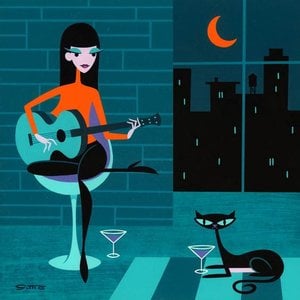
A Vibrant Echo of Midcentury Modern Dreamscape: Exploring Josh Agle’s “Lickity Split”
Josh Agle’s “Lickity Split,” more than just an image on canvas—it's a portal into a meticulously crafted realm where the optimism of midcentury modern design intertwines seamlessly with the unsettling charm of surrealism. Born August 31, 1962, in Sierra Madre, California, Agle’s artistic journey began amidst the influence of comic books and advertising imagery—a formative experience that would indelibly shape his visual storytelling prowess and ultimately define his distinctive aesthetic. This artwork stands as a testament to his singular vision within contemporary art—a bold declaration of color palettes and intricate detail rooted in an era brimming with both hope and subversive imagination.
Composition & Visual Narrative
The painting’s central anchor is undeniably the purple scooter, positioned prominently in the middle ground—a deliberate compositional choice that commands immediate attention and establishes a palpable sense of movement within the frame. Above this dynamic vehicle rides a humanoid wolf figure, facing forward with unwavering gaze, accompanied by a female passenger—a pairing that immediately evokes a playful tension between danger and delight. To his left stands a stylized bird, adding an element of whimsical eccentricity to the scene—a visual gesture that reinforces Agle’s penchant for unexpected juxtapositions. Behind them stretches a band of triangular shapes representing trees—a subtle nod to classic Pop Art landscapes that contributes to the artwork's overall feeling of immediacy and visual impact. The flattened perspective characteristic of midcentury design underscores Agle’s commitment to conveying complex ideas with remarkable clarity and stylistic precision.
Color Palette & Artistic Technique
“Lickity Split” explodes with color—a harmonious blend dominated by shades of blue, purple, turquoise, pink, and black—reflecting Agle's masterful command of acrylic paint on canvas or panel. The deliberate contrast between cool blues and purples against warmer pink tones is particularly striking, highlighting the woman’s clothing and injecting a vibrant energy into the composition. Agle employs layering techniques to achieve a smooth surface finish, utilizing clean lines and bold color planes—a hallmark of his signature style that distinguishes him from many of his contemporaries. Brushstrokes are visible in the background, hinting at textural nuances that enrich the artwork's visual richness without overshadowing its graphic aesthetic—a testament to Agle’s meticulous attention to detail and artistic craftsmanship.
Historical Context & Artistic Influences
Agle’s work draws heavily from the stylistic conventions of Pop Art and Midcentury Modern illustration—movements born from the aftermath of World War II, reflecting a renewed faith in progress and innovation while simultaneously questioning societal norms. Like Warhol and Lichtenstein before him, Agle utilizes simplified forms and vibrant colors to convey complex ideas with remarkable clarity and visual impact—a deliberate echo of artistic traditions that celebrate both beauty and intellectual provocation. However, unlike many of his peers, Agle infuses his art with dreamlike surrealism—a stylistic element that elevates it beyond mere representation, inviting viewers into a contemplation of subconscious desires and imaginative possibilities—solidifying “Lickity Split”’s place as a cornerstone of contemporary artistic expression.
Symbolism & Emotional Resonance
Beyond its captivating visuals, “Lickity Split” carries profound symbolic weight. The wolf figure, despite its somewhat menacing appearance—a deliberate nod to Shag’s fascination with darker themes—is presented in a context of carefree joy and playful juxtaposition—a visual paradox that speaks to the artwork's core emotional message: an embrace of optimism amidst uncertainty, a celebration of unconventional beauty, and ultimately, an invitation to escape into a realm of imaginative delight. The scooter itself symbolizes freedom and exploration—mirroring Agle’s artistic ambition to push boundaries and redefine perceptions of art. It encapsulates the spirit of midcentury modern optimism – a bold assertion of visual storytelling that continues to inspire collectors and interior designers alike.
Küsimused ja vastused
Millise riigi kunstilihubast pärineb Midcentury Modern Surrealism teos "Lickity Split"?
Teose "Lickity Split" on loonud USA-s sündinud Josh Agle, tuginedes Midcentury Modern Surrealism suunale. Kunstniku päritolu seob teose Midcentury Modern Surrealism stiiliga, mida praktiseerivad USA kunstnikud.
Kust saan osta teose „Lickity Split“, autor Josh Agle trükki?
Teose „Lickity Split“, autor Josh Agle trüket saate tellida otse lehelt see leht: kunstiprint puuvillalõikel}}^{\text{canvas}}$ või arhiveeritaval kangaspaberil.
Kes lõi "Lickity Split"?
Teose "Lickity Split" loovis Josh Agle. Selle lehe info kirjeldab Josh Agle algteost.
Kust saan osta teose „Lickity Split“, autor Josh Agle digitaalse pildi?
Teose „Lickity Split“, autor Josh Agle digitaalset pilti saab osta leheküljel see leht: kõrge resolutsiooniga digitaalse pildi allalaadimine.
Mis on teose „Lickity Split“, autor Josh Agle luminants?
Teose "Lickity Split" värvid näitavad Kerge luminants luminantsi.
Kas saan tellida teose "Lickity Split" õli-reproduktsiooni?
Teose „Lickity Split“, autor Josh Agle käsitsi maaldatud reproduktsiooni saab tellada otse lehelt see leht: käsitsi maalatud õlireproduktsioon linaelapale, valmistatud tellimusest.
Millist väripaletti teoses „Lickity Split“, autor Josh Agle on kasutatud?
Teose "Lickity Split" värvid moodustavad Tume paleti. See klassifikatsioon kirjeldab domineerivaid värvigruppe.



 Vaata sisu
 Lülita trükkitoodetele
 Jaga teost
 Jaga
Jaga
 Detailid
 Õppekate juhend

 Laadi alla
 Sarnased teosed
 Röntgenuuring
 Slaidietendus
 Statistika

 Loe lähemalt






































 Klaasivalik on saadaval ainult kuni 110 cm suuruses teostes