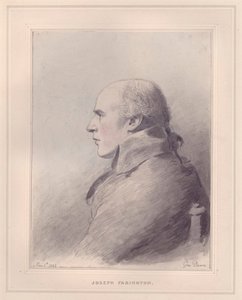
A Witness to an Era: The Life and Legacy of Joseph Farington
In the grand tapestry of British art history, few figures possess a dual significance as profound as Joseph Farington. While his brush captured the serene, topographical essence of the English landscape, his pen immortalized the very soul of the eighteenth- and nineteenth-century art world. Born in 1747 in Leigh, Lancashire, Farington was raised in an environment of intellectual rigor, the son of a rector whose influence instilled in him a lifelong devotion to observation. His early years were shaped by both the quietude of rural life and the far-reaching shadows of family tragedy, yet it was his move toward the artistic epicenter of London that would ultimately define his destiny. Under the tutelage of the esteemed Richard Wilson, Farington transitioned from a talented student to a master of detail, learning to translate the rugged beauty of the Lake District and the rhythmic flow of the River Thames onto canvas with an almost scientific precision.
Farington’s artistic evolution was deeply intertwined with the rise of the Royal Academy. As he ascended through the ranks—becoming an Associate in 1783 and a full Royal Academician in 1785—his work became more than mere documentation; it became a romanticized dialogue between man and nature. His landscapes, characterized by their meticulous topographical accuracy, offered a window into a Britain undergoing profound transformation. Whether depicting the haunting ruins of Roslyn Castle or the bustling vitality of Westminster Abbey and Bridge, Farington possessed a unique ability to imbue static scenery with a sense of temporal weight. His technique, rooted in the traditions of his mentor Wilson, utilized light and texture to evoke the atmospheric shifts of the English countryside, making him a pivotal bridge between the classical landscape traditions and the burgeoning Romantic movement.
The Chronicler of the Academy
Beyond the borders of his canvases, Farington’s most enduring contribution to history lies in his voluminous, meticulously kept diaries. To read Farington is to step into the heated corridors of the Royal Academy during its most formative and contentious years. He was not merely a passive observer but an active participant in the institutional politics that shaped British art. His writings provide an unparalleled, often biting, look at the personalities, rivalries, and scandals that defined his contemporaries. From the debates surrounding the presidency of Benjamin West to the social nuances of London’s elite, Farington recorded it all with a sharp, discerning eye.
His diaries serve as a vital primary source for historians, offering insights that no formal gallery catalogue could provide. Through his entries, we encounter the following elements of the era:
- The Intricacies of Artistic Patronage: Detailed accounts of commissions and the economic realities faced by painters of his time.
- Institutional Conflict: The internal struggles within the Royal Academy, including the legendary tensions that led others to label him the "Dictator to the Academy."
- Cultural Shifts: Observations on wider European events, such as the impact of the Napoleonic Wars and the atmosphere of Paris during the Peace of Amiens.
- Social Tapestry: The intersection of art, politics, and high society, capturing the gossip and grandeur of pre-Regency London.
Ultimately, Joseph Farington remains a monumental figure whose importance transcends the medium of his work. As a painter, he preserved the physical landscape of a nation; as a diarist, he preserved its cultural memory. His life was a testament to the power of observation, proving that whether through the delicate application of oil or the rhythmic scratch of a quill, the act of witnessing is one of the highest forms of art.



 Vaata sisu
 Lülita trükkitoodetele
 Jaga teost
 Jaga
Jaga
 Detailid
 Õppekate juhend

 Laadi alla
 Sarnased teosed
 Röntgenuuring
 Slaidietendus
 Statistika
 Loe lähemalt