TASUTA KUNSTIKONSULTATSIOON

x
Tellimaks maali Tellimaks maaliOsta digipilt Osta digipilt SaadaSaada
DetailidDetailid Lisa lemmikutesse Lisa lemmikutesse Laadi allaLaadi alla Sarnased teosedSarnased teosed RöntgenuuringRöntgenuuring SlaidietendusSlaidietendus

Dark

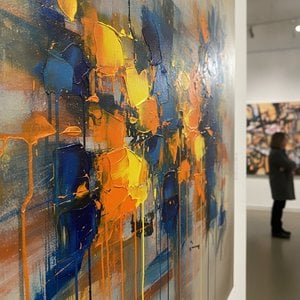
Experience Gerhard Richter's abstract expressionist masterpiece, 'Dark,' a vibrant canvas of bold brushstrokes and intense colors—reds, oranges, and blues—that captures the artist’s unique style. Discover this stunning reproduction and bring art home.

Gerhard Richter oli üks maailma suurimatest ja mõjutavamaid kunstnike, kes kasutasid fotorealistlikku ja abstrakti stiili ning pakkus tänu oma kriitilise lähenemuse ja innovatsioonile suurepäärasele kunstilisele ekspressioonile.

Giclée / Kunstiprint

Muuseumikvaliteediga giclée- või kangasprint kiire tootmisega ja paindlikud viimistlusvõimalused.

P118B $10
P118H $10
P118W $10
P438Z $10
P508JH $12
P508YH $12
P805H $10
P805Z $10
P919BZ $10
P919G $10
P919XJ $10
P959ZH $10
P968JZ $12
W106C $8
W218G $10
W218JH $8
W218Y $10
W307PJ $10
W316G $10
W316PJ $8
W316Y $10
W398PJ $8
W4111J $10
W500HY $15
W500JH $15
W692G $12
W849H $8
W940BG $15
W953PJ $8

Standard
custom
CM
INCH

Vali meie eelmääratud suurused, mis vastavad teose algupärastele proportsioonidele.

laius
kõrgus

Saate sisestada oma mõõdud, et need sobiks konkreetse raami või ruumi sisse. Kui valitud suurus ei vasta originaalteose proportsioonidele, lõigame teose ära või laiendame pilti peegeldatud või ühtlase servaga. Enne tootmisprotsessi algust saadetakse Teie kinnitamiseks digitaalne näidis.
Palun märka, et ekraanil kuvatav eelvaade ei kajasta tegelikku lõigamist või laiendamist. Ainult näidis kujutab täpselt lõplikku kompositsiooni.
Kuigi erimõõdu on saadaval, soovitame originaaproportsioonide säilitamiseks valida mõõt ette määratud nimekirjast.

Ülemaailmne tarne () 2 nädala jooksul, tavalise 4/5 nädala asemel. (2 juuli)

why_choose_icon
Tasuta ekspresssaatmine üle maailma
why_choose_icon
Kõrgekvaliteediline linakangas
why_choose_icon
Täielik transpordikindlustus
why_choose_icon
Tollimaksude tagastamise garantii
why_choose_icon
Värvitoime täpsuse garantii
why_choose_icon
60-päevane tagastusõig: ainult tootmisdefektide korral
why_choose_icon
100% raha tagasi garantii
why_choose_icon
Hulgusoodustus

Kogu summa

-

reproduction

Dark

Giclée / Kunstiprint

Reproduktsiooni suurus

-

Kogusumma

-

Teave teose kohta

  • Artist: Gerhard Richter
  • Subject or theme: Abstraction
  • Title: Dark
  • Medium: Painting
  • Notable elements: Bold brushstrokes, Color & texture
  • Year: 1968

Kogumuse kirjeldus

A Study in Controlled Chaos: Exploring Gerhard Richter’s “Dark”

Gerhard Richter's "Dark," painted in 1968, is not merely an abstract composition; it’s a carefully constructed meditation on memory, displacement, and the very nature of perception. This close-up view reveals a canvas saturated with vibrant hues – bold reds and oranges battling against cooler blues – all rendered through Richter's signature technique of layered brushstrokes and subtly blurred surfaces. The painting immediately evokes a sense of unease, a feeling amplified by the deliberate ambiguity at its core. It’s a work born from a specific historical moment: Germany in the turbulent years following World War II, a nation grappling with the aftermath of unimaginable destruction and profound moral questions.

  • Abstract Expressionism Revisited: While firmly rooted in the abstract expressionist movement, Richter's approach transcends simple imitation. He doesn’t employ the raw emotionality often associated with artists like Pollock; instead, he channels a more controlled, almost clinical energy into his work.
  • Technique and Texture: The painting’s surface is a complex tapestry of applied paint – thick impasto in areas contrasted by thinner washes. Richter's use of glazing techniques creates an illusion of depth and luminosity, while the deliberate blurring introduces an element of uncertainty, mirroring the fragmented nature of memory itself.

The Weight of History

Richter’s personal history profoundly informs “Dark.” Born in Dresden in 1932, he experienced firsthand the instability and trauma of a nation divided. His childhood was shaped by displacement – his family repeatedly relocated during the war – an experience that instilled within him a deep-seated sense of disorientation. This biographical context is crucial to understanding the painting’s emotional resonance. The intense colors, particularly the reds and oranges, can be interpreted as echoes of the fires and destruction that ravaged Germany during the conflict, while the blues represent a yearning for peace and stability – a desire perhaps never fully realized.

The blurred areas within the composition are not accidental; they actively disrupt our ability to grasp a definitive image. This technique subtly suggests the fallibility of memory, the way in which experiences can be distorted or obscured over time. Richter masterfully utilizes this ambiguity to invite viewers into a dialogue with the work, prompting them to confront their own interpretations and emotional responses.

Symbolism and Emotional Impact

"Dark" resists easy categorization or definitive interpretation. The title itself suggests a preoccupation with shadow – not just literal darkness, but also the hidden aspects of human experience. The painting’s power lies in its ability to evoke a profound sense of melancholy and introspection. It's a work that demands attention, inviting viewers to contemplate themes of loss, uncertainty, and the enduring impact of historical trauma.

  • Color as Emotion: Richter’s masterful use of color is central to the painting’s emotional impact. The vibrant reds and oranges convey passion, intensity, and perhaps even a hint of danger, while the blues offer a counterpoint of calm and reflection.
  • The Blur – A Key Element: The blurred areas are not simply stylistic choices; they represent the subjective nature of perception and the difficulty of accessing objective truth.

A Masterpiece of Controlled Ambiguity

Gerhard Richter’s “Dark” is a testament to his extraordinary skill as an artist and his profound understanding of human psychology. This painting, created in 1968, remains a powerful example of abstract expressionism's ability to convey complex emotions and ideas through the manipulation of color, texture, and form. A hand-painted reproduction offers a unique opportunity to experience this captivating artwork firsthand, bringing Richter’s vision into your space and inviting contemplation for years to come.

Sarnased teosed


Kunstniku elulugu

A Life Shaped by Division: The Early Years and Artistic Formation of Gerhard Richter

Gerhard Richter’s artistic journey began amidst the turbulent backdrop of postwar Germany, a nation scarred by war and grappling with the ideological divisions of the Cold War. Born in Dresden in 1932, his formative years were profoundly impacted by the rise of Nazism and the subsequent devastation inflicted upon his hometown during World War II. This early exposure to conflict instilled within him an inherent skepticism—a questioning spirit that would become a cornerstone of his artistic worldview for decades to come. His father, Wilhelm Richter, was a schoolteacher who navigated the challenges of life under Nazi rule with quiet resilience, while his mother, Gisela Richter, nurtured a love for literature and music within their family home – fostering an environment rich in cultural stimulation. These familial influences subtly shaped Richter’s artistic sensibilities, contributing to his distinctive blend of pragmatism and intellectual curiosity. Initially trained in socialist realism at the Dresden Academy of Fine Arts—a stylistic mandate imposed by the East German state—Richter quickly recognized the limitations inherent in adhering rigidly to ideological dogma. Even within this constrained environment, however, a yearning for artistic freedom persisted, fueled by a growing dissatisfaction with prescribed aesthetic conventions and an ardent desire to explore more expansive creative horizons. This burgeoning discontent propelled him toward experimentation—a deliberate dismantling of stylistic boundaries that would define his formative years. He sought inspiration from artists who challenged established norms, embracing dissonance as a catalyst for innovation. Pablo Picasso’s fragmented imagery and Jean Arp’s geometric abstractions served as crucial touchstones during this period, shaping Richter's evolving artistic vocabulary.

Escaping Constraints: Düsseldorf and the Exploration of Style

The pivotal moment arrived in 1961 when Richter made the courageous decision to abandon East Germany—seeking refuge in the vibrant art scene of Düsseldorf. This relocation represented a radical transformation in his artistic trajectory, liberating him from the constraints of socialist realism and immersing him in an environment brimming with intellectual ferment. Düsseldorf’s artistic community welcomed Richter's arrival with open arms, fostering an atmosphere conducive to experimentation and challenging conventional artistic perspectives. Recognizing the need for stylistic independence—a rejection of prescribed aesthetic formulas—Richter embarked on a period of intense exploration that would solidify his early mature work. He swiftly dismantled socialist realism’s rigid conventions, embracing diverse approaches simultaneously. Photorealism—characterized by meticulous replication of photographic images with astonishing precision—stood alongside abstract compositions infused with bold colors and dynamic brushstrokes. This duality wasn't about finding *a* style; it was about questioning the very notion of stylistic coherence, accepting contradiction as a fundamental principle. His collaboration with Sigmar Polke yielded the provocative term ‘Capitalist Realism,’ encapsulating their shared critique of artistic institutions and their appropriation of imagery from advertising and mass media. This period wasn’t merely about stylistic innovation; it was about confronting broader societal anxieties—a reflection of the anxieties prevalent during the Cold War era. Richter's technique evolved dramatically, incorporating innovative methods like squeegee printing—a process utilizing tools typically employed for window cleaning—to manipulate paint on canvas in unpredictable ways. This embrace of chance and spontaneity underscored his artistic philosophy—allowing him to relinquish control and invite unforeseen outcomes. He meticulously studied the work of Picasso and Arp, absorbing their stylistic innovations and integrating them into his own evolving visual language.

Blurring Boundaries: Photorealism, Abstraction, and the Power of Chance

Richter’s artistic repertoire expanded throughout the 1960s and beyond—embracing a remarkable spectrum of techniques and thematic concerns. His photorealistic paintings—based on family photographs or newspaper images—were not mere reproductions; they were investigations into perception and representation. By rendering these images with clinical detachment, he compelled viewers to confront the inherent ambiguity of photographic truth—a deliberate provocation designed to unsettle conventional assumptions about visual reality. Simultaneously, Richter pursued abstraction—creating canvases layered with vibrant hues and gestural marks—often utilizing squeegee printing to manipulate paint on canvas in ways that defied control. This embrace of spontaneity mirrored his artistic ethos—yielding unexpected results while rejecting stylistic rigidity. His ‘Color Charts,’ systematic arrangements of colored squares—challenged the notion of painting as purely decorative expression—examining color’s organizational potential and questioning its role in artistic communication. His influence extended far beyond Düsseldorf, inspiring countless artists who adopted his innovative methods and embraced his unwavering commitment to artistic exploration. Richter's legacy transcends stylistic trends; it resides in his profound engagement with historical and political themes—a reflection of the anxieties inherent in navigating a fragmented world. He didn’t offer definitive answers but posed compelling questions—prompting viewers to scrutinize their own preconceptions and engage in critical dialogue. Richter’s art continues to resonate today, demonstrating the enduring power of artistic experimentation and intellectual rigor. His unwavering dedication to pushing boundaries solidified his position as one of Germany's most celebrated artists—a figure whose work remains a testament to the transformative potential of creative vision.
Gerhard Richter

Gerhard Richter

1932 - , Saksa

Lühikesed faktid

  • Artistic Movement Or Style:
    • Фотореализм
    • Абстракция
  • Artists Who Influenced This Artist:
    • Жан Арп
    • Пабло Пикассо
  • Date Of Birth: 9 февраля 1932 г.
  • Full Name: Gerhard Richter
  • Nationality: Немецкий
  • Notable Artworks:
    • Жилет
    • С. с ребенком
    • Октябрь 18, 1977
  • Place Of Birth: Дрезден, Германия
Avastage teoseid, mis on koondatud teemade, stiilide ja omaduste kaupa.