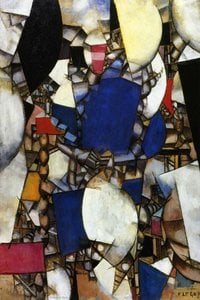
The Pulse of Modernity: A Cubist Vision
Fernand Léger's
untitled (2966) is far more than a mere arrangement of shapes; it is a crystallized moment from the dawn of the industrial era. Created around 1930, during the height of the Cubist movement, this work serves as a daring assertion that abstraction could capture both the frantic energy of progress and the tangible reality of a changing world. As one gazes upon the canvas, they are immediately met with a riot of geometric forms—angular blocks of white, gray, and vibrant orange that seem to defy traditional perspective. Léger, a master of the machine aesthetic, utilizes these fragmented shapes to mimic the repetitive, rhythmic patterns of factory machinery, inviting the viewer to experience the transformative power of industrialization through a purely visual language.
Texture, Color, and the Mechanical Rhythm
The brilliance of this piece lies in its profound physicality. Léger employed a technique known as
impasto, applying thick, deliberate layers of oil paint to create a surface that is as much about touch as it is about sight. By building up pigments such as
cadmium orange and
titanium white, he achieved a palpable texture that captures the very essence of his subject matter. This heavy layering does not merely add richness; it provides a sense of weight and permanence to the fleeting movement depicted on the canvas. The interplay between the stark whites and the energetic oranges creates a striking contrast, much like the bright sparks of a working engine against a cold, metallic backdrop. For the collector or interior designer, this piece offers a commanding presence, bringing a sophisticated, tactile energy to any contemporary space.
Symbolism Amidst the Fragments
Within this complex web of geometry, Léger embeds profound symbols of hope and liberation. At the heart of the composition sits a large, white bird, acting as a central anchor amidst the fractured landscape. This soaring figure serves as a poignant metaphor for freedom, rising above the rigid, mechanical structures that represent the constraints of modern life. Scattered throughout the scene, smaller birds and vibrant oranges add layers of depth and organic complexity to the otherwise structured environment. It is this delicate balance between the mechanical and the natural—the tension between the industrial machine and the spirit of life—that gives
untitled (2966) its enduring emotional impact. To possess a reproduction of this work is to invite a conversation about progress, resilience, and the beautiful chaos of the modern age into one's home.
Küsimused ja vastused
Millist meeleolu loovaks teos "untitled (2966)" ruumile?
Teose „untitled (2966)“, autor Fernand Léger meeleolu on Modern ning seda soovitatakse ruumides, mis on Living Room. Meeleolu tähistab seda, mida teos ümbritsevale piirkonnale lisab.
Kas on olemas sarnaseid teoseid kui "untitled (2966)"?
Teosed, mis sarnanevad teosega „untitled (2966)“, autor Fernand Léger, on koondatud teose lehel Sarnased teosed.
Kas teos "untitled (2966)" autorilt Fernand Léger kuulub avalikku omandisse ja miks?
Fernand Léger teos "untitled (2966)" on avalikus õiguses – selle autoriõigud onหมดunud. Autoriõiguse kaitseajad arvutatakse alates kunstniku surmaõigustest ning Fernand Léger suri aastal 1955.



 Vaata sisu
 Telli käsitsi maalitud reproduktsioon
 Jaga teost
 Jaga
Jaga
 Detailid
 Õppekate juhend

 Laadi alla
 Sarnased teosed
 Röntgenuuring
 Slaidietendus
 Statistika

 Loe lähemalt






































 Klaasivalik on saadaval ainult kuni 110 cm suuruses teostes